
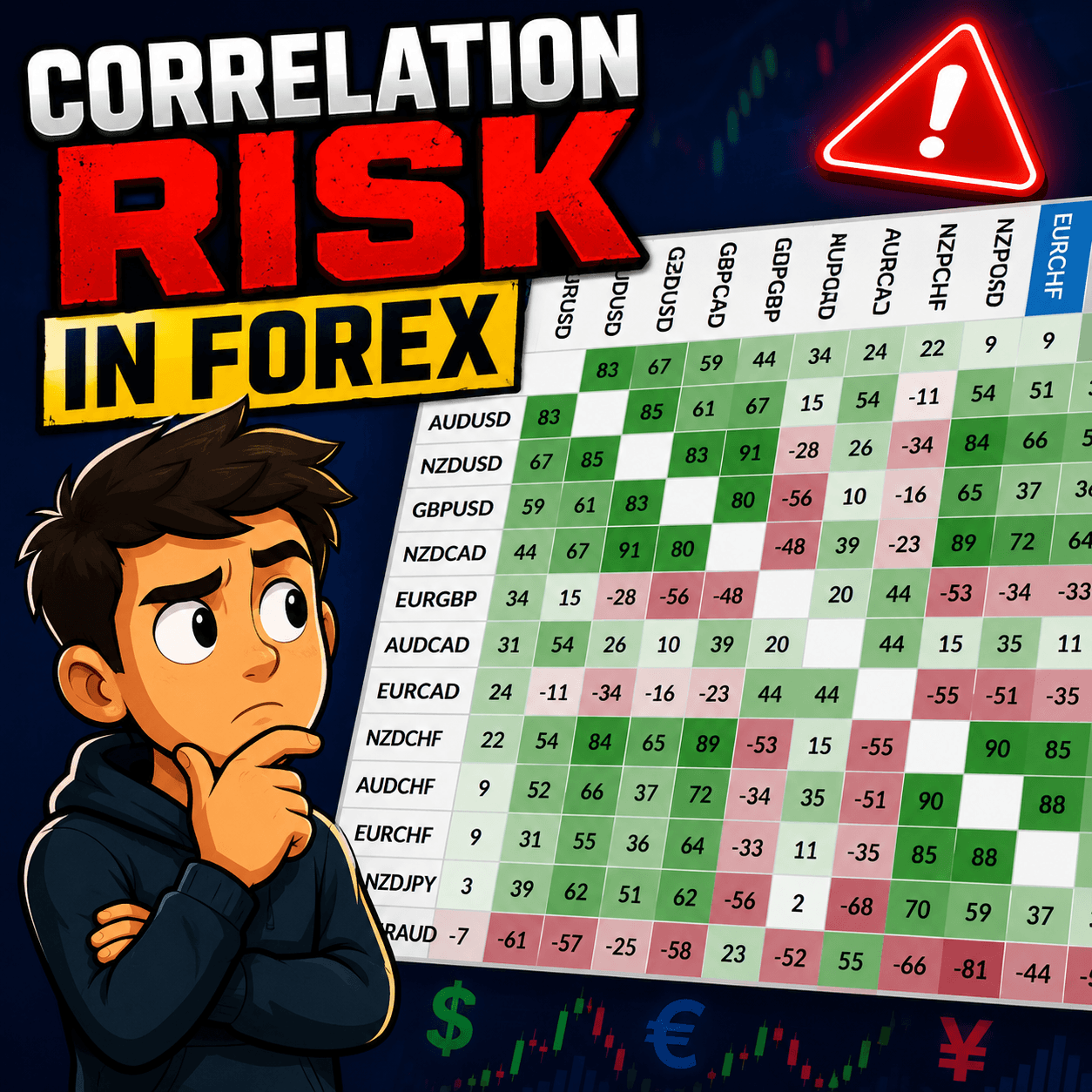
Have you ever opened three trades that felt completely different? Then you watched all three hit your stop loss at almost the same moment. That is not bad luck. It is usually correlation risk in Forex trading, and it catches even experienced traders off guard. You may believe you are spreading your risk across several currency pairs. In reality, you could be placing the same bet three or four times over. When the market turns against you, every one of those trades can lose together. Your account can take a much bigger hit than you planned for.
The tricky part is that this risk hides in plain sight. Two charts can look unrelated at first glance. Yet they can move in near perfect sync when you place them side by side. In this article, you will learn what correlation actually means. You will see how to tell positive correlation from negative correlation, and why combining correlated trades can double or even triple your losses. You will also get simple steps you can take to keep your risk under control. By the end, you will know how to check any pair of instruments before you risk your money on both at once.
Table of Contents
What Is Correlation Risk in Forex Trading
Correlation risk in Forex trading happens when two or more instruments tend to move in the same direction, or in exactly opposite directions, at the same time. On the surface, taking multiple trades can feel like a smart way to diversify. In practice, if those trades are correlated, you are not really diversifying anything. You are simply making one large bet dressed up as several smaller ones.
There are two main types of correlation you need to know about. Understanding both is the first step toward managing correlation risk in Forex trading properly.
Positive Correlation Explained
Positive correlation means that two instruments tend to move in the same direction at the same time. This does not happen every single day. At certain points, though, some currency pairs correlate quite strongly.
A good example is AUD/USD and NZD/USD. If you place these two charts next to each other, you will often notice matching patterns. A sell off on one pair frequently lines up with a sell off on the other. A period of rotation followed by a strong move often appears on both charts around the same time. These two pairs share the US dollar as the counter currency. Their two economies are closely linked, which is part of why they often move together.
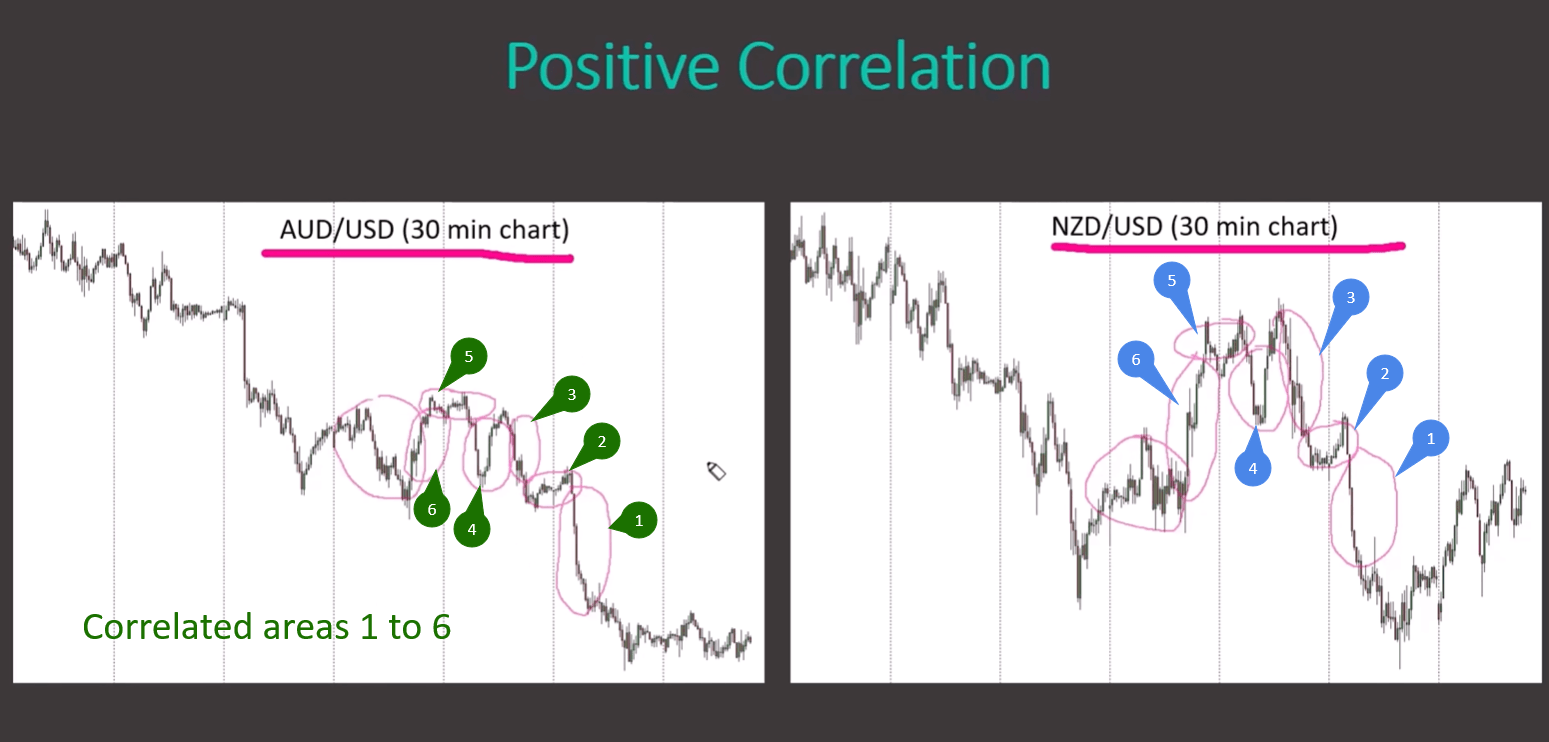
Now picture yourself entering a long trade because you spot support on AUD/USD. At almost the same time, you spot support on NZD/USD and enter a long trade there too. On paper, it looks like two separate opportunities. In reality, you are now holding two positions that behave like one. If price pushes through both support levels, you get stopped out on each trade. You take the loss twice for what was essentially a single market decision. This is exactly how correlation risk in Forex trading quietly doubles the damage from one wrong read on the market.
Negative Correlation Explained
Negative correlation works the opposite way. Instead of moving together, the two instruments tend to move in opposite directions. One of the most well known examples is EUR/USD and USD/CHF. These pairs frequently mirror each other. EUR/USD falls while USD/CHF rises, or the reverse happens.
If you happen to be long EUR/USD and short USD/CHF at the same time, you might think you have balanced your exposure. Unfortunately, because these pairs are negatively correlated, a move against EUR/USD often comes with a matching move against USD/CHF. Both trades can lose together, even though one is a buy and the other is a sell. This is another face of correlation risk in Forex trading. It can be even easier to miss because the trade directions look opposite on the surface.
Why Triple Damage Is the Real Danger
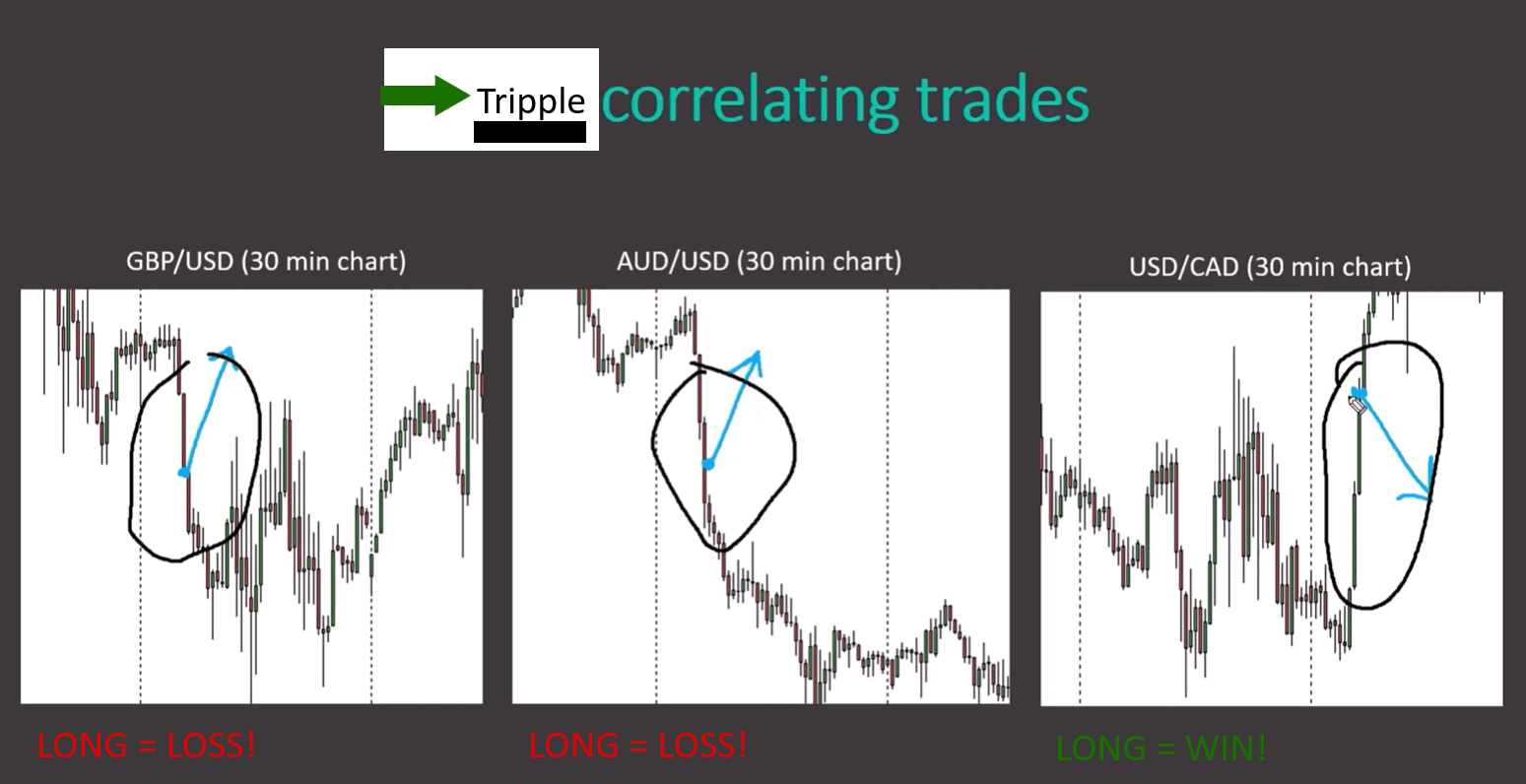
The real trouble starts when three or more correlated trades line up at once. Imagine you are long GBP/USD, long AUD/USD, and short USD/CAD. All three setups appear while the same broad selling or buying pressure moves through the market. If those three trades all move against you together, you are no longer looking at a single mistake. You are looking at triple damage, and a serious drawdown can happen extremely fast.
This is the point where correlation risk in Forex trading stops being a minor detail. It starts being a genuine threat to your account. A trader who risks two percent per trade might feel comfortable with that number for one position. Three correlated positions at two percent each is really six percent of the account riding on a single market view, whether that trader realizes it or not.
Cutting Position Size to Reduce the Damage
The good news is that this danger is very manageable once you know how to spot it. The most practical fix is to lower your trading volume whenever several likely correlated trades set up at the same time. A simple approach is to cut your position size by half. If you normally risk two percent per trade, drop it down to one percent while the correlated setups are active. This single habit can prevent a large drawdown from a handful of trades that were never really independent in the first place.
Spotting this in real time takes a bit of practice. Correlated moves are very often driven by strength or weakness in a single currency. You might notice one currency clearly strengthening or weakening across several pairs. If you also have valid trading levels on more than one of those pairs, treat it as a warning sign. All of those trades will likely land on the same side, either all winners or all losers. Sizing down protects you either way.
How Correlation Changes Over Time
It helps to understand that correlation is not fixed. It shifts depending on the time frame you are looking at and the events happening in the market. Strong correlation tends to appear during major macro news releases. It also shows up around important economic events that affect one currency.
During these events, one currency often strengthens or weakens sharply. Every pair that includes that currency tends to move together as a result. This is one of the clearest moments where correlation risk in Forex trading spikes. So many pairs are being pushed by the same underlying force.
Instruments That Correlate Even Without News
Some instruments correlate heavily even on quiet days with no major news. Correlation is usually measured on a scale from negative 100 to positive 100. A reading above 80 is generally a strong positive correlation. A reading below negative 60 is a meaningful negative correlation.
Here are a few well known examples worth remembering.
Instrument Pair | Typical Correlation | Type |
EUR/USD and USD/CHF | Around -94 | Strong negative |
XAU/USD and USD/JPY | Strong negative | Negative |
AUD/USD and USD/CAD | Around -76 | Negative |
AUD/USD and NZD/USD | Strong positive | Positive |
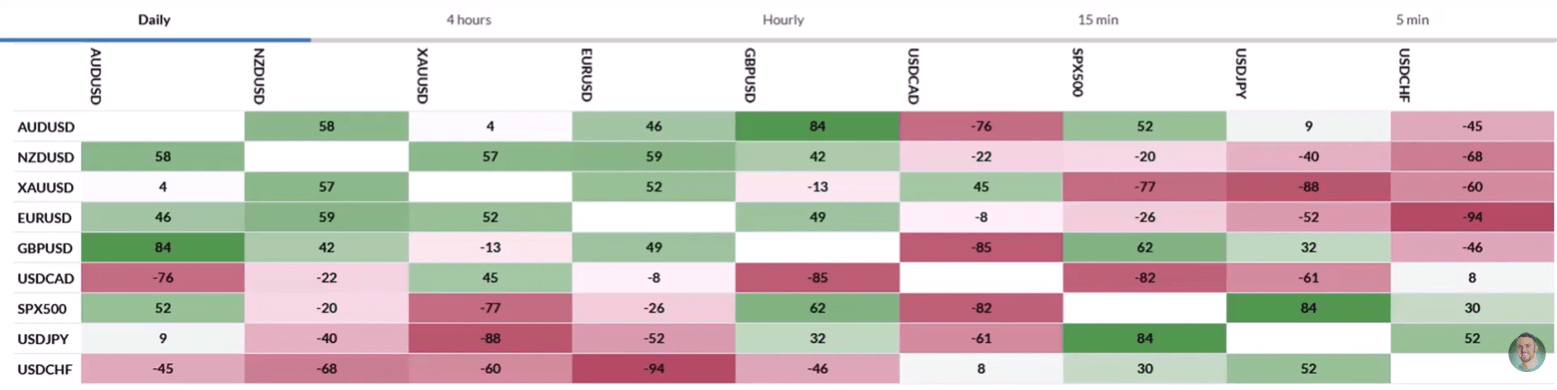
EUR/USD and USD/CHF are a great illustration of how strong negative correlation can be. A daily chart reading of negative 94 is very close to negative 100. These two pairs move opposite to each other with a very high degree of consistency. XAU/USD, or gold priced in US dollars, and USD/JPY are another pair worth watching closely. They also share a strong negative relationship. AUD/USD and USD/CAD sit a little lower at around negative 76. That still counts as meaningful negative correlation and deserves attention when sizing trades on both pairs.
Correlation on higher time frames, such as the daily chart, tends to be more stable. It is still worth checking a correlation table from time to time. Do not assume last year’s relationship still holds today.
Simple Steps to Manage Correlation Risk in Forex Trading
Once you understand how correlation works, protecting yourself becomes far more straightforward. Here are the core habits worth building into your routine.
- Check whether the pairs you plan to trade are known to correlate before you enter multiple positions.
- Reduce your position size, for example by half, whenever two or more correlated setups appear at the same time.
- Watch for one currency driving strength or weakness across several pairs, especially during major news events.
- Review a correlation table occasionally, since relationships between pairs can shift over time.
- Treat correlated trades as one combined risk rather than several separate ones when calculating your total exposure.
None of these steps require complicated tools. They mostly require a habit of pausing before you click the buy or sell button on a second or third trade. Ask yourself whether it is really a new opportunity, or simply the same trade wearing a different name.
Key Takeaways
- Correlation risk in Forex trading happens when your open trades move together instead of independently.
- Positive correlation means pairs move in the same direction, like AUD/USD and NZD/USD.
- Negative correlation means pairs move in opposite directions, like EUR/USD and USD/CHF.
- Three or more correlated trades can create triple damage and a fast drawdown.
- Cutting position size, for example to half, when correlated setups appear is a simple and effective safeguard.
Conclusion
Correlation risk in Forex trading is one of those problems that stays invisible until it shows up in your account balance. Two or three trades that felt like separate decisions can turn out to be the same bet repeated. When the market moves against that bet, the damage lands all at once instead of being spread out. The fix does not require advanced tools or a complicated system. It simply requires the habit of checking whether the pairs you are trading tend to move together. Watch for one currency driving strength or weakness across several charts. Reduce your position size when correlated setups line up. A correlation table, checked every so often, can make this process almost automatic once it becomes part of your routine. Traders who build this habit protect themselves from the kind of fast, multi trade drawdown that catches so many people off guard.
This does not mean you should avoid trading correlated pairs altogether. It means you should trade them with your eyes open, knowing exactly how much combined risk you are carrying. The next time you find yourself excited about three trading opportunities appearing at once, pause for a moment. Ask whether they are truly three separate ideas, or one idea appearing three times. That single question can save your account from a much harder day, and it costs you nothing but a few seconds of thought before you click confirm.
Frequently Asked Questions
What is correlation risk in Forex trading?
It is the risk of holding two or more trades that are not truly independent. The instruments involved tend to move together, or in opposite directions, at the same time. This can quietly multiply your losses on what feels like a diversified set of trades.
How can I check correlation between two currency pairs?
Many trading platforms and websites offer correlation tables. They show a numerical score, usually between negative 100 and positive 100, for pairs of instruments across different time frames. Checking this table before combining trades is a quick way to spot potential overlap.
Should I avoid correlated trades completely?
Not necessarily. Correlated trades are not automatically bad, but they should be sized with the combined risk in mind. Many traders simply reduce their position size on each trade when they notice strong correlation, rather than avoiding the setups altogether.
What To Do Next
If you want a structured way to spot high probability setups while keeping risk like this under control, explore the trading tools and courses built around Volume Profile, Order Flow, and Smart Money Concepts and courses. Learning to read the market with a clear framework makes it easier to notice when your trades are quietly overlapping. It also makes it easier to size your positions with confidence.
Apply my coupon code KEVIN10 at checkout for a 10% discount.

7j7cbg