
Do you want ME to help YOU with your trading?
Video Transcript:
If you are new to Order Flow trading, start here. Most beginners get overwhelmed because they try to read every number, every candle, and every setup at once. But that is the wrong approach. In this video, I will show you the simple way to begin. You will learn what Order Flow is, what software and data you need, what to look for on a chart, and how to use it as confirmation for better trade entries. This is not a complex webinar. It is a practical beginner guide so you know what to focus on first and how to move in the right direction. So let’s get to it, and let me start by saying why you should even care about Order Flow trading.
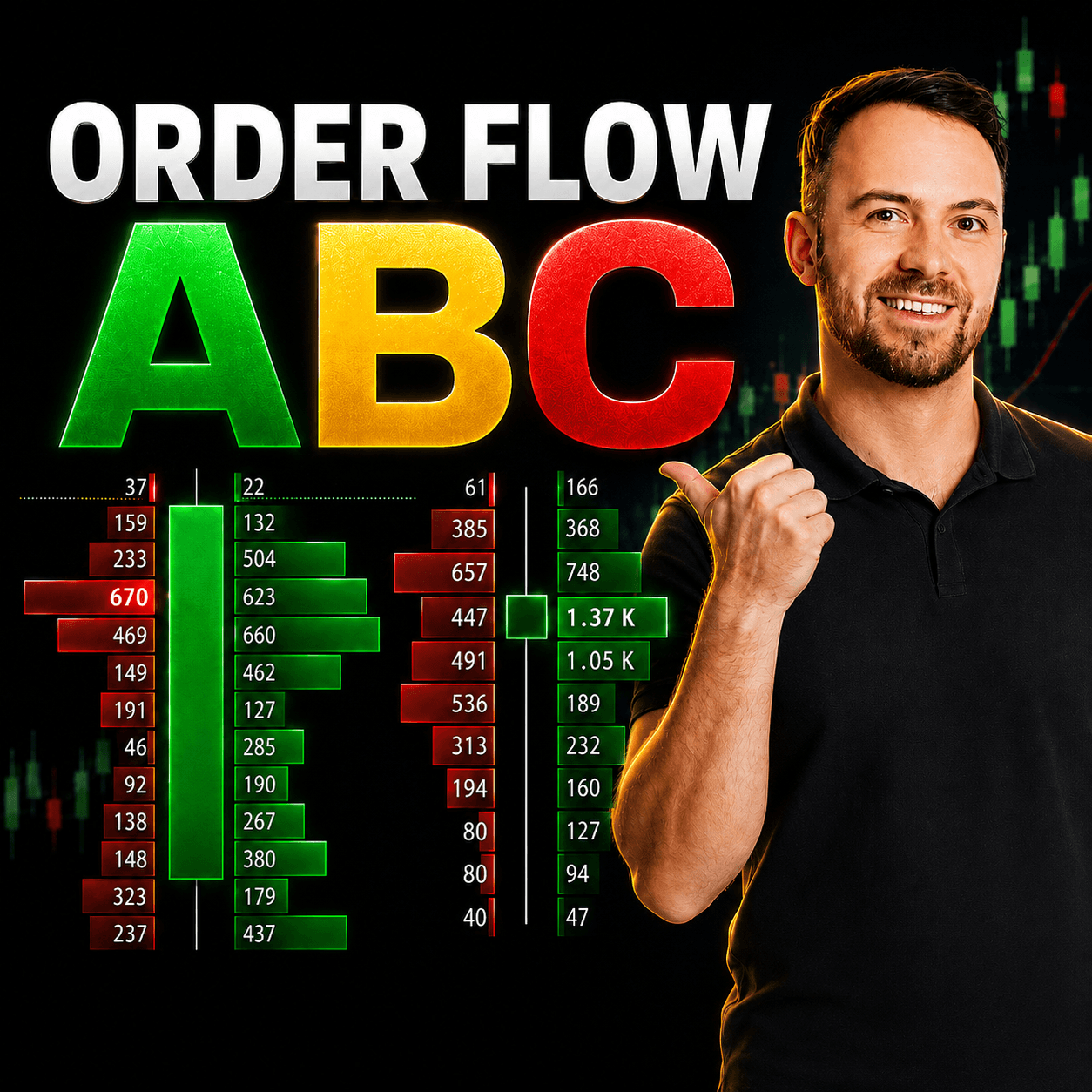
Order Flow is a fantastic tool. If you compare Order Flow to a standard price chart, then a standard candle only shows where it opened, where it closed, where the low was, and where the high was. And that is about it. But Order Flow lets you see inside each candle, and it shows executed trades at each price. That means that if you look, for example, here, then it shows that at this price level, 121 contracts were traded at the ask. If you look here, then you can see that 70 contracts were traded at the bid. So with Order Flow, you can see real volume data executed at each price level.
The reason why you should care about Order Flow is that it shows volume distribution per candle. So if, for example, you take a look here, then it can tell you that buyers are active here at the bottom of the candle, and sellers are active here. If you take a look here, then there were not really too many buyers active at this place. So you see how the volumes are distributed inside that candle. No other indicator can show you that.
It can also identify big player activity. Big players are, for example, institutions that move and manipulate the markets. And those guys are massive. They have huge amounts of capital that they trade with, and with Order Flow, we can see that. We can see massive volumes, and those heavy volumes of the institutions are called footprints. All right, footprints of the big players. So we can identify those as well. We can also see who is dominating the market, whether buyers or sellers, which is very important. And you can also see who is more aggressive, because aggression equals direction. If buyers are more aggressive, then the price goes up. So this is why we should care about Order Flow, and this is why it is such a fantastic tool to trade with.
But before you even start trading with Order Flow, you need to get the software. Unfortunately, it is not part of standard trading platforms. You need to use an Order Flow-friendly platform and install Order Flow on that platform. There are multiple options. I chose three that I recommend. Option number one is using NinjaTrader. NinjaTrader is kind of an industry standard, and if you purchase their license, which is $99 per month or $1,499 for a lifetime license, then the platform will enable you to use Order Flow.
Another option is TradingView. This is probably the most popular platform there currently is, and you need to have their Premium subscription, which is $60 per month, and then they will allow you to use Order Flow, or they call it Volume Footprint, if I am not mistaken. TradingView is more for retail traders rather than professional traders. So I only recommend using TradingView with Order Flow if you already have their Premium plan. So you do not need to pay anything extra. If you have the Premium plan, try out their Order Flow, see how it goes, and see if it fits your style of trading. And then, if you like trading with Order Flow, you will probably want to move on to something more sophisticated. Okay? Because all in all, TradingView is more for retail traders.
Another option, and this is the option that I am using and that I also recommend to our students, is using my Order Flow software with the free version of the NinjaTrader platform. So what I recommend is getting the free NinjaTrader 8 platform. It has all the functions. Don’t worry, it only does not have Order Flow. So get the free version and then install my custom-made Order Flow software there. My software costs $397 for a lifetime license. It is not just the software, but what is also included is a 12-hour-long course on Order Flow trading, express setup, Volume Profile indicators, lifetime support, and more. Simply put, everything that you need to be a successful Order Flow trader.
Okay, but I am not really forcing you to get my Order Flow. You can get any Order Flow you want. There are also a couple of popular platforms that have their own Order Flow, which I listed here, so it is up to you which one you use. All those options are quite fine to use.
Now, when you have the Order Flow, you also need to connect data. Preferably, you will be trading futures, and that means you need to get futures data. Depending on the instrument that you want to trade, you will need to subscribe to one of those exchanges to get the data. Here are the prices. If you want to get all four of them, then it is $30 to $40 per month. But I have a little trick for you. It is a trick that I am using, and students of my courses are also using it. With this trick, you can have all the data just for $4 per month. Here is how to do it. You open an account with NinjaTrader. You fund your account. There is no minimum balance. So you can open an account with, let’s say, $100. Then it will allow you to purchase the CME data only for $4 a month. There is only one thing you need to remember every month, and that is that you need to place at least one trade per month. Okay, that is the whole trick. If you want me to walk you through this from A to Z, then here is a link to a full video guide. I will also place the link below the video.
Now, speaking of the data, there are two kinds of data. Level 1 data, which shows executed trades, and Level 2 data, which shows market depth. For Order Flow trading, you only need Level 1 data because Order Flow shows executed trades. Level 2 data also shows pending orders, but you do not need that if you trade with Order Flow. Pending orders are limit orders that have not been filled yet, and most of them will never get filled because pending orders are very often used by algorithms. They place them above or below the price to lure the price in one direction or the other. When the price starts moving and starts getting close to those pending orders, the algorithms just withdraw those pending orders. So those are not actual trades. Those are not executed trades, and in my opinion, they are not as important as Level 1 data, which shows executed trades. Okay? So you just need Level 1 data.
Now, as I was saying, preferably, you will be trading futures. The reason why you want to trade futures is that futures are centralized. They are traded at a central exchange. That means that every trader on the planet sees the same data as you, the same volumes, the same prices, the same stuff. Right? If you want to trade forex, then it is not like this. Forex is decentralized. That means that there is no central exchange. Right? So every broker can have a bit different data about volumes and price, and you cannot really rely on it 100%. But when you trade with Order Flow, you really need that accuracy, and for that reason, futures are the better option.
Do you know what the biggest problem of Order Flow traders is? Order Flow shows so much information. It shows so many numbers. The charts are full of it, and you do not know what to look at first. You cannot really process all that data, all that information. So that is why people are lost. That is why Order Flow can look a bit confusing, especially to beginners who do not know what to look for. But Order Flow is not about reading all the numbers. It is about spotting certain things. And there are four major things that will make reading Order Flow way easier. Those four things are reading large orders, volume clusters, delta, and imbalances.
Large orders are important because they are footprints of the big players. Volume clusters are important because they show areas of heavy trading activity. Delta is so important because it shows the difference between buy volume and sell volume. And imbalances are important because they show if one side of the market is clearly dominating the market. So, for example, if buyers are dominating the market, imbalances will show you exactly that. Okay. So those are the four core things to look for in each Order Flow chart.
Now let me switch to my trading platform and let me show you. So here is the NinjaTrader 8 platform with my custom-made Order Flow indicator. This is the bid/ask setting, which means that it shows bid here and ask here on the footprint. The first thing that I want to show you is the high volume nodes, and those are the places with the largest orders. My software makes those brackets around those places. I would say most Order Flow software will, in one way or another, highlight those places. So this is what is called a high volume node, and it is the largest volume inside the footprint. In each footprint, there is one high volume node, and it is the most important place in that footprint. As you can see, in here, it was this one. There, it was this one. Then it was this one. It shows how the institutional volume is shifting. That is why it is important. Volumes are always important because they reveal the activity of the big players. So those are the high volume nodes or the large orders. That is the first thing you want to look for.
The second thing is the volume clusters. And to spot the volume clusters, what I will do is switch to the volume setting. It is no longer bid and ask, but it shows total volume, which is bid plus ask. The reason I am using this is because it is visually easier to read, and it highlights areas where heavy volumes were traded. See, this darker shade of gray shows the area where heavy volumes were traded. Not just one level, but multiple levels. See? And it is usually multiple levels like this. I call those volume clusters because this is how institutions trade. They are not like me or you, where they just enter a trade at one price level. They are huge, so they spread their orders across multiple price levels. Okay? So that is why we have those volume clusters. For example, this one, or here is another one. This one. See, my software makes them stand out. This is not a standard feature that every Order Flow software would have, but my software does have it. And I think this is a really, really important thing to have because it allows you to see at first glance where big players were active. You can kind of build on that. You can build a trading strategy around this. Right? I will not be mentioning this in this video, but you can watch another video, which I will drop a link to below, where I show how I do it. Anyway, those are the volume clusters.
The third important thing, and let me switch back to bid/ask, is delta. Delta is, simply put, the difference between buyers and sellers. It is the difference between ask and bid. It is usually below each footprint. Those are the negative deltas, and in here, there is a positive delta. Negative delta, like here, is telling me that in this footprint, sellers were in control. That is why the delta is negative. In this footprint, on the other hand, buyers were in control, and delta is positive.
Now, delta is a fantastic thing, and it can help you in many ways. For example, when the price is rising, the delta is usually positive. When the price is falling, the delta is usually negative. But sometimes it is not like that. And you will see a divergence, like for example here in this area, where price was rising but the delta was negative. Right? Negative delta. That is kind of weird because price is going up, but sellers are dominating. So this tells you that something fishy is going on and that the price might just turn from an uptrend to a downtrend because price follows delta. If the price is rising with negative delta, then the price will often follow the delta. Okay, not always, but quite often. That is one thing you can do with delta.
Another thing is, imagine that we, for example, had a resistance zone in here. Price makes it to that resistance zone, and then you see this footprint with massively negative delta. That means that somebody big is selling here in this footprint, quite possibly as a reaction to that resistance you are looking to trade. This is a trade confirmation by delta. When you see this, it is a signal for you to go short. Okay, this is another way you can use delta. Very, very handy tool.
Now, the last thing that I want to mention is imbalances. If you look closely, the imbalances are those blue numbers. This one, this one, this one. There are many of them on the chart. But when they are on top of each other or stacked on top of each other, like here, here, and here, they are more important because what they show is aggression at these levels where the imbalance is. Sellers were way more aggressive than buyers. Right? And when they are so close to each other, it is a big sign of aggression. This tells you that the price will most likely continue dropping because sellers are simply way more aggressive than buyers. Right? As I was saying, this is even stronger when they are stacked or when they are on top of each other rather than just seeing one in here or one in here. Okay? So this is an imbalance.
A selling imbalance is this because we have those blue numbers at the bid. A buying imbalance is, for example, in here. See? Because the imbalance is at the ask. That means aggressive buyers. But when it is just one number, then it does not mean much. They really need to be stacked like this to tell some kind of story and to show who is more aggressive. Okay, so those are the four main things to look at on any chart, and this will help you put the pieces of the puzzle together and show you the big picture of what is actually going on. As you can see, you do not really need to read all the numbers here. Just focus on the big volumes, delta, and imbalances, and you should be fine. You will see the picture, and you will know what is going on.
Now, what I really recommend is using Order Flow as confirmation, not as a standalone strategy. So your workflow could look, for example, like this. You find a level using, for example, Volume Profile. That is my preferred method. Then wait for a pullback to that level, and then use Order Flow for confirmation. Take a look at this example here. The first picture shows Volume Profile, and it shows a heavy volume zone in here. The price moves away from that heavy volume zone, then makes it back. And this is the place where you want to open Order Flow and look for confirmation. You want to see big players jumping in and confirming your short trade level.
So here is that resistance line. And what the price did is that it went to that line, did not really confirm anything, and was just moving around it. But then the confirmation came in here. This high volume node, that is the confirmation. It is confirmation by absorption. That is my favorite Order Flow setup to confirm trade entries. I will talk more about this a little bit later. But in here, I just wanted to show you really briefly how to go about this. Okay, so this is absorption. This is the signal that sellers are jumping in. And that is why, when you see this, you pull the trigger. You pull the trigger. Okay, so this is the confirmation.
An important thing is that without a level, Order Flow is just noise. Okay, so you really need that strong level around which you trade with Order Flow. Now I know what your question is. Okay, that sounds cool, but how do I find a strong level? My recommended method is using Volume Profile, mainly trading the point of control. If you take a look at this picture, then this is Volume Profile. It is a histogram, and here the histogram is the widest. That means the heaviest volumes were traded here. That is the place that is called the point of control. What you want to do is mark the point of control, and it will represent a strong level to trade from. If the price hits the point of control from below, then you will be going short because it will be resistance. If the price hits the point of control from above, then it would be support, and you would be looking for longs. In this case, price went below the point of control and made a pullback. That means short from here. Okay, so this is how you trade the point of control.
Now, there are a couple of reasons why Volume Profile works and why the point of control works. The reason is that the point of control is the place where the highest volumes were traded, where the big players or institutions were active. The second reason why the point of control works is that the big players who are active here defend this place. So when price makes a pullback to the point of control, they defend their positions and push the price away from that area. Now, I made a separate video on how to trade the point of control. I do not really want to dig too much into details here, but I will drop a link below this video so you can watch it. Okay, the link will be below in the video description.
Now, let me give you at least one example of an Order Flow setup that you can use. This is my favorite example. It is the absorption setup, and it goes like this. Take a look at this example and imagine that there is strong support. Let’s say that you found this support using Volume Profile and the point of control method, and you see that the price is dropping towards that support. When the price hits that support, that is when you open Order Flow and you want to see confirmation there. The confirmation in this case is in this high volume node: 514 contracts at the bid and 1,025 contracts at the ask. That is the confirmation. And the reason why this is a confirmation is the absorption setup.
You need to see heavy volumes, unusually heavy volumes, both at the bid and at the ask. What this is telling us is that sellers are pushing the price downwards, and those are the massive volumes they are placing here: 514 contracts. But at the same time, at this price level, buyers stepped in, and they bought everything the sellers had to sell. That is why the price stopped the downtrend. It stopped dropping and stayed at one level, and buyers were buying everything the sellers were selling. That is why the price stops, and that is why we see those massive volumes here at the bid and at the ask. And that is absorption. It is called absorption because the market is absorbing the pressure. In other words, the buyers are absorbing the selling pressure. So this is the confirmation for you to enter a long trade from here. As a little bonus, you can notice that there is positive delta also telling you that buyers are jumping in and that the price will most likely go upwards.
Okay, so this is the absorption setup, my favorite one. There is a separate video on the absorption setup. Again, I will drop a link below this video. Yeah, there will be a lot of links below this video, but they are worth looking into. So, yeah, that is absorption, my favorite setup.
And here is a little action plan for you guys on how to get started with Order Flow. First step, download NinjaTrader. The free version will do. Then you will want to connect to the $4 CME data using the trick that I showed you. The next thing is that you want to pick one instrument to focus on. Only one. I know it is tempting to go for more, but just pick one. The reason is that every instrument is a bit different. Every instrument has different volumes, different volatility, and different times when it is active or when the traders trading that instrument are active. So just pick one. Even the best traders on the planet trade just one or two instruments. No more.
So that is the third step. The next one is that for the first week, just observe. Focus on the large volumes, volume clusters, delta, and imbalances. But do not place any trades yet. Okay? Just observe. Get to know the market that you chose, get to know Order Flow, and get to know those things that I showed you today. Then start combining it with Volume Profile or with the point of control that the Volume Profile shows. When the price reaches the point of control, then you want to look for the Order Flow confirmation. All right. So that is the quick action plan.
And if you guys are interested in digging a bit deeper, then I have a couple of tips for you. The first thing is the Order Flow book. If you guys are based in the US, I will send the book over to you for free. I will even cover the shipping. Just follow the link below the video and fill in your address, and I will send the book. There are no strings attached. Just get the book, enjoy it, and let me know how you liked it.
The second thing you can do is watch the full Order Flow webinar. It is an extensive Order Flow webinar that focuses more on Order Flow setups and real charts. So I definitely recommend watching this one. Again, I will drop a link below this video. And if you are really into Order Flow trading and really want to get as much out of it as possible, then I recommend getting my Order Flow trading course and my software. You can find it on my website, Trader-Dale.com. You will get a 12-hour-long video course. You will get my software lifetime license. You will also get the Volume Profile indicators that I use, so you can combine them with Order Flow. As I was saying, this is a lifetime license, and you will also get all the help from me and from my team. All right, so that is that. Thanks for watching the video, and I will see you next time. Until then, happy trading.
