
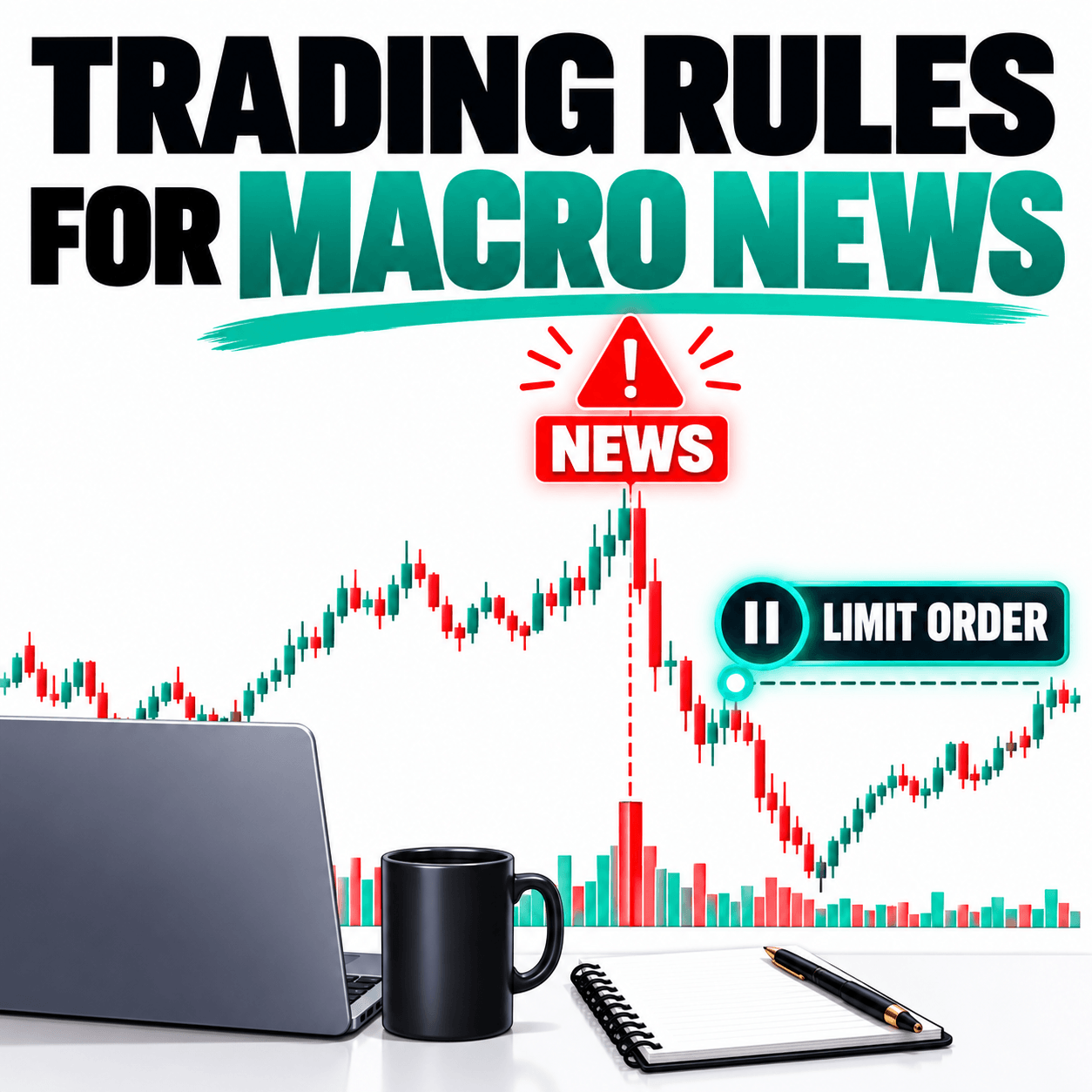
Macro news can shake the market in seconds. One minute your chart is calm and quiet. The next minute a huge candle appears out of nowhere and wrecks your plan. If you swing trade for a living or even just part time, you have felt this before, more than once probably. But here is the good news. You do not need to fear every news event, and you do not need to sit on the sidelines all day. The real answer lies in the trading rules for macro news, which separate the news you can safely trade through from the news that can genuinely hurt your account.
In this article, you will learn a simple system built from years of hands on swing trading experience. You will learn which news is safe, and which is genuinely dangerous. You will learn exactly what to do with your open trades and your limit orders before the danger hits. You will also learn the exact rules for macro news re-entry, so you never end up chasing the market after a big move. By the end, you will have a clear, repeatable checklist you can use before every high impact news release, whatever currency pairs you happen to trade.
Table of Contents
Macro News Trading Rules In 5 Points
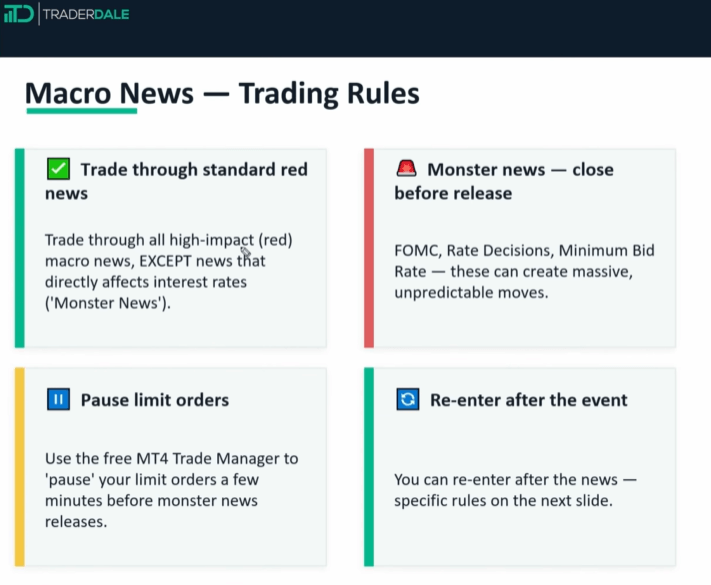
- Trade through red news. Most high impact news is safe.
- Watch out for monster news, like FOMC or Official Cash Rate decisions.
- Pause your limit orders, then replace them after the news.
- Quit open trades if the affected currency is in your pair.
- Re-enter only at the same price or better. Never chase.
Red News: The News You Can Usually Trade Through
What Red News Actually Means
Every trader who checks an economic calendar has seen red news, meaning high impact news. On Forex Factory, these events are marked in red, so they are easy to spot. Almost every day, there is some red news scheduled somewhere. If you tried to avoid all of it, you would barely trade at all.
This is where the first of the trading rules for macro news comes in. As a general habit, red news is safe to trade through. You do not need to close your trades just because a red flag shows up on the calendar. You do not need to cancel your orders either. Most red news creates a short burst of movement. Then price settles back into its normal behavior. Reacting to every single headline only adds stress. It would likely hurt your results more than it helps them.
Think of red news like a weather forecast. A forecast might warn of rain. Sometimes a short shower does pass through. But you do not cancel your entire day because of it. You simply carry on, knowing a little rain will not change your plans. Red news often works the same way in the market. It creates some noise and a few quick candles. Then things return to normal fairly quickly.
The One Exception Worth Knowing
There is one important exception to this rule, and it is the reason this guide exists. Not all red news behaves the same way. A small group of news events are far more dangerous than the rest. Treating them the same as ordinary red news is a mistake. It can catch out even experienced swing traders. That special group is what we call monster news. It deserves its own full explanation, which comes next.
Monster News: The News That Changes Everything
What Makes Monster News Different
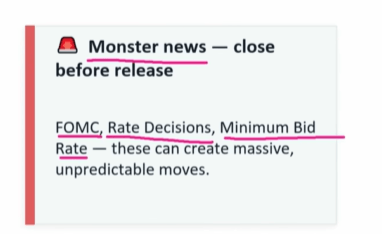
Monster news is the exception inside the wider set of macro news trading rules, and it is the one category you always want to respect. Monster news refers to any news release that directly affects the interest rate of a currency. This includes the FOMC rate decision from the United States Federal Reserve, and the Official Cash Rate decision from a central bank, such as the Reserve Bank of New Zealand. These are sometimes called minimum bid rate announcements too.
The reason monster news needs a different set of rules is simple. Interest rate decisions can create massive, unpredictable moves in seconds. Spreads can widen, stop losses can be skipped, and price can gap straight through key levels. This is very different from the gentle rain of typical red news. Monster news is closer to a sudden storm.
A Real Monster News Example
A good real world example is the Official Cash Rate on the New Zealand dollar. It directly sets the interest rate for that currency, so it belongs firmly in the monster news category. This does not mean every trader must fear it, though. If you trade EUR/USD, this decision has nothing to do with your trade. But if you trade NZD/CAD, this news directly affects one of your currencies, and you need to plan around it.
This point is worth repeating. Monster news only matters when it involves a currency you are actually trading. You only need to watch news that touches the currencies inside your open trades or pending orders. Once you know which pairs are affected, two questions become practical. What should you do about limit orders on the chart? What should you do about a trade you already hold? Both are covered next.
What To Do With Your Limit Orders Before Monster News
How To Pause Your Limit Orders
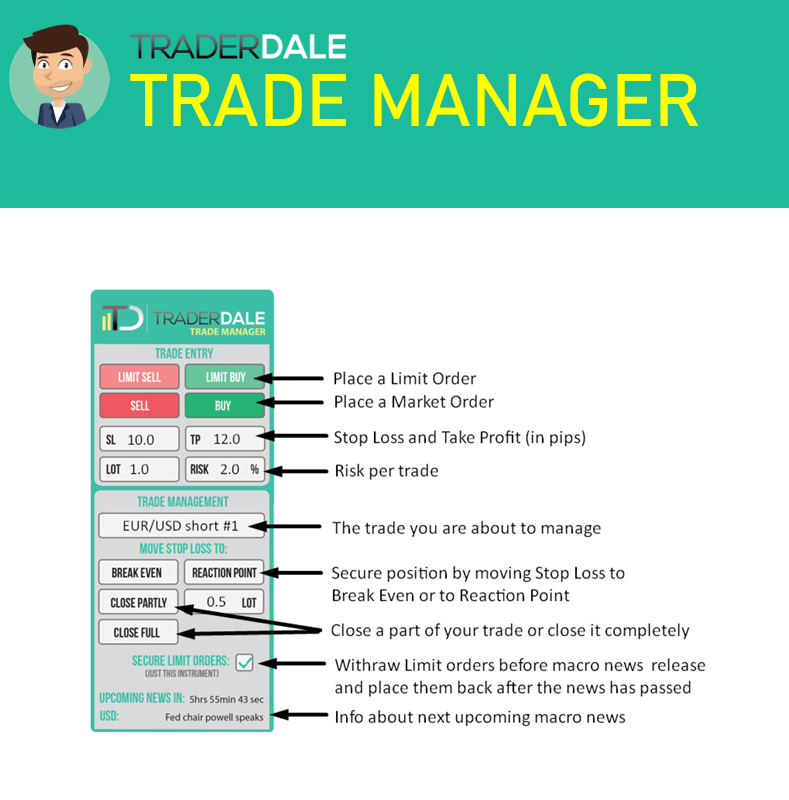
One of the most practical trading rules for macro news deals with pending limit orders. If you have limit orders on your chart, monster news can trigger them at a terrible price, or fill them right before a spike works against you. The safest habit is to pause your limit orders before the news, then place them back once the danger has passed.
Pausing simply means you withdraw the pending orders from your chart for a short period. You are not deleting your trading plan, only removing the order from the market temporarily, so a sudden spike cannot trigger it at a bad moment. Once the monster news has passed and the market has settled, you place the same limit orders back where they were before.
Automating It With A Trade Manager
Doing this manually for every monster news event can be tedious, especially if you trade several pairs at once. This is where a tool like a Trade Manager becomes useful. A well built Trade Manager tool can automatically withdraw your limit orders before a scheduled monster news event, then place those same orders back once the news has passed. This removes the manual work entirely, and you never have to sit at your screen refreshing the calendar every few minutes waiting for a release.
The benefit of this approach is peace of mind. Your account stays protected during the riskiest minutes of the release, and your trading plan resumes automatically once conditions calm down. This single habit can prevent some very costly, avoidable losses over a trading career. It also frees up your attention for the part of trading that actually matters, reading the chart, not babysitting a calendar full of red flags.
When To Quit An Open Trade Before Monster News
Why Timing Does Not Need To Be Perfect
Pending orders are only half the story. The other half concerns trades you already hold right now. If you have an open trade, and monster news is about to hit a currency inside it, the safest choice is to quit the trade before the news arrives. Close the position manually a short time before the scheduled release.
You might worry that closing early means giving up a good opportunity. In reality, since this is built for swing trading, timing does not need to be perfect to the second. Closing a couple of minutes, or even hours, before the news is fine. Swing trades usually play out over days, so losing a small window around one news event rarely changes the overall picture.
This is one of the calmer trading rules for macro news, and it is easy to follow once it becomes a habit. You are not trying to predict how big the news candle will be. You are simply stepping out of the market for a short window, so an unpredictable spike cannot damage a trade that was otherwise working well. Many traders set a simple reminder a few minutes ahead of any known monster news event, so closing the position becomes routine rather than a last minute scramble.
What Happens After You Quit The Trade
Once your trade is closed, the natural next question is what happens afterward. Do you walk away from that setup forever, or is there a way back in? Re-entry is possible, but only under the right conditions. Chasing the market back into a trade at any price is exactly the mistake this whole system tries to prevent. The next section walks through the precise re-entry rules, using a clear visual example.
How Re-Entry Rules For Macro News Actually Work
The Re-Entry Rule Explained
This next part might be the most important of the trading rules for macro news. The rule is simple. You only re-enter after monster news if you can get the same price as your exit, or a better price.
Let us walk through an example using the Volume Accumulation Setup, which appears when a heavy volume zone sits under a strong uptrend. Imagine you entered a trade inside that zone, with a healthy trend above it, and monster news is scheduled for later that day. You quit before the news candle forms.
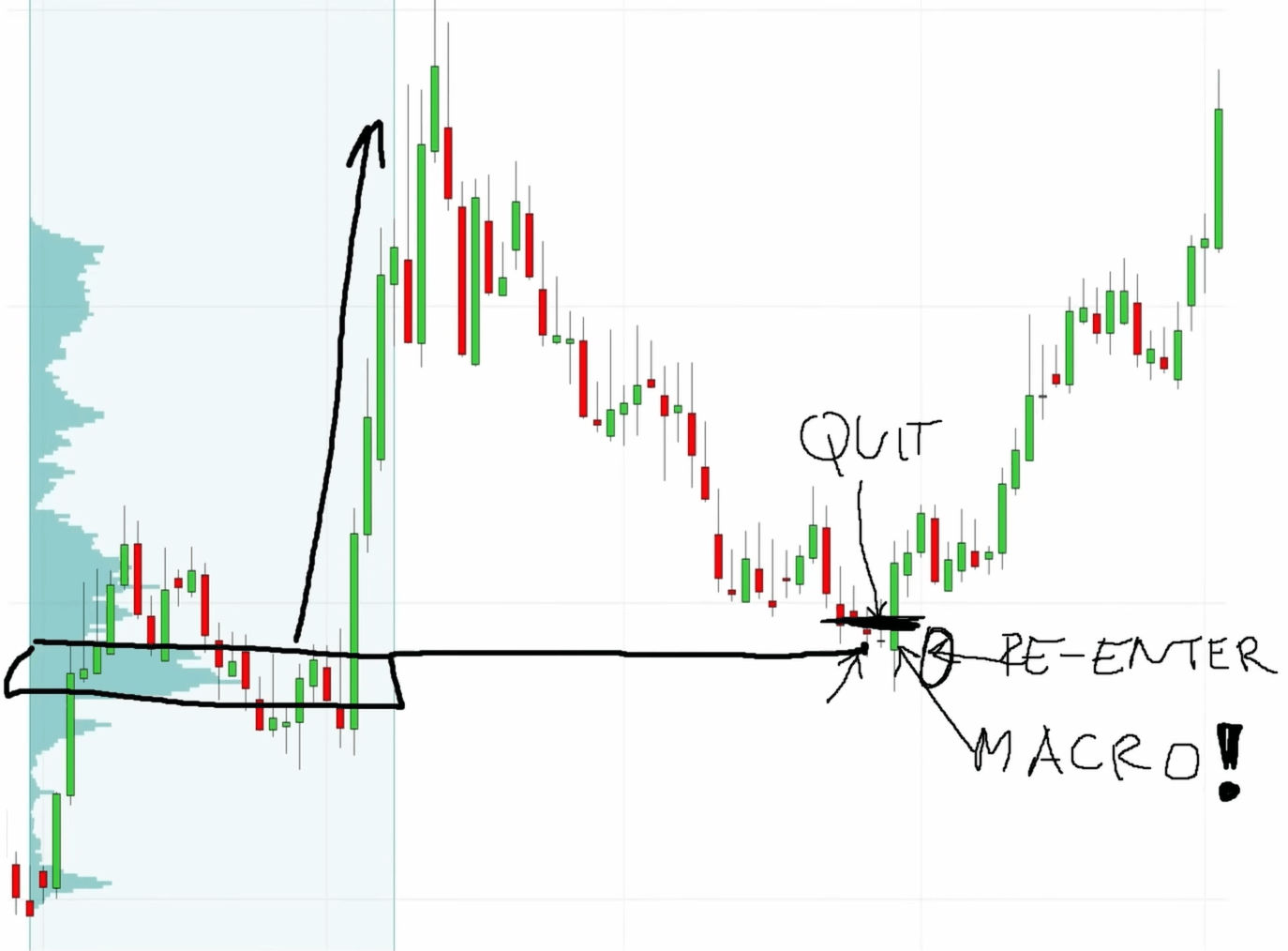
Once the monster news candle has formed and closed, there are three possible outcomes for price. Only some of them allow a valid re-entry.
Outcome After The News | What Price Does | Can You Re-Enter? |
Ideal outcome | Price barely moves and settles near your exit price | Yes, at the same price |
Best outcome | Price gives you a slightly better price than your exit | Yes, at the better price |
Not allowed | Price runs strongly and only offers a worse price | No, this is chasing |
If the news causes only mild volatility, you can often jump straight back in at the price where you quit. That is the ideal scenario. An even better one happens when price improves, letting you in at a more favorable price. Both count as valid re-entries.
When Not To Re-Enter
The situation to avoid is different. If price runs hard and only offers a worse level, this counts as chasing the market. The rule is firm. You let that trade go and shift focus to the next valid setup. The core lesson is simple. Same price or better means a valid re-entry. A worse price means you walk away.
What Happens If The News Hits Your Stop Loss
Why This Rule Is Non-Negotiable
There is one final scenario worth covering inside these macro news trading rules, because it removes any confusion for good. Suppose you could not close your trade before the monster news, perhaps because the release came early, or because you were away from your screen. The news candle ends up hitting your stop loss directly. The rule here is very clear. You do not re-enter that trade at all.
This rule exists for a good reason, even though it can feel strict at first. A stop loss hit by monster news is not the same as a stop loss hit by ordinary market movement. When news causes the spike, the move is often driven by a sudden shift in how traders view an entire currency, not by the normal push and pull of buyers and sellers around your setup. Once that shift has happened, the original chart picture you based your trade on no longer applies in the same way. Treating that spike as a fresh signal to jump straight back in would mean building a brand new decision on top of old, outdated information, and that is rarely a good trade to take.
Accepting The Loss And Moving On
This might feel disappointing, especially if you believe your original idea was still valid. But once your stop loss has been triggered by a monster news spike, the setup is finished. The market has already delivered its verdict. Trying to re-enter usually means fighting a market that has just shown real, unpredictable strength. It is far safer, and far more disciplined, to accept the small loss and look ahead toward the next opportunity. This single rule protects traders from unnecessary frustration around news events.
Conclusion
Macro news does not need to be something you fear every day. Most red news is safe to trade through. Treating every headline as a threat only adds unnecessary stress to your routine. The real skill lies in recognizing monster news, the small group of interest rate events that can genuinely move the market in unpredictable ways.
Once you can spot monster news, the rest becomes a simple checklist. Pause your limit orders before the event. Quit any open trade that involves the affected currency. Only re-enter afterward if you can get the same price, or a better price, than where you exited. If price runs away, let it go and wait for the next setup. If the news hits your stop loss, accept it and move on.
These trading rules for macro news are not complicated, but they do require discipline to follow consistently. Traders who apply them tend to avoid the painful surprises that catch out less prepared traders during big news releases. Start applying this checklist the next time monster news appears on your calendar, and you will likely notice calmer, more controlled decisions around every future release, no matter which currency pair you trade.
Frequently Asked Questions
Do I need to close every trade before red news?
No. Ordinary red news is safe to trade through. You only act around monster news, like FOMC or Official Cash Rate decisions.
What counts as monster news?
Interest rate decisions: FOMC, Official Cash Rate, and minimum bid rate.
Can I always re-enter after monster news?
Only at the same price as your exit, or better. A worse price means chasing the market, so skip it and wait for the next setup.
Ready To Put These Rules Into Practice?
Watch the full video walkthrough above. Start marking monster news events on your own calendar this week. Bookmark this article so you always have this checklist ready before the next major news release hits your charts.
Knowing when to step aside for news is only one piece of the puzzle. If you want the full system, the same Volume Profile, Order Flow, and Smart Money Concepts strategies used to plan every trade in this article, my courses walk you through it step by step, with real charts and real trade breakdowns.
Apply the coupon code KEVIN10 at checkout for an extra 10% discount.
