

Every trader I’ve ever spoken to starts with the same goal: “I want to make X% per month.” It sounds like a professional mindset. In reality, it’s the fastest path to blown accounts and broken discipline.
I made this mistake myself early in my career. I set monthly targets, hit them in good months, then forced trades in bad months trying to catch up. The goal became the enemy of the process.
In this article — based on a topic I cover in depth in the video above — I’ll show you why profit goals are counterproductive, what to focus on instead, and the three-step framework I teach my students to build sustainable trading discipline.
Table of Contents
Summary in 5 Points
Profit goals lead to forced trades: When you chase a percentage, you take bad setups just to hit a number.
The market decides the payout: You cannot control the market; you can only control your adherence to your plan.
Process over Results: Like a pro athlete, focus on the “swing” or the “serve,” not the scoreboard.
The 20-Trade Challenge: Success comes from executing 20 trades in a row with zero deviations from your rules.
The “Ice Cube” Effect: Progress in trading is often invisible until you hit a breakthrough threshold.
The Hidden Danger of the 5% Profit Goal
When you set a fixed monthly goal — say 5% — you’re making an assumption the market can’t guarantee: that it will provide enough qualifying setups in exactly 30 days. Some months the market is choppy and offers nothing clean. Other months it trends beautifully and gives you 10 perfect setups.
But with a 5% goal in your head, you don’t have the luxury of waiting. If it’s the 25th of the month and you’re only up 1.5%, your brain starts rationalising marginal trades. You bend your entry rules slightly. You move a stop loss to avoid a loss that would push you further from the goal. You take a trade on an instrument you don’t normally trade because it “looks like” it might work.
This is where accounts blow up. Not from one catastrophic trade, but from a series of increasingly compromised decisions made in pursuit of an arbitrary number. The goal you set is actively working against the discipline you’re trying to build.
The Gym Analogy: Why Forcing Results Leads to Injury

Imagine you want to bench press 225 lbs within 30 days. To hit that number on time, you skip rest days, ignore the shoulder twinge that started on day 10, and compensate with bad form because the weight has to go up regardless. Maybe you hit 225 for one rep. Then your shoulder gives out and you’re sidelined for three months.
Trading is exactly the same. When you obsess over hitting a profit target, you stop executing with discipline and start ego-trading. You push through the warning signs — a market that’s ranging with no clear setups, a day when you’re emotionally compromised, a trade that barely qualifies. You force the lift.
The result is the same as the gym: a short-term “hit” followed by a period of recovery (or account blow-up) that wipes out everything you gained. Focus on the form — your trading plan — and the results will follow at their own pace.
Comparison: Trading vs. Weightlifting
The parallel between trading and physical training is useful because most people intuitively understand why forcing results in sport leads to injury — but they apply exactly that thinking to their trading accounts. The athlete focused on “lift this specific weight by this specific date” gets hurt. The athlete focused on “improve my technique every session” gets strong.
The result-oriented trader chases the 5%, forces bad trades, and blows the account. The process-oriented trader follows the plan, accepts that some months will be flat or down, and builds a statistically valid track record over time. The second trader is the one still trading two years later.
Feature
The Result-Oriented Approach
The Process-Oriented Approach
Goal
Bench 225 lbs / Make 5%
Follow the Form / Follow the Plan
Risk
Physical injury / Blown account
Managed fatigue / Controlled risk
Long-term
Months of recovery needed
Consistent, sustainable growth
Focus on the Process, Not the Scoreboard
A professional tennis player in a high-stakes match isn’t staring at the score after every point. They’re focused on footwork, ball placement, and reading their opponent. The score takes care of itself when the fundamentals are right.
The same applies to trading. Ask yourself: what kind of trader do I need to become to achieve consistent results? That trader has a structured daily routine. They keep a detailed journal with screenshots and notes. They treat their desk like a business office, not a casino. They sit on their hands when the market isn’t offering clean setups — and they feel completely comfortable doing it.
Reverse engineering the goal: If you want to make 5% a month consistently, don’t focus on the 5%. Focus on the behaviors of a trader who achieves 5%. Embody those behaviors first. The 5% arrives as a consequence of becoming that trader, not as a reward for forcing it.

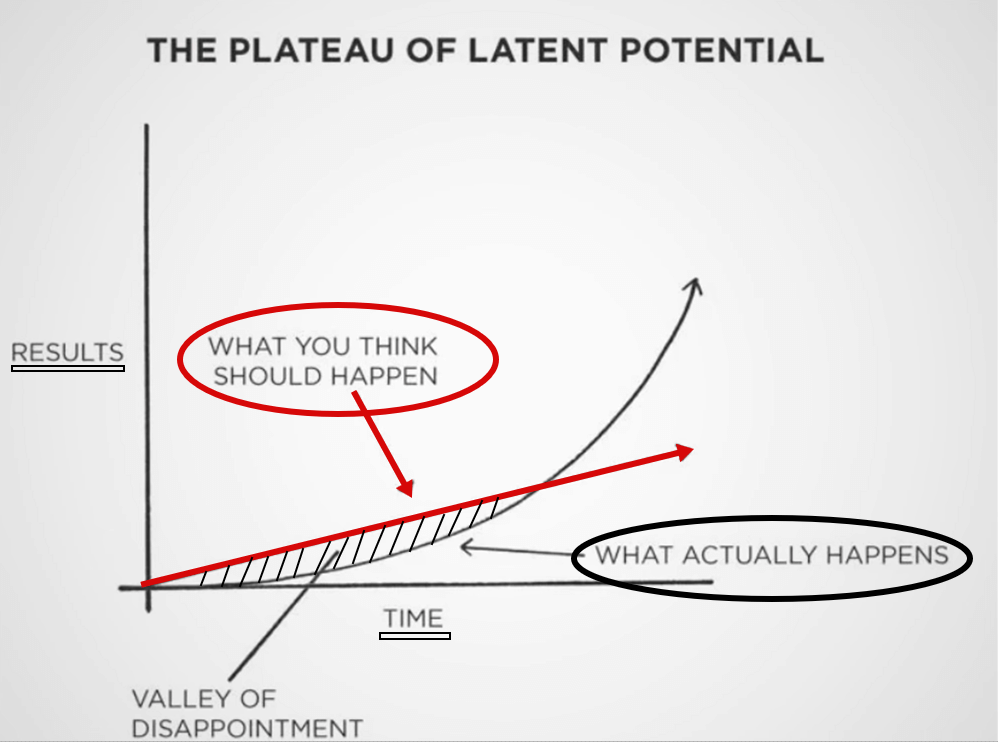
The Ice Cube Theory: Why Progress Is Often Invisible
James Clear describes this in Atomic Habits as the Plateau of Latent Potential. Imagine an ice cube in a room that’s 26°F. You heat the room to 27°, 28°, 29°, 30°, 31°. Nothing happens. The ice cube looks exactly the same. It feels like you’re failing.
Then you hit 32°. The ice melts.
Every degree of heat you added before that moment was necessary. Without degrees 27 through 31, you never get the melt at 32. The progress was real the entire time — it just wasn’t visible yet.
Trading works identically. You might follow your plan for three months and see no meaningful improvement in your P&L. But you’re adding degrees. You’re getting better at reading setups, managing emotions, and staying disciplined. If you quit at month two because the ice hasn’t melted, you waste all that invisible progress.
The traders who succeed are almost never the most talented. They’re the ones who kept heating the room past the plateau.
3 Practical Steps to Fix Your Trading Today
If you’ve been trading to a profit target and it isn’t working, here are the three steps I use with students to break the cycle. Do all three, in order.
1. The Identity Audit
The shift from “I want to make 5%” to “I am the kind of trader who makes 5%” sounds subtle but it changes everything. Wanting is passive. Being is active.
Sit down and write out the specific characteristics of a consistently profitable trader. They’re patient. They don’t revenge trade. They follow their plan regardless of what the last three trades did. They journal every trade with screenshots. They stop for the day when they hit their maximum loss limit without needing to think about it.
Now look at your own daily trading behaviour. Where are the gaps? Be honest. The gaps between who you are now and who that trader is — those are your actual development targets. Not a percentage goal, but specific behavioural changes.
2. Start the 20-Trade Challenge
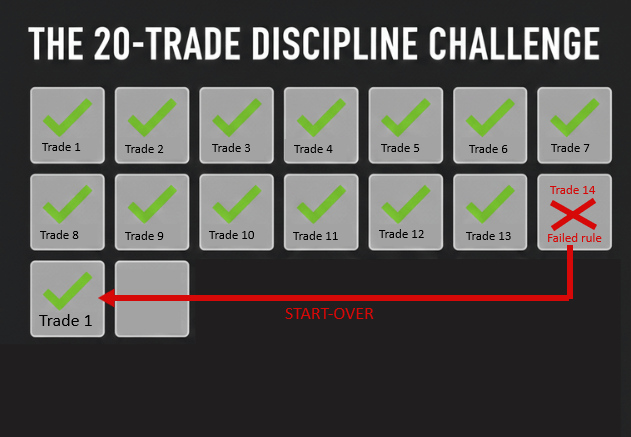
This is the single most effective exercise I give to struggling traders. The rules are simple:
- Take your next 20 trades.
- The only metric that matters is: did you follow your rules on this trade? Yes or no.
- If you break a rule — enter too early, move a stop loss, take a trade that doesn’t qualify — reset the count to zero. Back to trade #1.
That’s it. Profit and loss are irrelevant. Whether the trade wins or loses is irrelevant. The only question after each trade is: “Did I execute my plan perfectly?”
Why 20 trades? Because it forces you to accept that individual trade outcomes don’t matter. It builds the muscle memory of disciplined execution before the P&L becomes a distraction. Most traders I’ve put through this exercise are surprised to discover they can’t get past 5 or 6 without breaking a rule. That discovery alone is worth more than any profit target.
Complete 20 consecutive rule-adherent trades and you’ll experience something interesting: you stop caring whether any individual trade wins. You start thinking in terms of process and probability, not outcomes. That’s professional trader thinking.
3. The Ice Cube Audit
When your account looks flat after a month of consistent effort, do this before drawing any conclusions about your progress:
Open your trading journal and review the last 20–30 trades specifically looking for invisible progress: Did you wait for better setups this week compared to last month? Did you exit a position that was going against you faster, with less hesitation? Did you skip a trade that you previously would have forced?
These are degrees of heat. The ice hasn’t melted yet, but the room is getting warmer. If the audit shows your behaviour is improving, you’re on the right path — regardless of what the P&L says in this moment. Trust the process and keep adding degrees.
If the audit shows your behaviour is not improving — if you’re still breaking the same rules, taking the same marginal trades, moving the same stop losses — then you have a real problem to address. But that’s a behaviour problem, not a strategy problem. And behaviour problems have solutions.
Conclusion & FAQ
Trading is a performance discipline, not a numbers game. The traders who achieve consistent profitability aren’t the ones who set the most aggressive targets — they’re the ones who built the most consistent habits over the longest period.
Stop asking “how much can I make?” and start asking “what kind of trader am I becoming?” Do the Identity Audit. Start the 20-Trade Challenge. Perform the Ice Cube Audit when progress feels invisible. Keep heating the room.
If you want a structured programme that applies this exact framework — with trade analysis, journaling tools, and a clear progression path toward a funded account — the Funded Trader Academy is built around these principles. And if you’re newer to the technical side, the trading course and tools will give you the strategy foundation to make the process worth following.
Here are the most common questions I get about profit goals, trading discipline, and the 20-Trade Challenge:
Zero. Seriously. For the first six months, your goal should be to break even through perfect execution of your rules. The purpose of early trading is to validate your strategy with a statistically significant sample of disciplined trades — not to make money. Once you can follow a plan consistently across 50+ trades, the profitability tends to follow naturally. Setting a specific profit target before that discipline is in place almost always leads to forced trades and account blow-ups.
Do nothing. Walk away. Professional traders are essentially paid to wait for high-quality setups — the discipline of not trading is just as important as the discipline of trading when you should. Taking a trade just to feel active, or to hit a goal, is gambling. If your plan has no qualifying setups today, that is a successful trading day. You protected your capital and maintained your discipline. That counts.
Yes. The 20-Trade Challenge is about behavioural discipline, not the specific strategy. Whether you trade Volume Profile, price action, VWAP setups, or anything else, the challenge is the same: execute your defined rules perfectly 20 consecutive times. The strategy provides the setup criteria; the challenge forces you to follow them without exception. It works across all approaches because the problem it solves — emotional interference with rule-based execution — is universal.
There is no universal timeline, but in my experience most serious traders need 1 to 3 years of consistent practice before their results stabilise. This is uncomfortable to hear when you want results now, but it’s accurate. The traders who try to compress that timeline by taking more risk or trading more aggressively almost always set themselves back further. Accept the plateau, keep heating the room, and the breakthrough arrives when the skill is genuinely there to support it.
Because they shift your attention from the process (following your rules) to the outcome (hitting a number), and the market will not cooperate with your schedule. When you’re behind your target, you experience psychological pressure that leads to: taking marginal setups that don’t fully qualify, holding losing trades too long hoping for a recovery, and increasing position size to “catch up” — which amplifies losses. Every one of these behaviours is caused by the goal, not the market. Remove the goal, and most of them disappear.
Prop firm challenges do have profit targets — typically 8-10% in Phase 1. The trap is treating that target as a daily urgency rather than a long-term average. If your strategy has a positive expectancy and you execute it consistently over 20-30 trades, the target will come naturally. The traders who fail prop firm challenges are almost always the ones who start forcing trades or overriding their rules in the final days to ‘hit the number.’ Trade the process for the full challenge period. If your strategy is sound, the profit target takes care of itself. If you’re consistently missing it after trading cleanly, the issue is strategy — not effort.
