

If you have ever experienced the frustration of crushing a demo account or passing a high-stakes funding evaluation only to watch your live account evaporate in a matter of days, you are not alone. This is the “great divide” in professional trading. The transition from a simulated environment to a live market is the ultimate “train wreck” moment because the stakes have shifted from a game of numbers to a battle of identity. In an evaluation, you are playing with house money; in a live account, you are playing with your ego, your future, and your self-worth.
In my 20 years of navigating these markets, I have realized that mastering your trading psychology is the only bridge that spans this gap. Most traders treat their mental state like a footnote, focusing instead on finding the “perfect” indicator. However, psychology is the literal foundation of your equity curve. You can possess a world-class strategy, but if your “zero-to-six lens”—the emotional programming you received as a child regarding loss, scarcity, and authority—is triggered by a market drawdown, your logical brain (the prefrontal cortex) will effectively shut down. When this happens, you aren’t a trader anymore; you are a collection of childhood defense mechanisms trying to “win” back lost pride. This guide is designed to dismantle those patterns, offering you the same “white-glove” psychological framework we use in the Funded Trader Academy to turn emotional gamblers into disciplined business owners.
Table of Contents
5 Keys to Trading Discipline
The 20-Trade Challenge: Prove you can follow your plan for 20 trades, regardless of profit or loss.
The Logic Injection: Learn to “interrupt” emotional spirals with rational questions.
The 20-Minute Walk: Use physical movement to clear stress hormones like cortisol.
Written Trading Plan: If it isn’t written down, you aren’t trading; you’re gambling.
The Mirror Principle: How you do one thing is how you do everything—discipline starts at home.
Why You Pass Evaluations but Blow Live Accounts
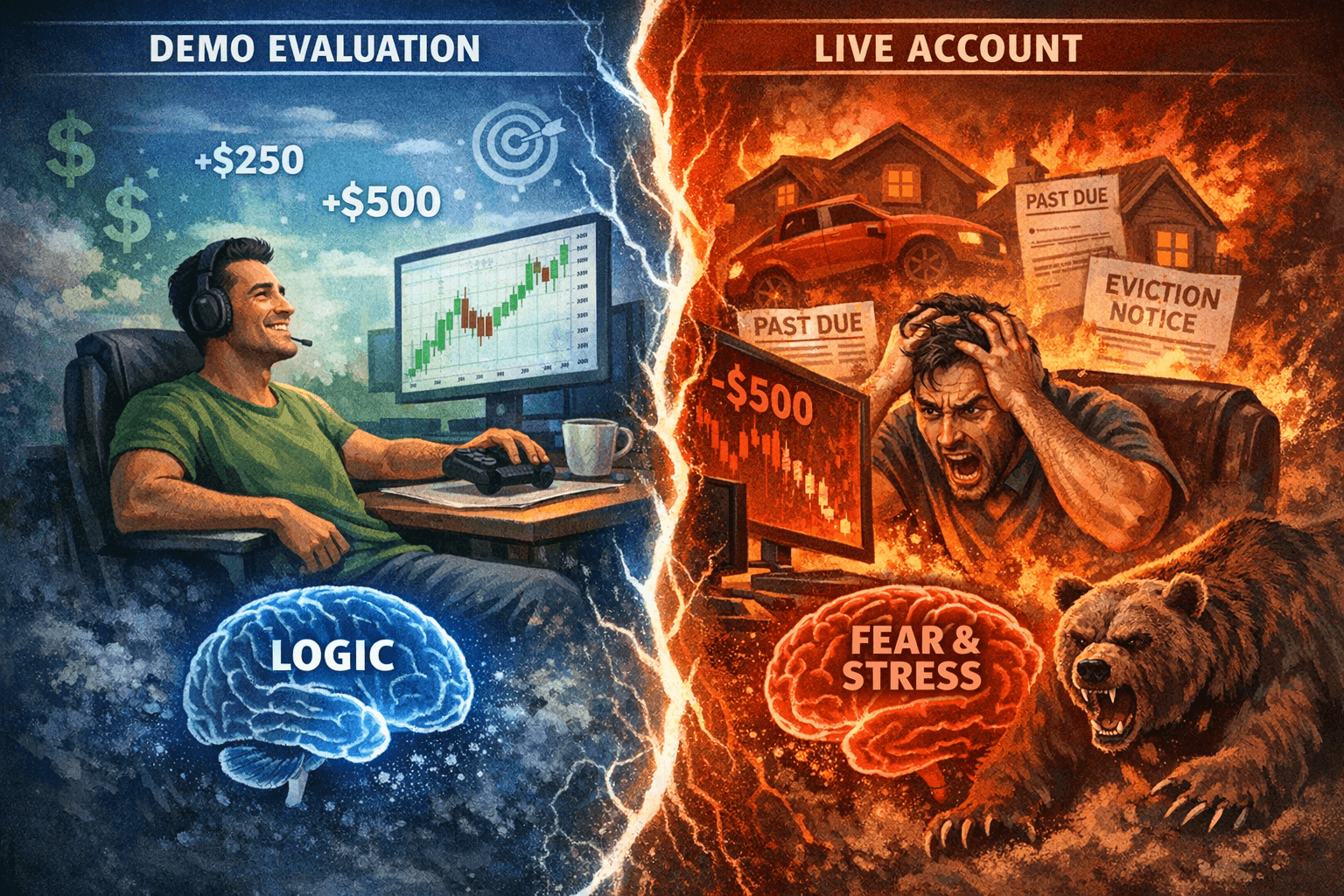
The transition from a simulated environment or a “demo” evaluation to a live account is where most traders fail because the physiological response to real risk is entirely different. When real money is on the line, your body enters a “fight or flight” state.
The Illusion of Success in Evaluations
During a funding evaluation, your brain perceives the environment as a game. Even though the goal is professional funding, the “risk” is capped at the cost of the audition fee. This lack of true financial consequence allows you to stay calm and follow your strategy. However, the moment you move to a live account, the “Survival Instinct” kicks in. Suddenly, a $500 loss isn’t just a number on a screen; it’s the rent, the car payment, or your proof to your spouse that you can actually do this. This added weight changes how your brain processes data.
The Biological “Hijack”: Amygdala vs. Frontal Lobe
When you experience a loss in a live account, the Amygdala—the part of your brain responsible for emotional reactions—takes over. It signals a threat, flooding your system with adrenaline and cortisol. In this state, the Prefrontal Cortex (your logical “trading brain”) essentially goes offline. You are biologically incapable of making rational decisions. This is why you find yourself taking trades you know you shouldn’t—your biology has hijacked your strategy.
The “Zero-to-Six” Lens and Childhood Programming
Most of our reactions to loss are formed between the ages of zero and six. If you grew up in a household where loss was met with anger or where scarcity was a constant fear, your brain will replay those ancient scripts in the market. Men, specifically, often struggle with an anger response to loss. We cover sadness or fear with anger because it feels “safer” or more “powerful” to express. If you don’t address these deep-seated reactions, you will continue to “revenge trade” until your account balance hits zero.
The Mirror Principle: Trading as a Reflection of Life
You must understand that your personality at the dinner table is your personality at the charts. You cannot be a disciplined trader and a “slob” at home. If you leave dishes in the sink for two weeks, neglect your morning routine, or lack discipline in your physical health, that lack of structure will eventually bleed into your stop-loss management. Mastering your trading psychology requires a holistic approach to your life. To be a “Pro” at the screen, you must first be a “Pro” in your daily habits.
The 20-Trade Challenge: The Ultimate Discipline Test
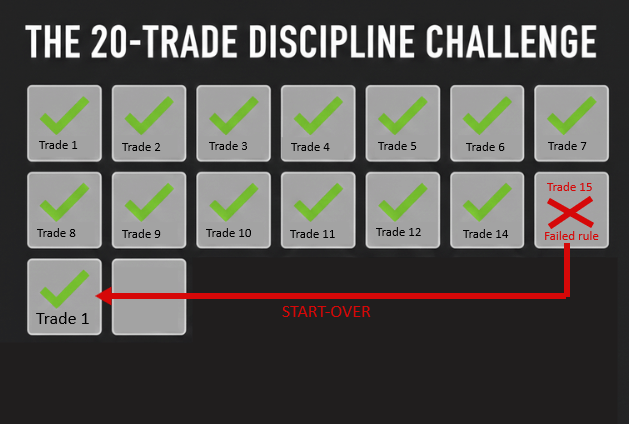
If you want to know if psychology is holding you back, take the 20-Trade Challenge. This is a simple but brutal test: look at your journal and see if you can find 20 trades in a row where you followed your plan exactly. The outcome—whether the trade was a winner or a loser—is completely irrelevant.
The Challenge Guidelines:
No Deviation: You cannot move your stop loss or take profit once the trade is live.
No FOMO: You only enter when your exact setup appears.
No Revenge: If you lose, you wait for the next valid signal.
Process Over Profit: A “win” is a trade where you followed the rules. A “loss” is any trade where you broke a rule, even if it made money.
Most traders cannot make it past trade number four. This challenge acts as a mirror, revealing your “personal spiral”—the specific way you self-sabotage when things get tough. Once you identify that pattern, it becomes the “lowest-hanging fruit” for improvement.
| Metric | Amateur Trader | Disciplined Trader |
| Primary Goal | Making money today | Following the process |
| Response to Loss | Anger/Revenge trading | Acceptance/Reviewing the plan |
| Trade Frequency | High (Boredom trading) | Low (Quality over quantity) |
| Documentation | Random or non-existent | Detailed journal of every trade |
The 8-Step Sequence: How to Stop a Trading Spiral

Understanding the sequence of a mistake is the “holy grail” of mastering your trading psychology. Most traders only notice they’ve made a mistake after the money is gone. To become a professional, you must learn to identify the “Trigger” at the very beginning of the chain.
The sequence typically looks like this:
The Trigger: A loss, a win, or the market missing your entry.
The Thought: An internal monologue (“The market is rigged”).
The Emotion: A deep-seated feeling (anger, fear).
The Behavior: Fiddling with timeframes or “zooming in.”
The Action: Changing your orders or narrowing your focus.
The Decision-Making Change: You justify a trade that doesn’t fit your plan.
The Market Perception Shift: You “see” a move that isn’t there because you need it to be.
The Mistake: You enter the trade and take a massive loss.
The faster you can stop this sequence, the better. If you catch yourself at the “Thought” or “Emotion” stage, you can perform a Logic Injection. Ask yourself: “Do the best traders in the world take losses?” If the answer is yes, then your current loss is just a business expense, not a personal failure.
How to Treat Your Trading Like a Real Business
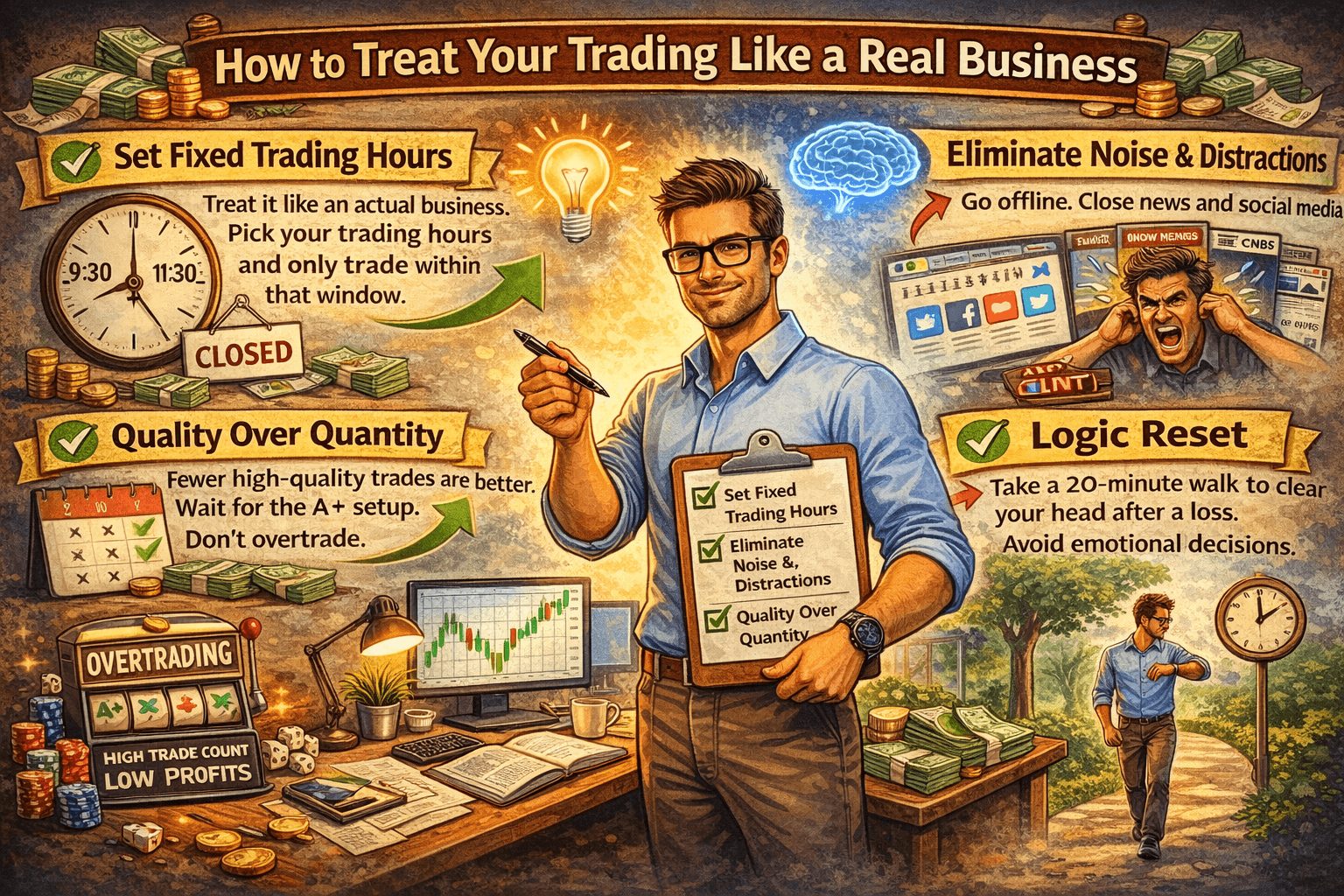
To succeed, you must move beyond the “hobbyist” mindset. A hobby costs you money; a business earns you money. To bridge that gap, you need a rigorous operational framework that protects your capital from your own impulses.
Establishing Fixed Operational Hours
Professional businesses don’t open “whenever they feel like it.” If you trade whenever you have a free five minutes on your phone, you are gambling. You must pick a specific window—for example, the first two hours of the New York open—and dedicate that time exclusively to the market. When that window closes, your “shop” is shut. This prevents the mental fatigue that leads to sloppy decision-making later in the day.
Eliminating Information Overload and Noise
Most traders are overstimulated. They have CNBC running, three different Twitter feeds open, and “expert” YouTubers yelling in another tab. This creates a “chorus of opinions” that drowns out your own plan. A professional business relies on internal data and a repeatable process, not external chatter. Close your browser tabs, put your phone in another room, and focus solely on the price action in front of you. Simplicity is the ultimate sophistication in trading.
The Inverse Relationship of Trade Count and Profit
One of the most difficult lessons for new traders is that “working harder” (taking more trades) usually results in “earning less.” In a traditional job, more hours equals more pay. In trading, the more you trade, the more you expose yourself to the “noise” of the market and the higher the probability of emotional exhaustion. Professionals understand that their job is to wait for the “A+” setup. If that setup doesn’t appear for three days, a professional does nothing. A gambler, driven by boredom, creates a trade where none exists.
Implementing The 20-Minute “Logic Reset”
When you feel your heartbeat accelerating or your jaw clenching after a loss, your “business” is in crisis. Physically walking away is your emergency protocol. A 20-minute walk isn’t just about “calming down”; it is a biological necessity to clear cortisol from your bloodstream and allow blood to return to the frontal lobe. If you cannot walk away for 20 minutes, you are not a business owner—you are an addict. Professionalism is the ability to recognize when you are no longer making logical decisions and having the strength to pull the plug.
Dealing with "Tilt": Injustice, FOMO, and Fear
“Tilt” comes in many forms. Injustice Tilt is when you get stopped out by a single tick, and then the market goes to your target. To fight this, create a “Good Breaks vs. Bad Breaks” table in your journal.
| Date | Bad Break (Screwed) | Good Break (Lucky) |
| Oct 1 | Stopped out by 1 tick | Target hit by 1 tick |
Over time, you will see that the distribution is even. You aren’t being targeted; you’re just experiencing the “noise” of the market. For FOMO, remind yourself that the market is a constant stream of opportunities.
Conclusion: Your Path to Consistency
Ultimately, the difference between a trader who survives for decades and one who burns out in months is not the quality of their charts, but the quality of their character. Mastering your trading psychology is an ongoing investment that pays dividends far beyond your bank account balance. When you fix your responses in trading—when you learn to accept a loss without anger or wait for a setup without anxiety—you are actually fixing your responses in life. You will find yourself becoming more patient with your family, more disciplined in your health, and more focused in your daily routines. This is why I find this topic so fascinating; how you do one thing is truly how you do everything.
As you move forward, remember that one single trade does not have the power to define your career unless you allow it to trigger a destructive emotional spiral. You have spent countless hours refining your strategy and documenting your plan; do not let a momentary impulse undo months of hard work. If you find yourself slipping, return to the 20-Trade Challenge. Let it be the mirror that keeps you honest and the anchor that keeps you grounded. If you are serious about moving past the “evaluation trap” and into long-term, funded profitability, commit to making your mental game your primary focus. The market will always be there with a fresh stream of opportunities—ensure you are mentally prepared to capitalize on them.
FAQ: Mastering Your Trading Psychology
Q: Can I really fix my psychology by just walking?
A: Yes. Physical movement resets your biology, moving you from a “fight or flight” state back to a logical one.
Q: How do I stop "Boredom Trading"?
A: Treat trading like a job. If there are no setups, your “job” is to wait.
Q: Why does my childhood "lens" affect my trading?
A: Our brains form their response to loss very early. Recognizing this allows you to “inject logic” and separate your self-worth from your P&L.
Next Steps:
Ready to stop the cycle of blown accounts? Master your mindset and secure your funding by booking your strategy call today. [Explore our courses at Trader Dale today.]

YOUR $25,000 PROMO CODE FOR A LUCKY STREAK https://jbiv.com/kgPNf
A $25,000 PROMO CODE TO RULE THE ROOST https://telegra.ph/Win-the-1000000-jackpot-today-Message-ID-455336-08-30