

Do you trade with the Daily, Weekly, or Monthly VWAP? Then there is one important thing you should know. When a new VWAP starts, it has not collected enough data yet. That makes its levels unstable and less reliable for trading. So how long should you wait before you can actually trust those levels?
In this article, I will show you how I approach this with the Daily, Weekly, Monthly, and even the Yearly VWAP. You will learn why a fresh VWAP behaves in such a wild way. You will also see the rough waiting times I use for each one, with simple tables and chart examples.
Black Friday pricing on the VWAP pack and the other 3 indicator packs. Ends Nov 30.
I have traded futures with VWAP, Volume Profile, and Order Flow for years. Over that time, I learned to give every new VWAP some room to breathe before I trust it.
Here is the short version. For the Daily VWAP, I wait about 5 hours. The Weekly VWAP needs about two days. With the Monthly VWAP, I give it about 10 days. And the Yearly VWAP gets the first two months of the year.
These are not magic numbers. They are a practical routine that keeps you away from the most chaotic part of each VWAP period. Let me break it all down for you, step by step.
Table of Contents
This Article in 5 Points
- A new VWAP starts from zero every day, week, month, or year, so it has no history at first.
- In the beginning, the VWAP line and its deviations are wild and unstable.
- My rough waiting times are 5 hours for the Daily, two days for the Weekly, 10 days for the Monthly, and two months for the Yearly VWAP.
- After the waiting period, the VWAP is wider, more stable, and more dependable.
- These numbers are not set in stone, but you should always give the VWAP some time to calculate.
Why Should You Let the Daily, Weekly, and Monthly VWAP Develop First?
I think it is pretty important to let the VWAP develop before you start trading with it. The reason is simple. The VWAP starts calculating anew every time a new period begins.
What Does Starting Anew Mean?
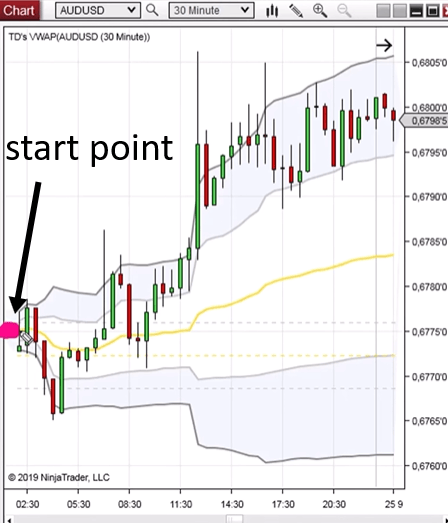
Take the Daily VWAP as an example. Every new day, a new Daily VWAP starts getting calculated. It does not carry any historical data from the day before. It starts from the first bar of the day and begins collecting three things:
- Volume, which shows how much was traded
- Price, which shows where it was traded
- Time, which shows when it was traded
The same happens with the other VWAPs. A Weekly VWAP resets every new week. Each Monthly VWAP resets every new month. And a Yearly VWAP resets every January.
A Simple Analogy
Think about a new restaurant on your street. On the first day, it has only a few reviews. One angry review can drop its rating a lot. One happy review can lift it a lot. After a few months, it has hundreds of reviews. Now a single review barely moves the rating. That rating is something you can trust.
The VWAP works the same way. In the first period, every new bar has a big influence on the line. Later, there is so much data that one bar cannot push it around easily.
Stage | How much data | How the VWAP behaves |
Right after the reset | Very little | Wild, jumpy, unreliable |
During the waiting period | Growing | Settling down |
After the waiting period | Plenty | Wider, stable, dependable |
So the waiting period is not about being lazy. It is about giving the indicator time to become useful. Patience here protects you from trading lines that are still moving under your feet.
What Makes Early VWAP Levels So Unreliable?
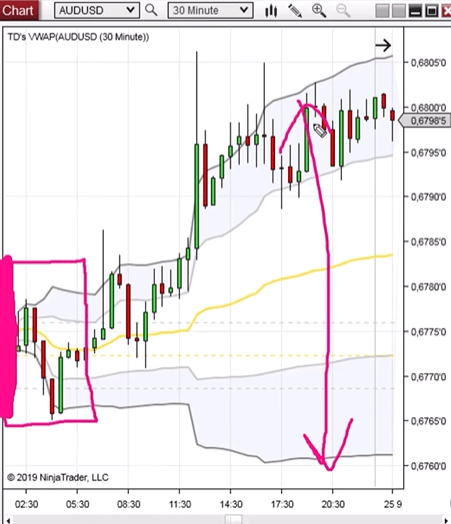
In the initial period, the VWAP does not have enough data, so it is sort of wild. It is still collecting data. Later, it has more data, and things change a lot.
The VWAP Line Jumps Around
At the start, the VWAP line follows price very closely. Every push up or down drags the line with it. That means the line is not really a level yet. It is more like a shadow of the current price. If you try to use it for a VWAP trading strategy, you are trading a level that may move away from you a few minutes later.
Imagine trying to measure the average height of people in a room when only two people have walked in. Your average will change a lot with every new person. That is exactly what a young VWAP is doing.
The Deviations Are Too Narrow
The VWAP also has deviations. Those are the bands above and below the main line. Early in the period, the bands sit very close to price. As data comes in, the indicator becomes wider. That widening is a good sign. It tells you the VWAP now reflects a real range of trading, not just a few bars.
Why This Matters for Your Trades
When the lines are unstable, a few problems show up:
- Your entry level can shift after you place the order.
- A stop loss might sit at a spot that has no real meaning.
- The take profit target can drift closer or further away.
None of that helps you. A stable VWAP gives you lines you can depend on, both on the VWAP itself and on the deviations. That is the whole point of waiting.
|
Feature |
Early in the period |
After the waiting period |
|
VWAP line |
Follows price closely |
Holds as a real level |
|
Deviations |
Narrow and jumpy |
Wider and stable |
|
Trading value |
Low |
High |
How Long Should You Wait With the Daily VWAP?
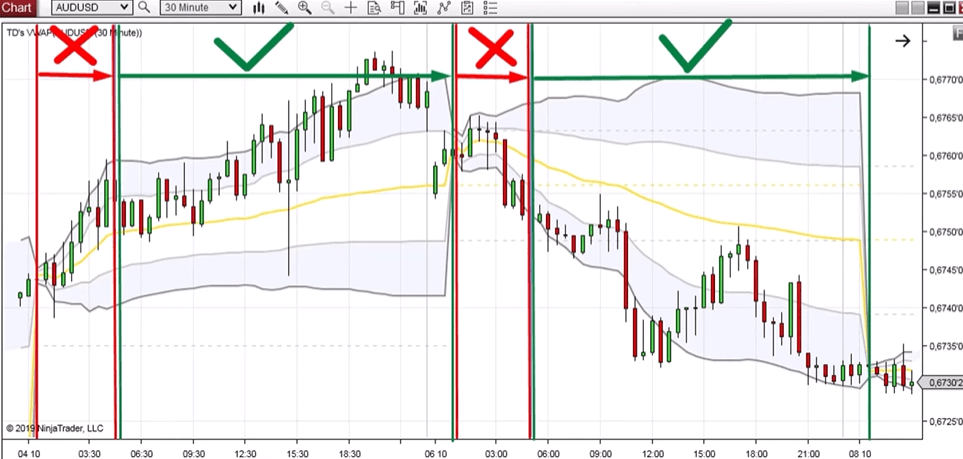
When I trade with the Daily VWAP, I recommend waiting around 5 hours before you start applying the strategies. This is the period when the VWAP is collecting data and when it is volatile. You do not really want to trade with VWAP during that time.
How the Daily Waiting Period Looks on a Chart
Picture the market open on your chart. Count five hours forward from that point. Everything inside those first five hours is a no trading zone for VWAP strategies. After that, the rest of the day is okay to trade with the Daily VWAP.
Then the next day begins. A fresh Daily VWAP starts calculating, and the cycle repeats. The first five hours are a no go again. Then, for the rest of the day, it is fine to use the VWAP.
A Daily Routine You Can Follow
- Market open: a new Daily VWAP starts from zero.
- First 5 hours: let it collect volume, price, and time data.
- After 5 hours: start looking for VWAP trades.
- Next day: repeat the same process.
Why Five Hours?
In my experience, five hours gives the Daily VWAP enough time to collect a solid amount of data. By then, the line has settled, and the deviations have spread out. It is a rough number, not a magic one. I will explain that later in the article.
Think of it like letting a cake bake before you open the oven. Open it too early, and you get something half done. Wait the right amount of time, and you get something solid that holds its shape.
Time of day | Use the Daily VWAP? |
Market open to 5 hours later | No, let it develop |
After the first 5 hours | Yes, okay to trade |
Next market open | No, a new VWAP starts |
What Is the Right Waiting Time for the Weekly VWAP?
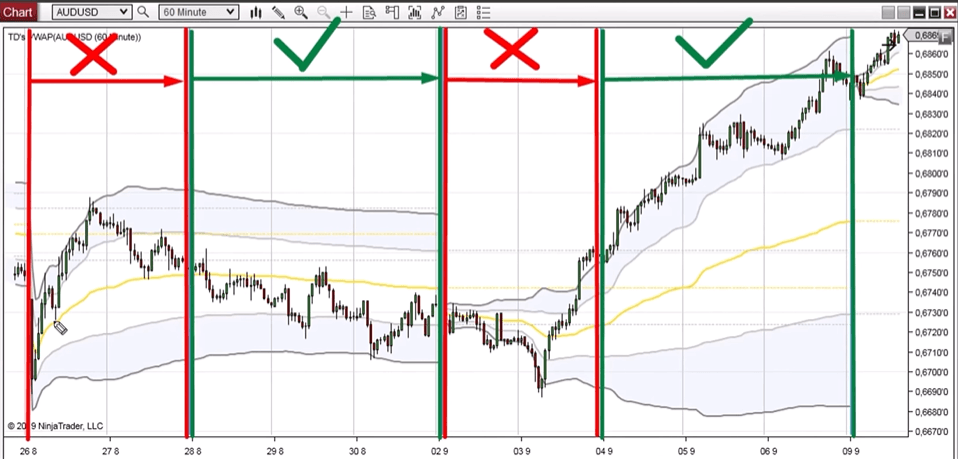
With a Weekly VWAP, it is best to wait around two days. Every week, a new VWAP gets calculated, so every week has its own waiting period.
Which Days Are Off Limits?
Here is how a typical week looks:
- Monday: no trading with the Weekly VWAP.
- Tuesday: still no trading with the Weekly VWAP.
- Wednesday: it is okay to use it.
- Thursday: it is okay to use it.
- Friday: it is okay to use it.
Then the next week starts, and the same pattern repeats. Monday and Tuesday are for watching. The rest of the week is for trading with the Weekly VWAP.
Watch Out for One Common Mix Up
Be careful here. When I say no VWAP on Monday and Tuesday, I mean not with the Weekly VWAP. Each VWAP has its own clock. The Daily VWAP follows its own five hour rule, no matter what day of the week it is.
For example, take a Tuesday. Once the first five hours have passed, the Daily VWAP is ready to use. You just would not trade the Weekly VWAP levels yet. Keeping these clocks separate stops you from skipping good trades for the wrong reason.
Why Two Days Make Sense
Two days give the Weekly VWAP about 40% of the trading week to collect data. By Wednesday, it has a solid base. The line is calmer, and the deviations have room to show real levels.
One day of data is still a thin base for a whole week. Adding a second day gives the Weekly VWAP a broader picture of where trading is happening.
Day | Weekly VWAP status |
Monday | Collecting data, do not trade it |
Tuesday | Collecting data, do not trade it |
Wednesday | Okay to trade |
Thursday | Okay to trade |
Friday | Okay to trade |
When Can You Start Trading the Monthly and Yearly VWAP?
The longer the VWAP period, the longer the waiting time. That makes sense. A bigger period needs more data before it becomes reliable.
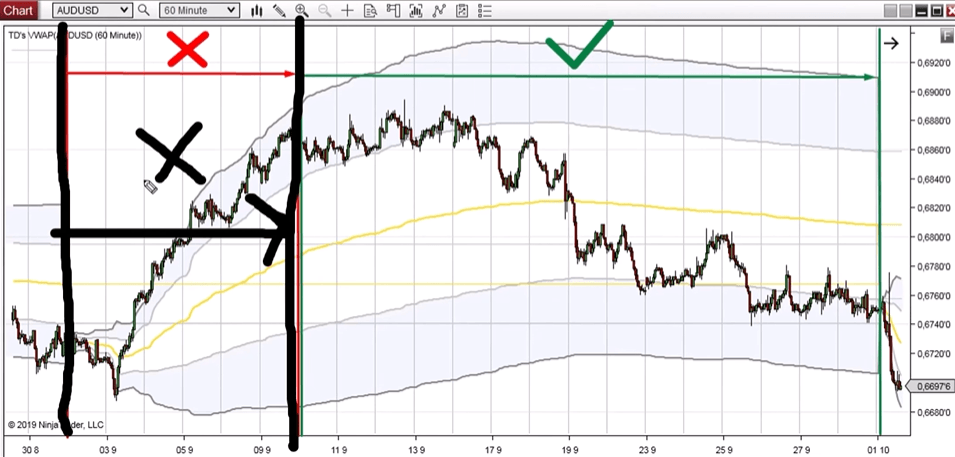
The Monthly VWAP: Wait 10 Days
For the Monthly VWAP, I recommend waiting for the first 10 days of the month. During this period, do not trade with it. You need to wait until it collects enough data. Then, for the rest of the month, it is okay to use.
So if the month starts on the 1st, leave the Monthly VWAP alone until around the 11th. After that, its levels are much more dependable. Ten days is roughly a third of the month. That is a fair amount of data for a level that has to serve you for several weeks.
The Yearly VWAP: Wait Two Months
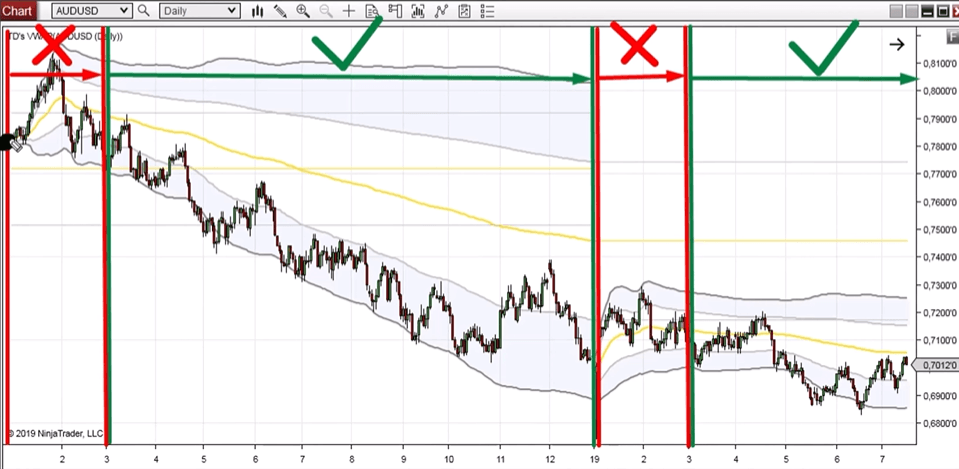
The Yearly VWAP starts calculating in January. January and February are the months when it is best not to trade with the Yearly VWAP. Let it collect enough data first.
Then, as it starts to develop, you can use it and trade with it until the end of the year. When the next January comes, the cycle starts again. January and February are off, and the rest of the year is okay.
Two months may sound like a long wait. But compare it with the rest of the year. You still get around ten months to trade with a stable Yearly VWAP.
Putting the Long Term VWAPs Side by Side
VWAP | Resets | Wait before trading | Okay to trade |
Monthly | 1st of each month | First 10 days | Rest of the month |
Yearly | Every January | January and February | March to December |
Notice the pattern. The waiting time is a small slice at the start of each period. You still get most of the period to trade.
Are These Daily, Weekly, and Monthly VWAP Rules Set in Stone?
No, they are not. Those are just rough numbers that I use. They are not set in stone.
When You Can Bend the Rules
Sometimes a nice trading opportunity shows up that goes against one of these rules. Imagine a clean setup appears four hours into the day instead of five. In that case, you can take it. Trading is not about following a stopwatch.
The One Rule I Never Skip
There is one thing I always do. I allow some time for the VWAP to calculate before trading with it. Trading a VWAP level right after the reset is something I avoid. The exact number of hours or days can flex. The principle does not.
How to Combine the Waiting Times
If you use more than one VWAP, check each one on its own. Late in the day on a Wednesday, the Daily VWAP and the Weekly VWAP may both be ready. Later on a Monday, only the Daily VWAP is ready. Early in the month, the Monthly VWAP is still building. Treat each VWAP separately, and you will always know which lines you can trust right now.
My Full Waiting Time Cheat Sheet
This table sums up how I handle the Daily, Weekly, Monthly, and Yearly VWAP in one place.
VWAP type | Rough waiting time | When it resets |
Daily VWAP | About 5 hours | Every new day |
Weekly VWAP | About 2 days | Every new week |
Monthly VWAP | About 10 days | Every new month |
Yearly VWAP | About 2 months | Every January |
Keep this next to your charts. When you open a chart, ask yourself one quick question: has this VWAP had enough time to develop? If the answer is no, wait. If the answer is yes, go ahead and look for your setups.
FAQ
Why can't I trade the VWAP right after it resets?
Because it has almost no data. The line and the deviations jump around, so the levels are not reliable yet.
How long should I wait with the Daily, Weekly, and Monthly VWAP?
I wait about 5 hours for the Daily, about two days for the Weekly, and about 10 days for the Monthly VWAP. For the Yearly VWAP, I wait two months.
Can I take a trade during the waiting period?
Yes, if a nice opportunity shows up. These numbers are rough guidelines. Just always give the VWAP some time to calculate first.
Final Thoughts
Every VWAP starts from zero. The Daily, Weekly, and Monthly VWAP all reset at the start of their own period. The Yearly VWAP resets every January. In the beginning, it has no history, so its lines are wild and unreliable.
That is why I give each VWAP time to develop. While it collects volume, price, and time data, the line settles down. The deviations also become wider and more stable. Only then can you depend on those lines for your trades.
Here are my rough waiting times one more time:
- Daily VWAP: about 5 hours after the market open
- Weekly VWAP: about two days, so Monday and Tuesday
- Monthly VWAP: about the first 10 days of the month
- Yearly VWAP: January and February
Remember, these numbers are not set in stone. If a nice trading opportunity shows up a bit early, you can take it. Just never trade a VWAP that has had no time to calculate at all.
My advice is to add these waiting periods to your trading plan. Mark them on your charts so you can see them at a glance. Over time, it becomes a habit. You will stop reacting to every early wiggle of the line, and you will focus on levels that actually mean something.
A little patience at the start of each Daily, Weekly, or Monthly VWAP goes a long way. It keeps you trading with stable levels, not guesses.
Ready to Learn the Full Strategy? If you want to learn how I trade with VWAP, Volume Profile, and Order Flow, visit Trader-Dale.com. Click the “Trading Course and Tools” button to see everything I teach. |
Black Friday pricing on the VWAP pack and the other 3 indicator packs. Ends Nov 30.