
Trading success is rarely about finding a “magic” strategy; it is about how you manage your money. In this guide, I draw on my years of market experience to show you exactly how to master trading risk management so you can protect your capital and grow your wealth sustainably. Most traders enter the market with the dream of high returns, but they fail to realize that the market is a game of survival first. To how to master trading risk management, you must learn to treat your trading like a business where capital is your only inventory. In the following sections, we will break down the specific percentages to risk based on your account size, the psychology of staying consistent, and the exact moments to scale your positions up or down to ensure long-term profitability. By the time you finish this article, you will have a professional blueprint for keeping your account safe while others are blowing theirs.
Table of Contents
5 Key Takeaways
Risk Management is King: Most accounts fail due to poor money management, not bad strategies.
Size Matters: Risk 0.5% for large accounts, 2% for mid-size, and up to 5% for aggressive small-account growth.
Be Consistent: Use the same risk amount for every trade to avoid emotional bias.
Don’t Chase Peaks: Never increase risk during a winning streak; wait for equity stability.
Scale Back, Don’t Stop: During deep drawdowns, cut risk by 50% instead of quitting to catch the recovery.
The Golden Rule: Why Money Management Trumps Strategy
The Strategy Trap
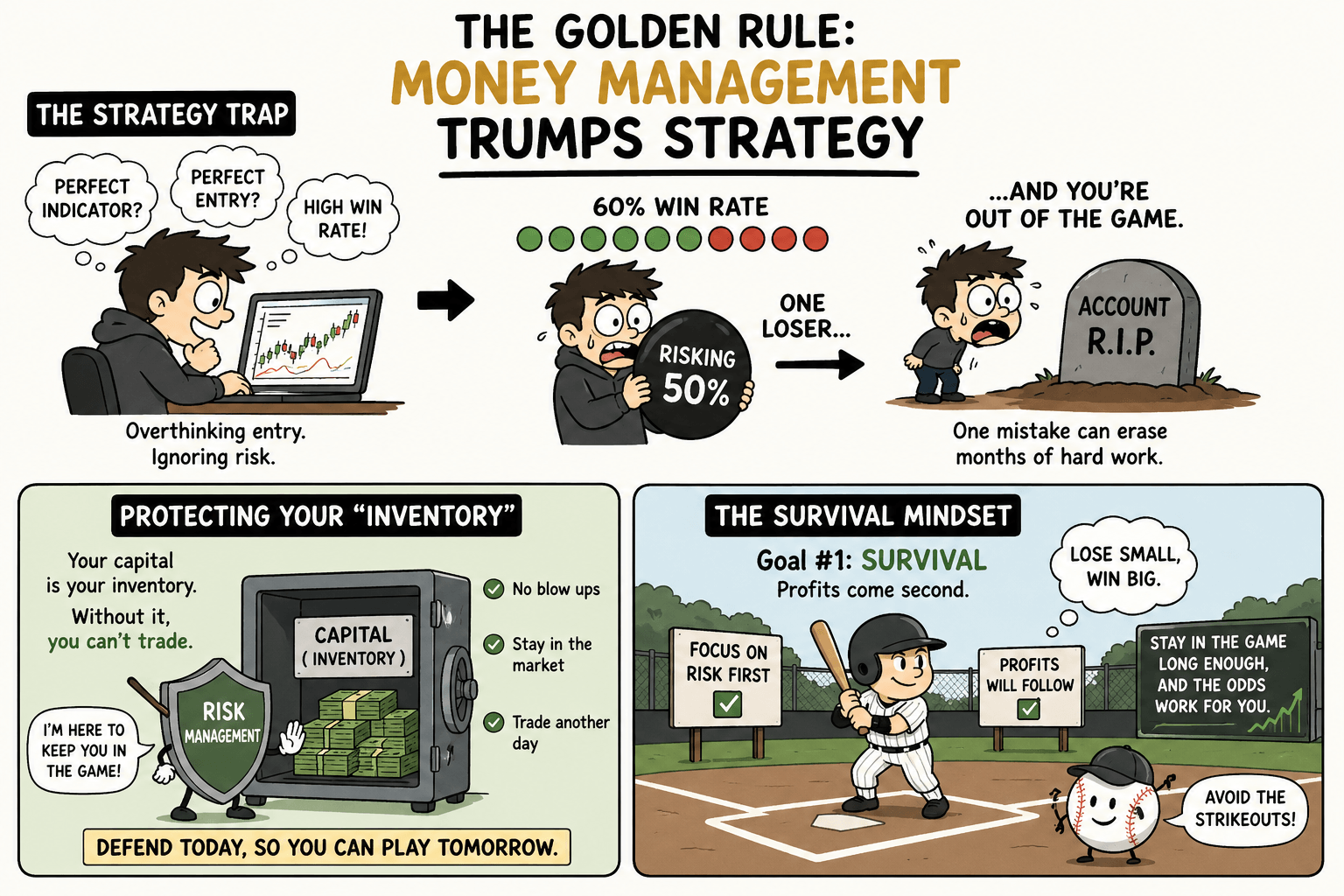
When you first enter the world of trading, it is easy to get distracted by flashy indicators and complex charts. You might spend hundreds of hours looking for the perfect entry point, thinking that a high win rate is the only thing that matters. However, the hard truth is that most traders don’t lose money because their strategy is “wrong.” They lose because they don’t know how to master trading risk management. If you have a strategy that wins 60% of the time, but you risk 50% of your account on a single “sure thing” that happens to be a loser, you are out of the game. It only takes one mistake to erase months of hard work if your risk is not controlled.
Protecting Your "Inventory"
Money management is the defensive play that keeps you in the stadium. Think of your trading capital like a professional athlete’s health. If they get a career-ending injury, it doesn’t matter how talented they are; the game is over. In trading, “blowing up” your account is that career-ending injury. By focusing on how to master trading risk management, you ensure that no single mistake can take you out of the market. This approach transforms trading from a high-stakes gamble into a structured, professional business. You need to view your capital as your inventory—without it, you cannot trade.
The Survival Mindset
The primary goal of any beginner should be survival. The longer you stay in the market, the more you learn. If you burn through your funds in the first month, you haven’t given yourself enough time to see the patterns or develop the “market feel” that comes with experience. Professionals focus on risk first and profits second. By the end of this article, you will understand that the secret to long-term wealth isn’t hitting home runs every day, but avoiding the strikeouts that clear your bench. Once you master the art of losing small, the winning will eventually take care of itself through the power of edge and probability.
Choosing Your Risk: 0.5%, 2%, or 5%?
Understanding Account Tiers
One of the most common questions I hear from my students is, “How much money should I actually put on the line for a single trade?” There is no one-size-fits-all answer because everyone has a different starting point. However, to how to master trading risk management, you must align your risk with your account size and your financial goals. You cannot treat a $500 account the same way you treat a $500,000 account. The math simply doesn’t allow for it if you want to see meaningful progress without risking total loss.
Scaling for Small Accounts
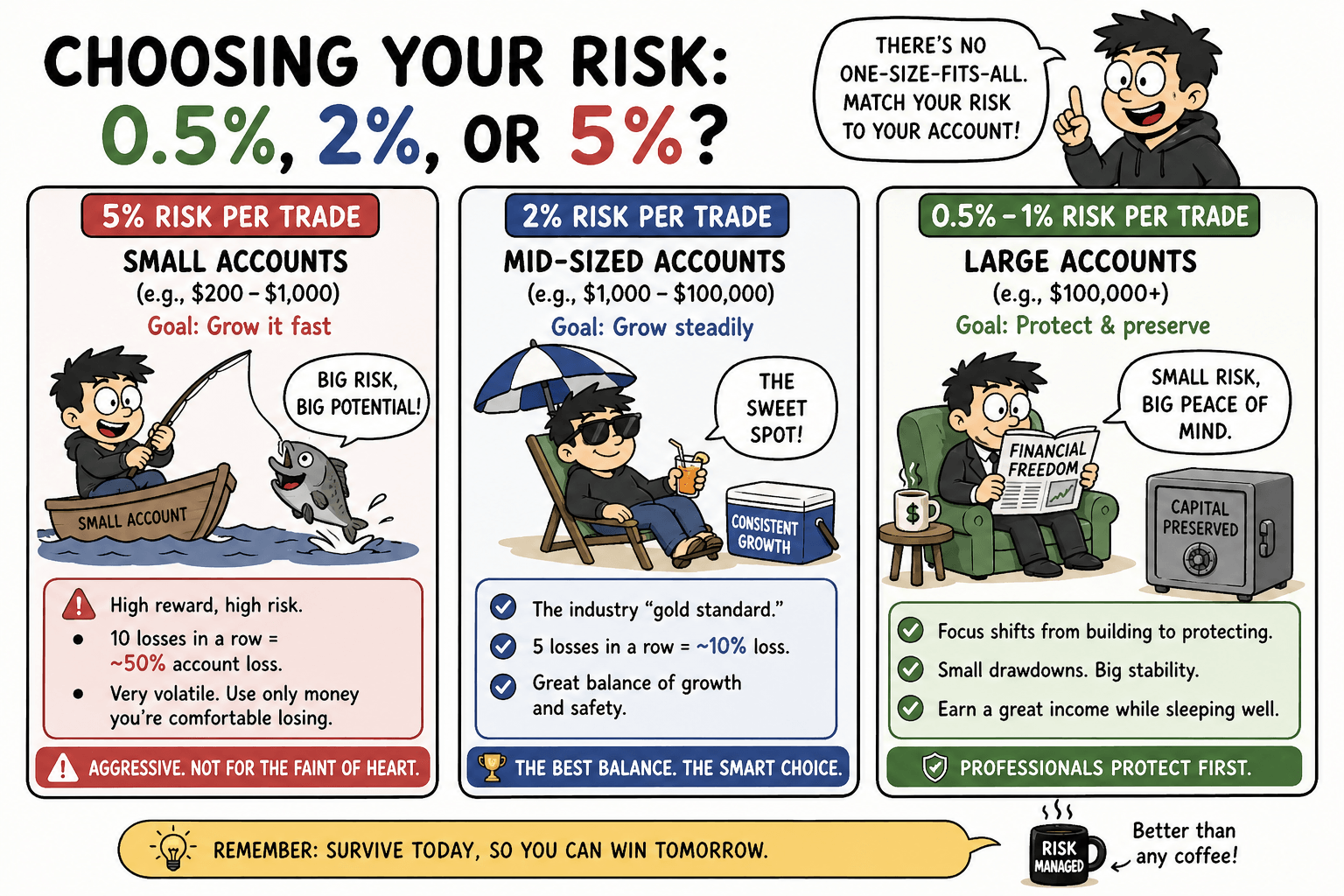
If you are starting with a very small account—perhaps a few hundred dollars—and your goal is to grow it rapidly, a 5% risk per trade is often the starting point. Let’s be honest: risking 0.5% on a $200 account means you are only making pennies per trade. It is incredibly hard to stay motivated when your gains can’t even buy a cup of coffee. However, you must realize that 5% is very aggressive. It means a string of just 10 losers will wipe out half your account. You must be prepared for that high level of volatility and only use money you are truly comfortable losing.
The Standard of Excellence
For the average trader with a mid-sized account, 2% is the “sweet spot.” It is widely considered the gold standard in the industry. It provides a healthy balance between growth and safety. If you lose five trades in a row at 2%, you are only down 10% of your total balance. This is a manageable drawdown that can be recovered with a few good winning trades. This is the baseline I recommend for most people who are serious about learning how to master trading risk management while building a long-term career.
Professional Capital Preservation
If you have a large account—say, $100,000 or more—and you are looking to live off the returns, you should scale back. At this level, your goal shifts from “building” to “protecting.” Risking 0.5% or 1% per trade allows you to earn a significant absolute income while keeping your “drawdowns” (the dips in your account balance) very small. This ensures that even a bad month won’t change your lifestyle.
| Account Type | Risk Level | Goal |
| Small / Micro | 5% | Rapid Growth |
| Standard / Intermediate | 2% | Balanced Growth |
| Large / Professional | 0.5% – 1% | Capital Preservation |
The Power of Consistency: Why Every Trade is Equal
Fighting the “Ranking” Habit
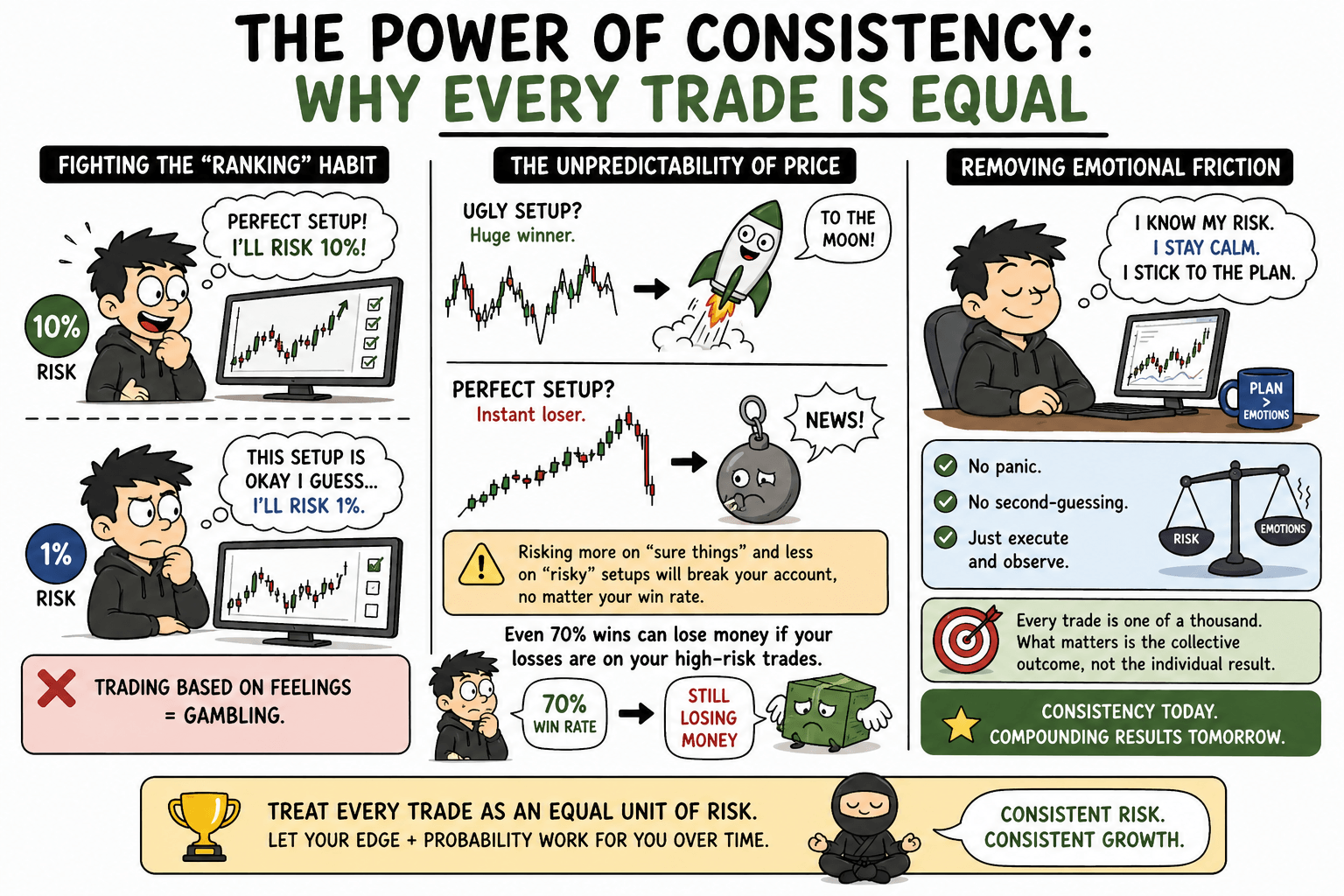
A massive mistake that even experienced traders make is “ranking” their trades based on how they feel. You might see a setup that looks “perfect” or fits every single one of your criteria and decide to risk 10% because you are “sure” it will win. Then, on a setup that looks “okay” or a bit messy, you risk only 1%. This is a recipe for disaster and a total failure in how to master trading risk management. When you trade based on feelings, you are no longer a trader; you are a gambler hoping for a lucky break.
The Unpredictability of Price
The reason consistency is so important is that the market is inherently unpredictable. No matter how good a setup looks, there is always a chance it will fail. Some of the setups that look the “ugliest” or most uncertain often turn into the biggest, cleanest winners. Conversely, the “perfect” setup can fail instantly due to a sudden news event or a large bank moving the market in the opposite direction. If you risk a lot on the losers and very little on the winners, your math will never work out. You could have a 70% win rate and still lose money if your losses are on your high-risk trades.
Removing Emotional Friction
Consistency removes the heavy emotional burden from your shoulders. When you know exactly how much you are going to lose if you are wrong, you don’t panic. You don’t sit there staring at the screen with your heart racing. You become an objective observer of your strategy rather than someone caught in the heat of a bet. This mindset shift is the true cornerstone of how to master trading risk management. Every trade is simply one of a thousand trades you will take over your career; its individual outcome doesn’t matter as much as the collective outcome of your next 100 trades. Treating them all as equal units of risk ensures that your edge plays out statistically over time.
When to Increase Your Risk (And When Not To)
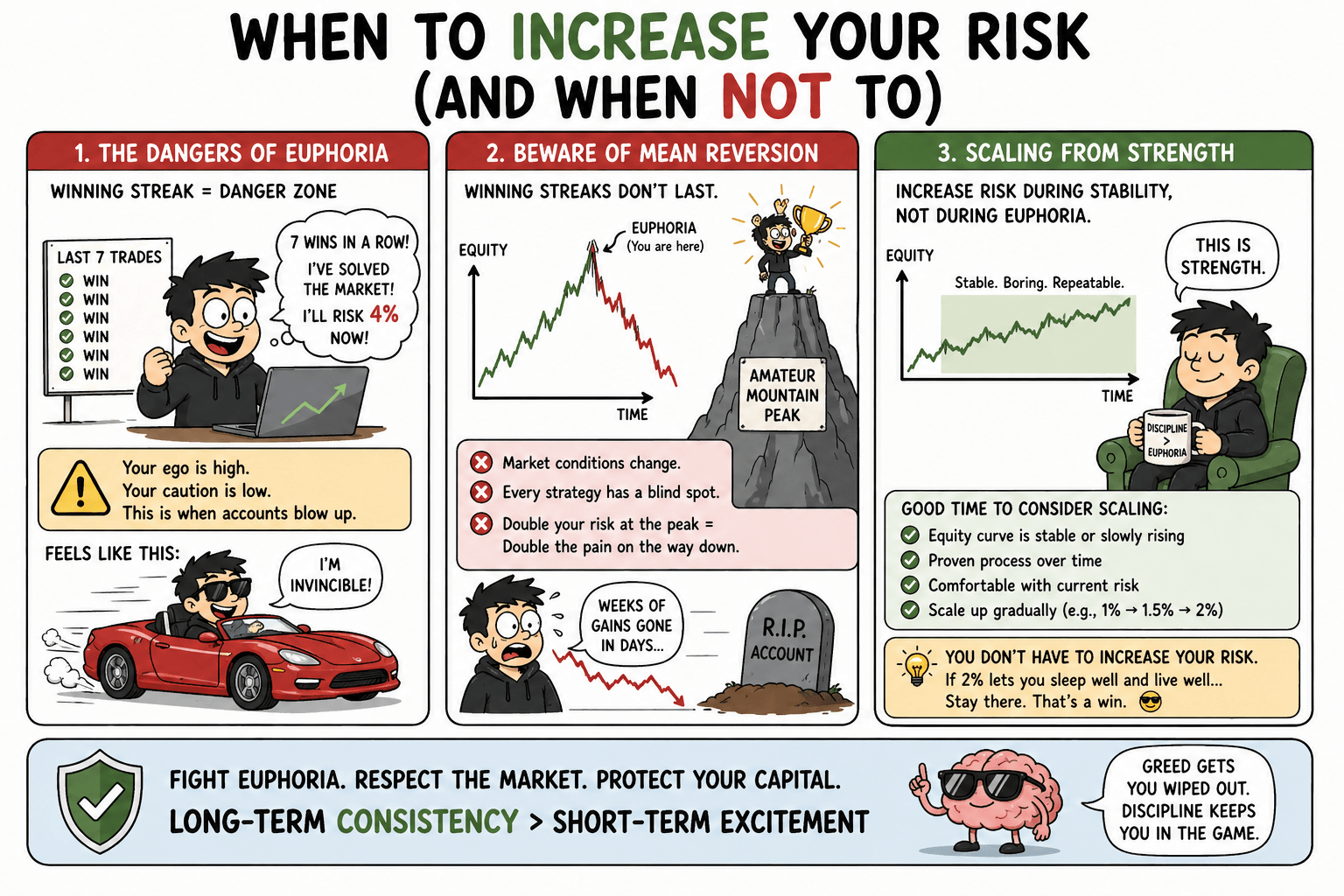
The Dangers of Euphoria
It is human nature to want more. When you have a “hot hand” and win five, six, or seven trades in a row, you feel like you have finally “solved” the market. You feel invincible. You think to yourself, “If I had just doubled my risk, I’d be rich by now!” This is the exact moment most traders blow up their accounts. To truly master trading risk management, you must fight the biological urge to increase your risk on stop losses during a winning streak. This is when your ego is at its highest and your caution is at its lowest.
Beware of Mean Reversion
Winning streaks are often followed by a period of “mean reversion.” This is a fancy way of saying that the market conditions that made your strategy work so well have changed. Every strategy has a blind spot, and eventually, the market will hit it. If you double your risk right at the peak of your success, you will enter that rough patch with a doubled loss rate. Your account balance will drop much faster than it climbed, often erasing weeks of gains in just a few days. This “mountain peak” equity curve is a sign of an amateur trader who hasn’t learned the hard lessons of the market.
Scaling from a Position of Strength
The best time to increase risk is when your equity curve is moving sideways or slightly upward in a stable, boring fashion. This stability proves that your success isn’t just a “lucky streak” but a result of a robust, repeatable process. If you are comfortable at 1% and want to move to 2%, wait for a period of stability, not a period of euphoria. Also, remember that you don’t have to increase your risk. If 2% is making you a good living and you can sleep soundly at night, staying there is a perfectly valid way to how to master trading risk management. Never let greed push you out of your comfort zone.
Managing Drawdowns: When to Decrease Your Risk
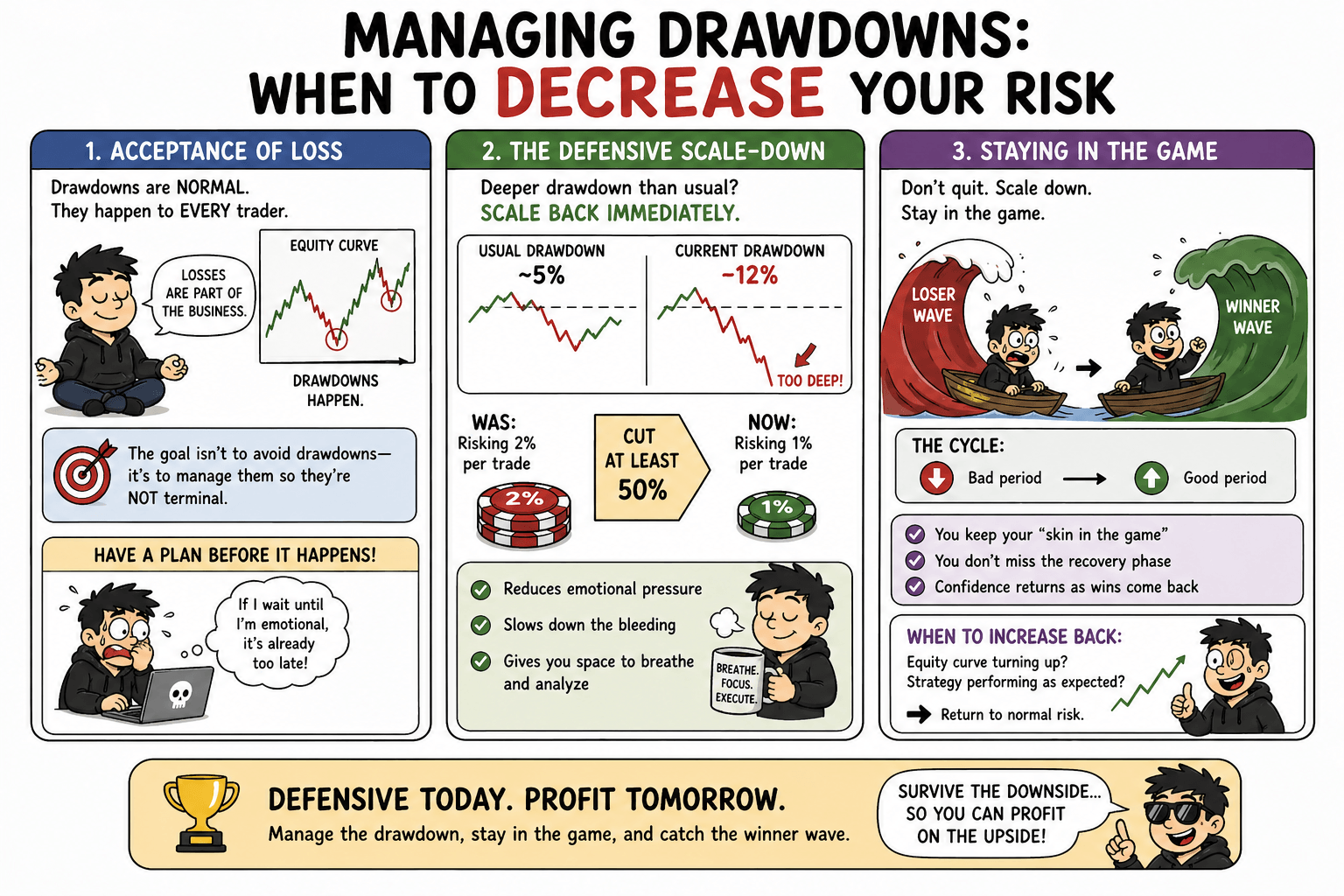
Acceptance of Loss
A drawdown is a period where your account balance drops from its previous peak. It is a natural part of the trading business. Every trader, including the legends of Wall Street, goes through them. The secret to how to master trading risk management isn’t avoiding drawdowns—because that is impossible—but managing them so they don’t become terminal for your account. You need to have a plan for when things go wrong before they actually go wrong. If you wait until you are emotional to make a plan, it is already too late.
The Defensive Scale-Down
If you find yourself in a drawdown that is deeper than what you usually experience—for example, if your strategy usually loses 5% but you are currently down 12%—it is time to scale back immediately. I recommend cutting your position size by at least 50%. If you were risking 2% per trade, drop it to 1%. This reduces the emotional pressure and slows down the “bleeding” of your capital. It gives you the space to breathe and analyze the market without the fear of losing everything. It turns a “crisis” back into a manageable situation.
Staying in the Game
The biggest mistake traders make during a drawdown is stopping completely. Many traders get scared, close their platforms, and miss the “recovery” phase where the strategy starts winning again. Markets move in cycles, and usually, right after a bad period, a good period follows. By staying in the game with a smaller size, you keep your “skin in the game” and your confidence grows as the wins return. Once you see your equity curve heading back up and your strategy performing as expected, you can return to your normal risk. This defensive maneuvering is the most advanced part of how to master trading risk management. It ensures you catch the “winner wave” that always follows a “loser wave.”
Conclusion: The Path to Long-Term Success
Mastering the markets is 10% finding a strategy and 90% having the discipline to manage your money. By following these rules, you are doing more than just “trading”—you are managing a professional business owner’s portfolio. You now know how to master trading risk management by choosing the right percentage for your account size, staying consistent regardless of your “feelings,” and adjusting your size based on your equity curve rather than your greed or fear.
Trading is a marathon, not a sprint. The goal is to be here next year, and the year after that. If you protect your downside, the upside will take care of itself. Keep it simple, stay disciplined, and watch your account grow over time.
FAQ: Common Questions on Risk
Can I change my risk based on the currency pair or asset?
It is much better to keep your risk consistent across all pairs. While some pairs are more volatile, your total “dollar amount” at risk should remain the same. This is the simplest way to how to master trading risk management without overcomplicating your math.
What should I do if I lose three trades in a row?
First, check if you followed your rules. If you did, then you should do nothing. Three losses in a row is a statistically normal part of any strategy. If you didn’t follow your rules, then you should step away from the computer for a day to reset your mindset.
Is 5% really too much for a $1,000 account?
It is aggressive, but for a small account, it is often necessary to see growth. However, you must accept that you are “fast-tracking” a potential blow-up. Only use this level of risk with money that you are 100% okay with losing.
Next Steps:
Ready to take your trading to the next level? [Click here to explore my Trading Course and Custom Tools] at Trader-Dale.com and start applying these risk management rules with my professional-grade indicators.
