
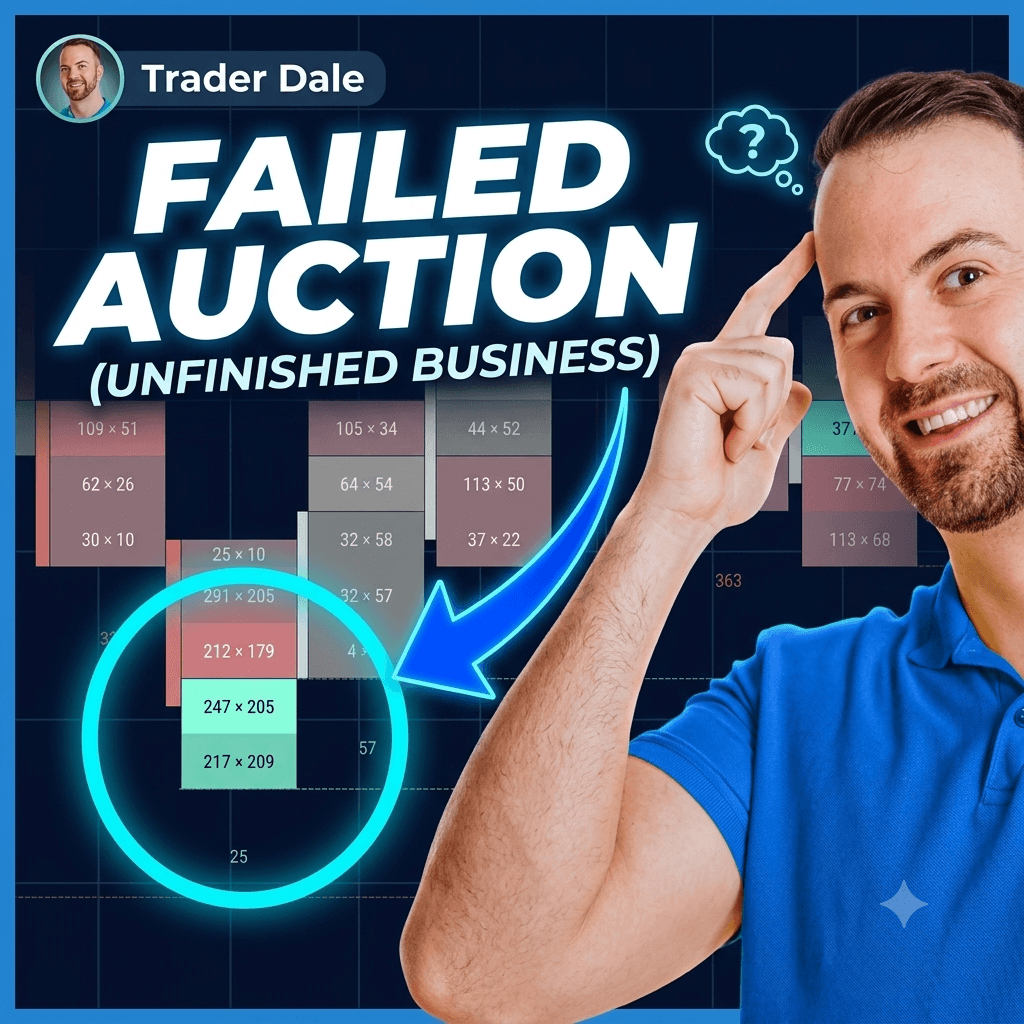
Order flow failed auction is one of the most useful signals a footprint chart can give you. It shows you exactly where the market left something unfinished. It can also tell you whether the current trend is likely to continue or turn around. This article will teach you, step by step, what an order flow failed auction looks like, how to spot one on your own charts, and how traders use it to plan and manage their trades.
Many traders watch price move up and down without knowing that the footprint itself is leaving clues behind. An order flow failed auction is one of those clues. It shows you a spot where buyers or sellers did not finish their job. The market often comes back later to finish it. Once you learn to spot this pattern, you start seeing the chart in a whole new way.
This guide keeps things simple on purpose. There are no confusing terms here. We will walk through clear examples, a simple table, and pictures pointing to exactly what to look for. Even a brand new trader can follow along. By the end, you will know what a failed auction is, how to find one, and how to avoid the most common mistakes traders make with this concept.
Let us begin with the basics.
Table of Contents
Quick Summary
- Order flow failed auction happens when the high or low of a footprint bar does not end in zero the way it should.
- It shows a spot where the market left something unfinished, also called unfinished business.
- Price often comes back later to test and close that gap, like a magnet.
- A cluster of several failed auctions close together is a stronger signal than a single one alone.
- Custom order flow software can mark these spots automatically, but you can also learn to spot them by eye.
What Is an Order Flow Failed Auction?
The Simple Idea Behind a Failed Auction
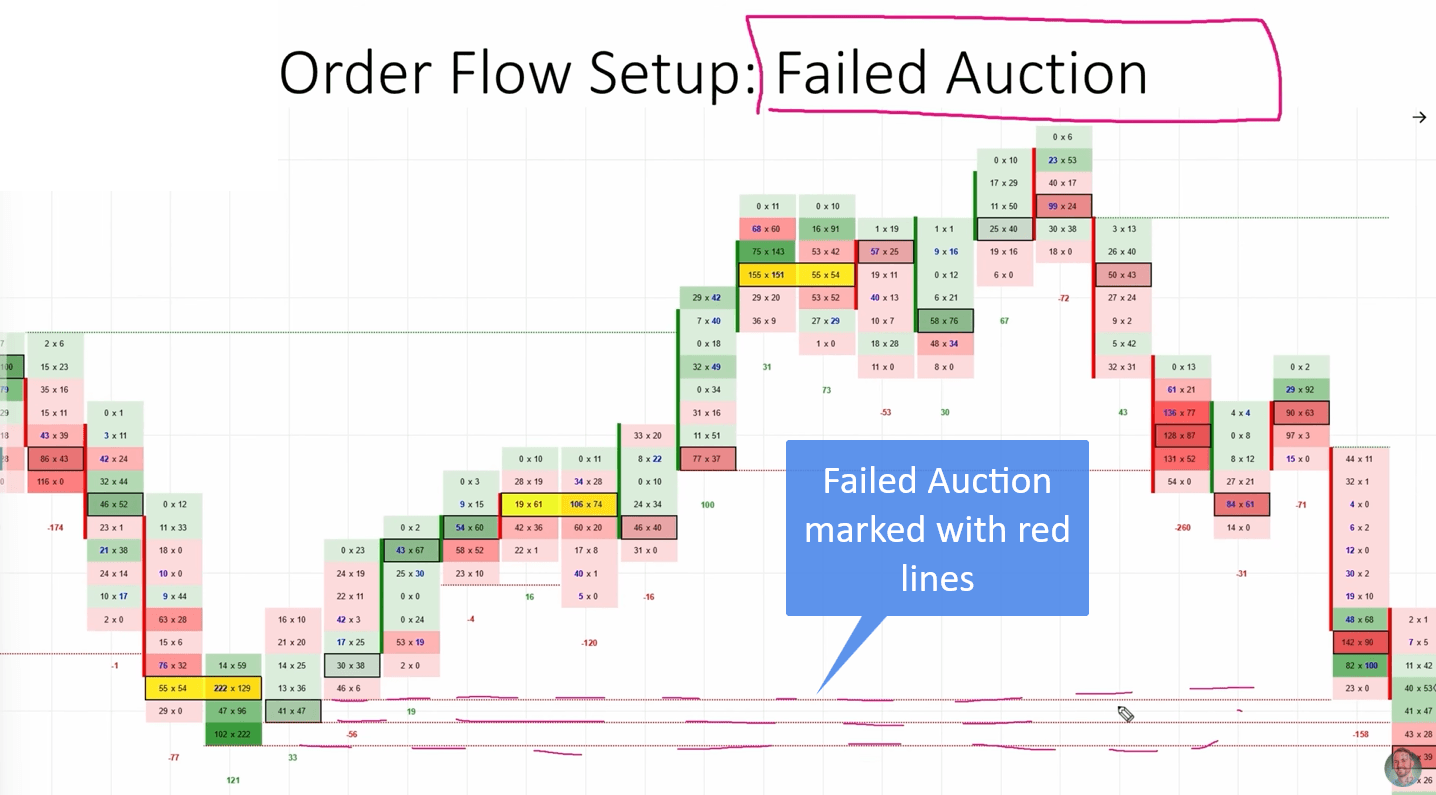
An order flow failed auction, also called unfinished business, happens when the high or low of a footprint bar does not form the way it should. Markets are always in an auction. Price moves up and down, up and down, without ever really stopping. Every high and every low that forms during this auction is supposed to look a certain way on the footprint. When it does not, the auction is considered failed.
Think of an auction like a room full of buyers and sellers agreeing on a fair price together. When the auction works properly, it ends cleanly. One side clearly finishes its business at that price. When an order flow failed auction happens, the deal was left incomplete. The market skipped a step it normally takes. That gap becomes visible on the footprint chart, and it stays there until price comes back to close it.
Why the Market Cares About Unfinished Business
This matters to traders because markets do not like leaving things unfinished. An order flow failed auction leaves a small imperfection behind on the chart. It is almost like an open loop. Because markets are built on fair pricing, price often wants to come back later and close that loop by testing the same spot again. This single idea is the foundation for everything else in this guide. It is worth reading through this section more than once until it feels natural.
Many order flow trading platforms, including custom software built for this purpose, will mark these spots automatically with a line. That way you do not have to search for them by eye. Even without that kind of tool, once you know the pattern, you can start spotting an order flow failed auction on a plain footprint chart with a bit of practice. Give yourself a few sessions of quiet chart review before you try to use it live.
How to Spot a Failed Auction on a Footprint Chart
Reading a Valid High or Low
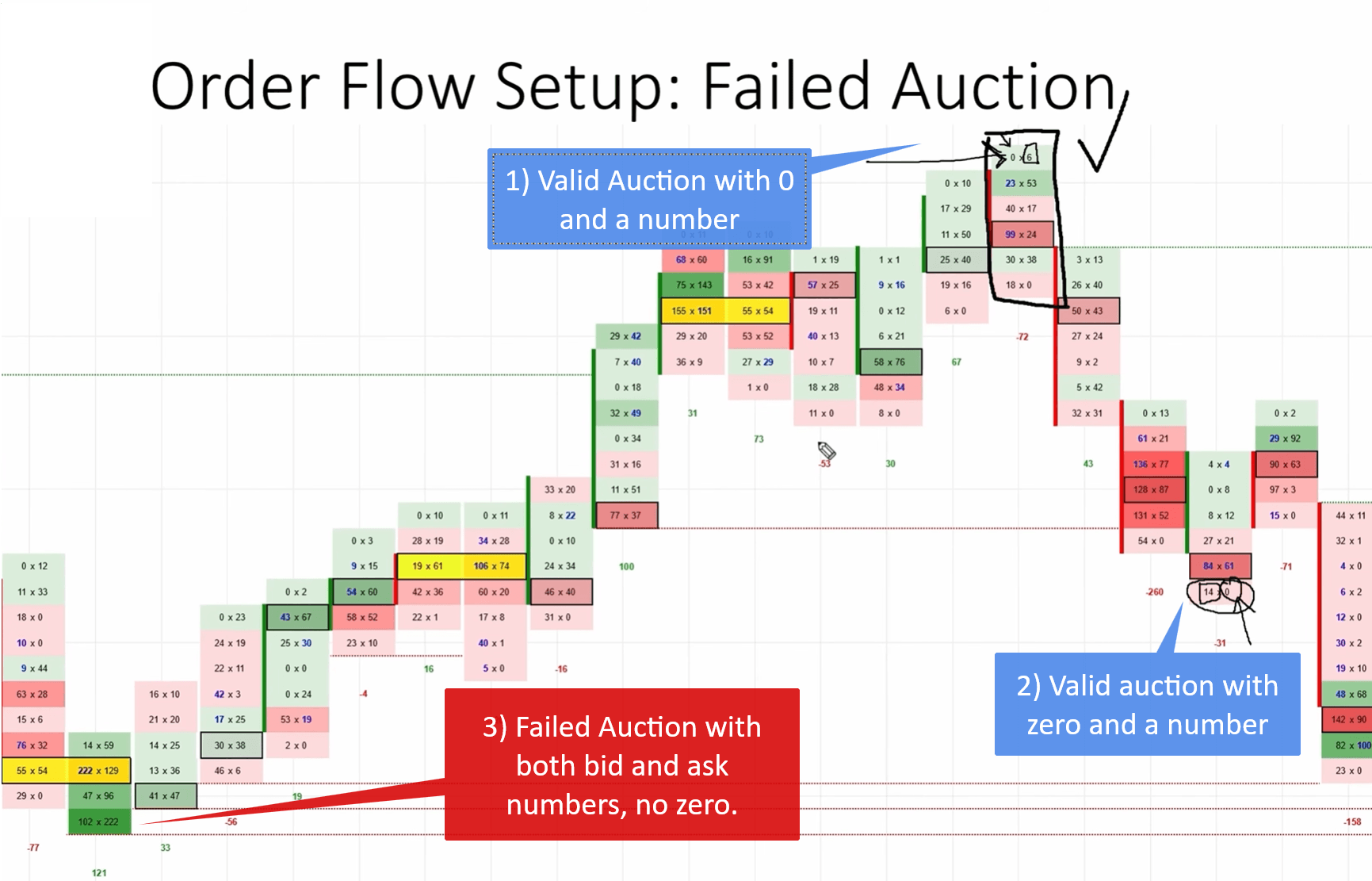
Every footprint bar has a high and a low. Each one is supposed to form in a specific way. At a valid high, the bid side should show a zero. Some number of contracts should trade on the ask side above it. At a valid low, it works the other way around. There should be some number of contracts trading on the bid side. That should be followed by a zero on the ask side below it.
That zero is the important part. It shows that the market fully finished trading at that extreme before turning around. Without that zero in place, something was left undone. This one small detail is the entire key to spotting a failed auction, so it is worth practicing until it becomes automatic.
Spotting the Zero That Is Missing
An order flow failed auction happens when that zero is missing where it should be. If the low of a footprint should show a zero but instead shows a real number, the market never actually finished trading down there. It should have continued a little lower. Instead it turned around and moved back up. The same idea applies at the high, in reverse. The auction failed to complete itself properly, which is exactly why it is called a failed auction.
Here is a simple table to make the difference easy to remember.
Chart Point | Valid Auction | Failed Auction |
High | Zero on the bid, a number on the ask | A number on the bid where the zero should be |
Low | A number on the bid, zero on the ask | A number on the ask where the zero should be |
Learning to check this one detail, whether the zero is present or missing, is really all it takes to start spotting an order flow failed auction on your own charts. It takes a bit of practice to train your eye. The rule itself never changes, no matter which market or timeframe you are trading. Once your eye is trained, you will often spot a failed auction within a second or two of glancing at the chart.
Why the Market Comes Back to Test Failed Auctions
The Magnet Effect
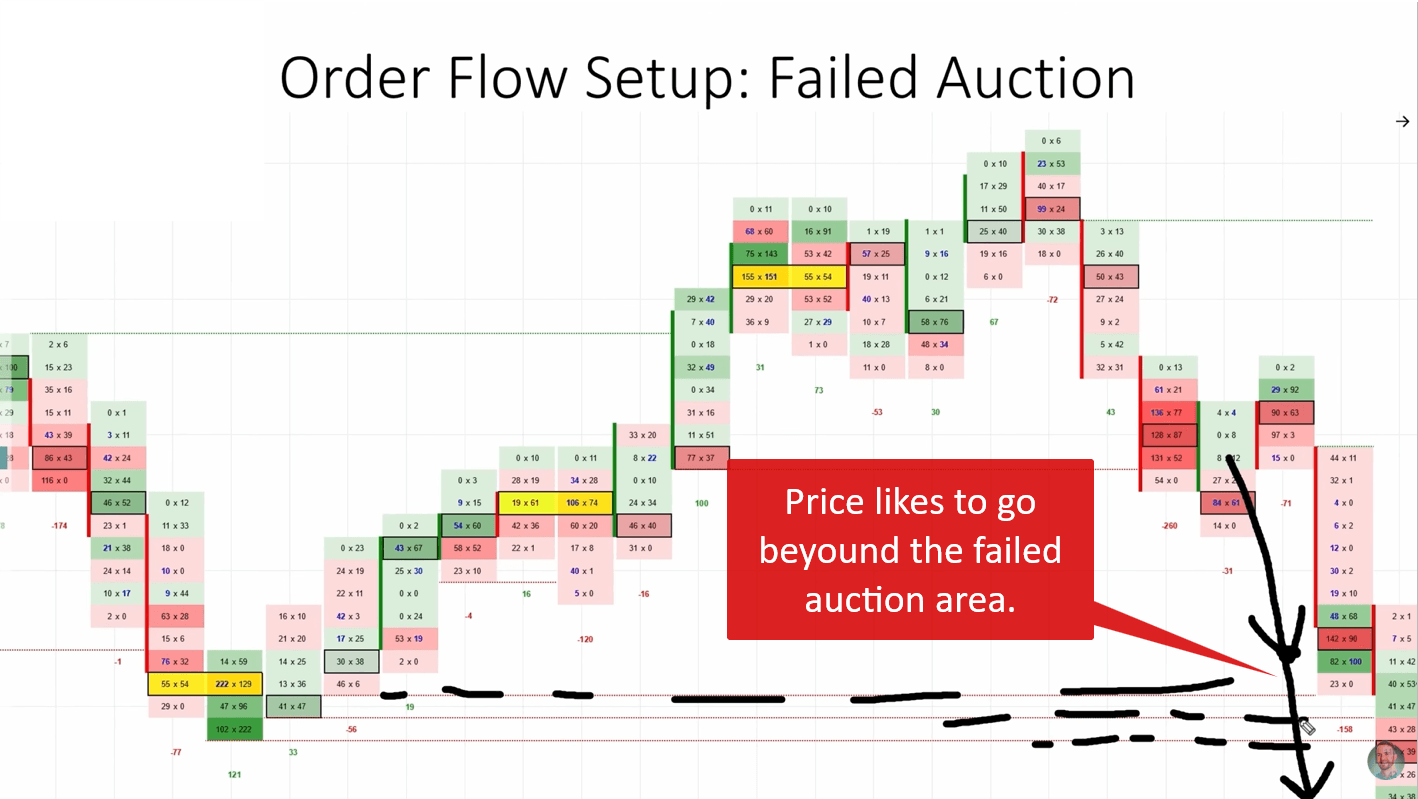
Once an order flow failed auction has formed, the market tends to remember it. Because the auction was left incomplete, price often wants to travel back to that same spot later on. It goes there to finish the job properly. Traders sometimes describe this as a magnet effect. Price is pulled back toward the failed auction even after the market has already moved away from it.
This does not mean that every failed auction gets tested right away. It also does not mean you should jump into a trade the moment you spot one. It simply means that when price later comes close to that same level again, there is a good chance it will continue toward it. It is more likely to test it directly than to stop just short of it.
What Testing a Failed Auction Actually Looks Like
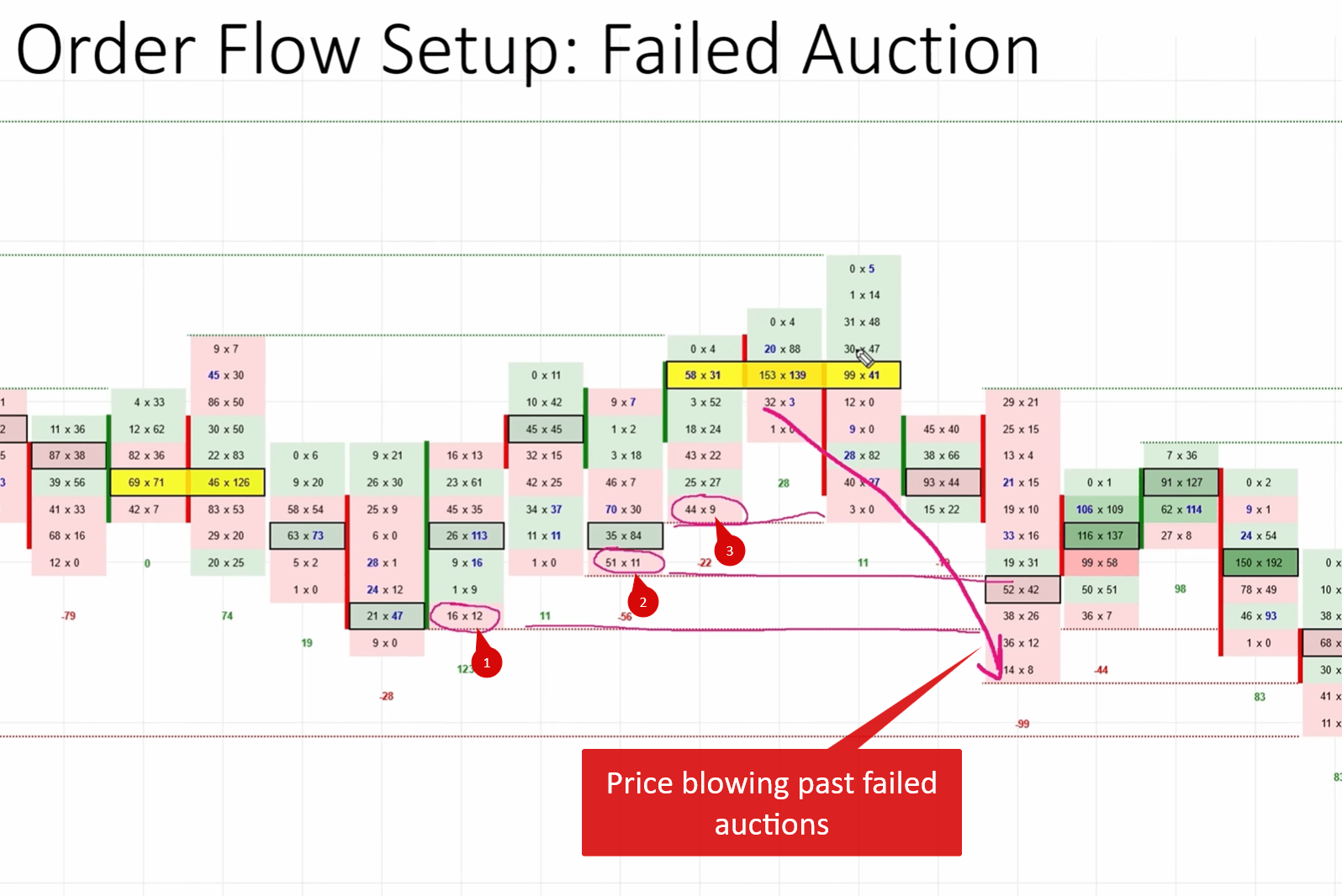
When price returns to test an order flow failed auction, it usually pushes through the exact spot where the zero was missing. This closes that imperfection and creates a cleaner auction in its place. Once this happens, that particular failed auction has done its job. The market is free to move on without needing to revisit it again.
This single behavior, price drifting back toward old failed auctions, is one of the more reliable patterns you will find in order flow trading. It will not predict every single move. It does give you a strong, repeatable clue about where price is likely to head once it gets close to one of these levels. Watching this play out on your own charts, again and again, is the fastest way to build real confidence in the pattern. Many traders keep a short list of active failed auctions on their chart at all times, simply so they never miss one when price starts drifting back toward it.
Failed Auction Clusters and How to Use Them
Why Clusters Matter More Than a Single Line
A single order flow failed auction is useful. A cluster of them sitting close together is even stronger. When you see three failed auctions stacked near one another, it tells you that the market left several small imperfections in the same general area. Because of this, price is even more likely to travel through the whole cluster once it gets close. It is less likely to stop at just one of the lines.
Traders often wait for these clusters instead of reacting to a single failed auction on its own. A cluster gives you a wider and more reliable zone to plan around. A single thin line is easier for price to brush past without much reaction, so treat clusters as the stronger signal whenever you have a choice between the two. Marking clusters on your chart ahead of time also helps you stay patient, since you already know where price is likely headed before it even gets there.
Using Failed Auctions to Manage an Open Trade
One practical way to use this idea is with trade management. Imagine you are already short from a certain level and price is dropping. You start wondering whether it makes sense to close the trade early. Then you notice a failed auction sitting just below the current price, and maybe another one just below that.
It can be worth holding the trade a little longer in that case. The market often wants to test that cluster. You could aim to hold until price reaches roughly one pip below the last failed auction in the group. Take profit around there instead of exiting too soon.
This does not mean you should ignore your own trade plan or risk rules. It simply means that a nearby failed auction cluster gives you a logical, chart based reason to expect a little more movement before the move is finished.
Common Mistakes to Avoid With Order Flow Failed Auctions
Mistakes That Happen Before the Trade
Even a simple concept like this can be used the wrong way. Here are the mistakes that trip up most beginners when they start working with an order flow failed auction, along with simple fixes for each one.
The first mistake is treating every failed auction as an instant trade signal. Spotting one does not mean price will test it immediately, or at all in the short term. Wait for price to actually approach the level before expecting anything to happen.
The second mistake is ignoring clusters in favor of single lines. A lone failed auction is a weaker clue than three of them sitting close together. When you have a choice, pay closer attention to areas where several failed auctions overlap.
The third mistake is forgetting that this is a probability tool, not a guarantee. Price is likely to test a failed auction when it comes close, but likely is not the same as certain. Always combine this idea with your own risk management instead of relying on it alone.
Mistakes That Happen After You Learn the Basics
The fourth mistake is only looking for failed auctions on one side of the market. Both highs and lows can fail. Both directions are worth marking on your chart, not just the ones that match the trade you already want to take.
The fifth mistake is rushing through the learning process. Spotting an order flow failed auction by eye takes practice. This is especially true before you get comfortable reading a footprint chart in general. Give yourself time with older charts. Mark the failed auctions you find, and watch what price does afterward. Over time the pattern becomes familiar, rather than something you have to think hard about in the middle of a live trade.
One last mistake worth mentioning is trading this pattern on very quiet or thin markets. When volume is low, footprint numbers can look messy and unreliable no matter how carefully you read them. Order flow failed auctions work best on active, liquid markets where the bid and ask numbers are clear and easy to trust.
Final Thoughts
Order flow failed auction gives you a clear way to see where the market left something unfinished. It also gives you a strong clue about where price is likely to head once it comes back around. Once you understand it, you stop reacting to price alone. You start reading the story hidden inside the footprint.
The idea is simple at its core. A valid high or low always ends with a zero on one side of the tape. When that zero is missing, the auction failed. The market often wants to return to that spot later and finish the job properly. That return trip is what gives this pattern its real trading value.
Remember the two rules that matter most. Always check whether the zero is actually missing before calling something a failed auction. Pay extra attention when several failed auctions cluster close together, since that combination pulls price through the zone more reliably than a single line on its own.
Like any skill, this takes practice. Study old footprint charts, mark the failed auctions you find, and watch how price behaves when it comes back to test them. Over time, spotting an order flow failed auction will start to feel natural. You will read your charts with more confidence, because you are working from real structure, not just a guess about where price might turn.
Keep practicing, stay patient, and let the charts teach you at their own pace.
FAQ
1. What is an order flow failed auction?
It is when the high or low of a footprint bar does not end in zero the way it should, showing that the market left that price unfinished.
2. Why does price come back to test a failed auction?
Because the auction was left incomplete, the market often wants to close that gap later by trading through the same spot again.
3. Is a single failed auction as strong as a cluster of them?
No. A cluster of several failed auctions close together is a stronger and more reliable signal than one line on its own.
Ready to Go Deeper?
Learn the complete order flow strategy from A to Z Visit trader-dale.com, click the Trading Courses and Tools button, and check out the Order Flow pack, which includes the full strategy along with custom order flow indicators. You can also get all four packs in one special combo bundle at the bottom of the page.
Apply the coupon code KEVIN10 at checkout for an extra 10% discount.
