
If you have ever opened an Order Flow chart for the first time, you probably felt a little dizzy. Numbers everywhere, orders flashing on both sides of the price, and no clear starting point to focus on. This reaction is completely normal, and almost every trader who tries Order Flow for the first time feels the same way. Order Flow shows every single trade executed in the market, and most of those trades come from small retail traders buying and selling in tiny sizes throughout the day. The real challenge with Order Flow is not learning how to read it. It is learning what to ignore.
In this article, you will learn how to use an Order Flow trade filter to cut through that noise and focus only on the trades that actually matter, the big single orders placed by institutions and large players. You will learn how to recognize when a big order appears at a support or resistance zone, what it means when that order sits on the bid or the ask, and how spotting repeated order sizes can even reveal when a big trader is closing their position. By the end of this article, you will have a simple, repeatable method for treating big orders as confirmation before you ever enter a trade, so you can act with clarity instead of guessing.
Table of Contents
Five Things To Remember
- Order Flow shows every trade in the market, but most of it is small retail noise.
- A trade filter removes the noise and only shows large single orders.
- A big single order appearing at support or resistance is a strong signal that an institution just entered the market.
- Orders on the bid near support suggest buying pressure. Orders on the ask near resistance suggest selling pressure.
- Watching for repeated identical order sizes can reveal a big trader exiting a position, giving you a second trade idea.
1. What Is Order Flow And Why It Can Feel Overwhelming
What Order Flow Actually Shows You
Order Flow is a way of viewing the market that shows you every trade as it happens, rather than just the candlestick or the line on a regular price chart. Think of a normal price chart as a headline in a newspaper. Order Flow is the full article underneath, showing you exactly who bought, who sold, and how much size was involved in each transaction.
This level of detail is powerful, but it also creates a problem for beginners. The market is full of small retail traders placing small orders all day long, and when you open a raw Order Flow chart, all of that activity appears mixed together with the much larger trades placed by institutions and professional trading firms.
Why The Noise Feels Overwhelming
All of this information shows up at the same time, on the same chart, which is exactly why so many traders find Order Flow overwhelming the first time they try it. The good news is that you do not need to pay attention to every single trade that flashes across the screen. The small retail orders are simply noise. They rarely move the market in any meaningful way on their own.
What actually creates real turning points and moves price are the large orders placed by big institutions, the kind of traders who can commit hundreds of contracts to a single position in one transaction. If you can find a way to separate these big trades from the noise around them, Order Flow becomes far easier to use and far more reliable as a trading tool.
How Filtering Changes Everything
This is where the idea of filtering comes in. Instead of trying to process every trade on the chart, you simply remove everything except the big ones. Once you make that shift, you stop feeling overwhelmed and you start seeing exactly what the big players are doing in real time, at the exact price levels you already care about.
2. What Is A Trade Filter And How It Helps You Read Order Flow
The Big Order Footprint
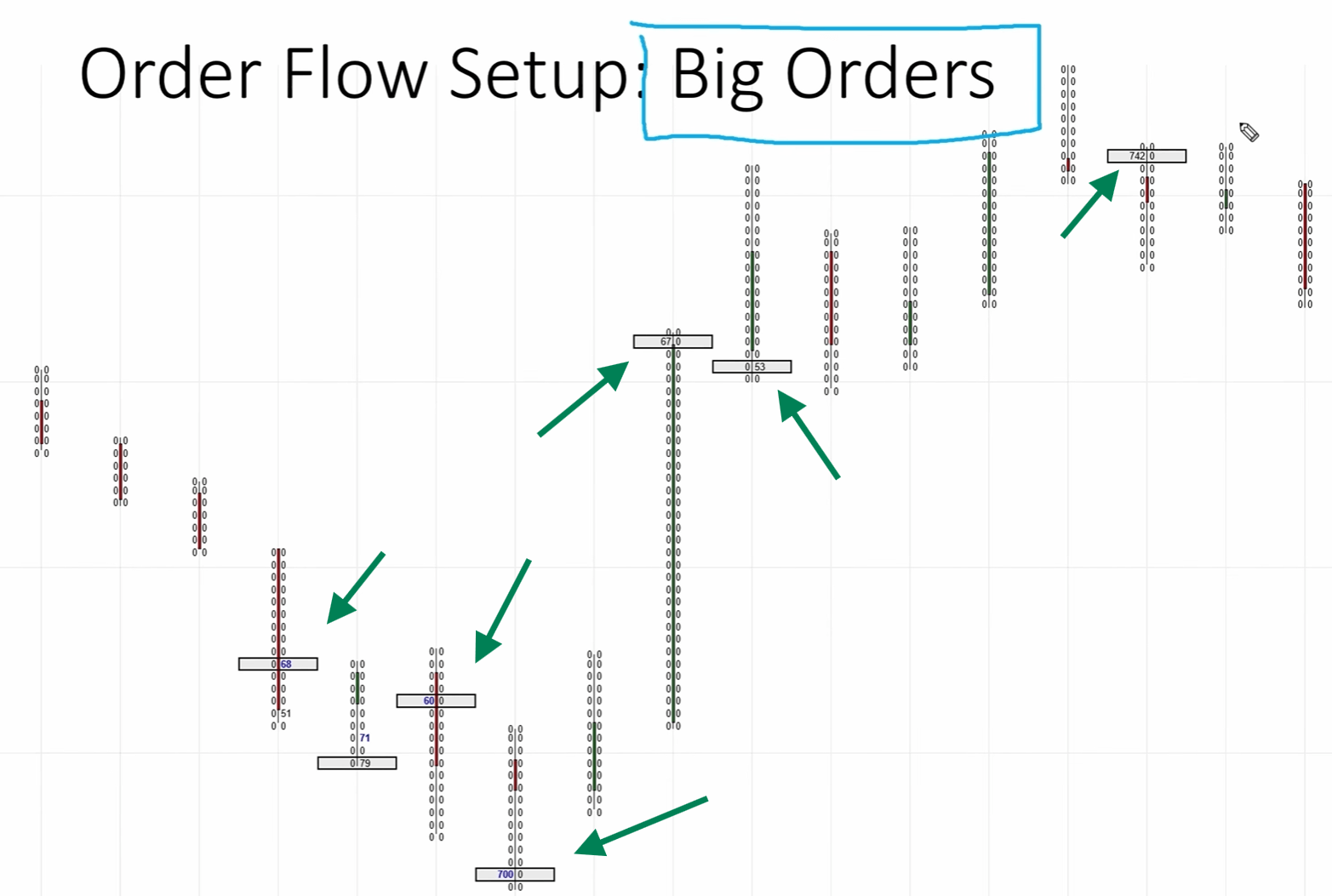
A trade filter is a tool that strips away the small orders on your Order Flow chart and leaves only the large single orders behind. Instead of scrolling through hundreds of tiny trades, you see a clean chart that only lights up when someone places a genuinely large order, the kind of size a retail trader would rarely place in one go.
This matters because big orders leave a footprint. When a large institution enters the market, it cannot hide completely. Its order has to be filled somewhere, and if it is big enough, it shows up clearly once you filter out everything smaller. A trade filter hands you a map of where the big players are stepping into the market.
What Counts As A True Big Order
It is important to understand what counts as a genuine big order confirmation. We are not talking about an iceberg order, which is a large order broken into many smaller pieces to disguise its true size. We are also not talking about several smaller orders bunched together over time.
A true big order confirmation on the trade filter is one single order of a large size, executed all at once. For example, a single order of 700 contracts appearing in one moment is a strong sign that one large trader made a deliberate decision to enter the market right there, at that exact price.
How To Use The Trade Filter In Practice
Once you have a trade filter running, your job becomes much simpler. You are no longer trying to interpret every flicker of activity on the chart. You are watching specific price zones, like support and resistance levels, and waiting to see if a big single order shows up there.
If it does, that is your confirmation. If it does not, you simply wait for the next opportunity. This approach turns Order Flow from an overwhelming wall of data into a focused, patient method that lines up naturally with the support and resistance analysis you may already use.
3. How To Spot Big Order Confirmation At Support Zones
The Support Zone Scenario
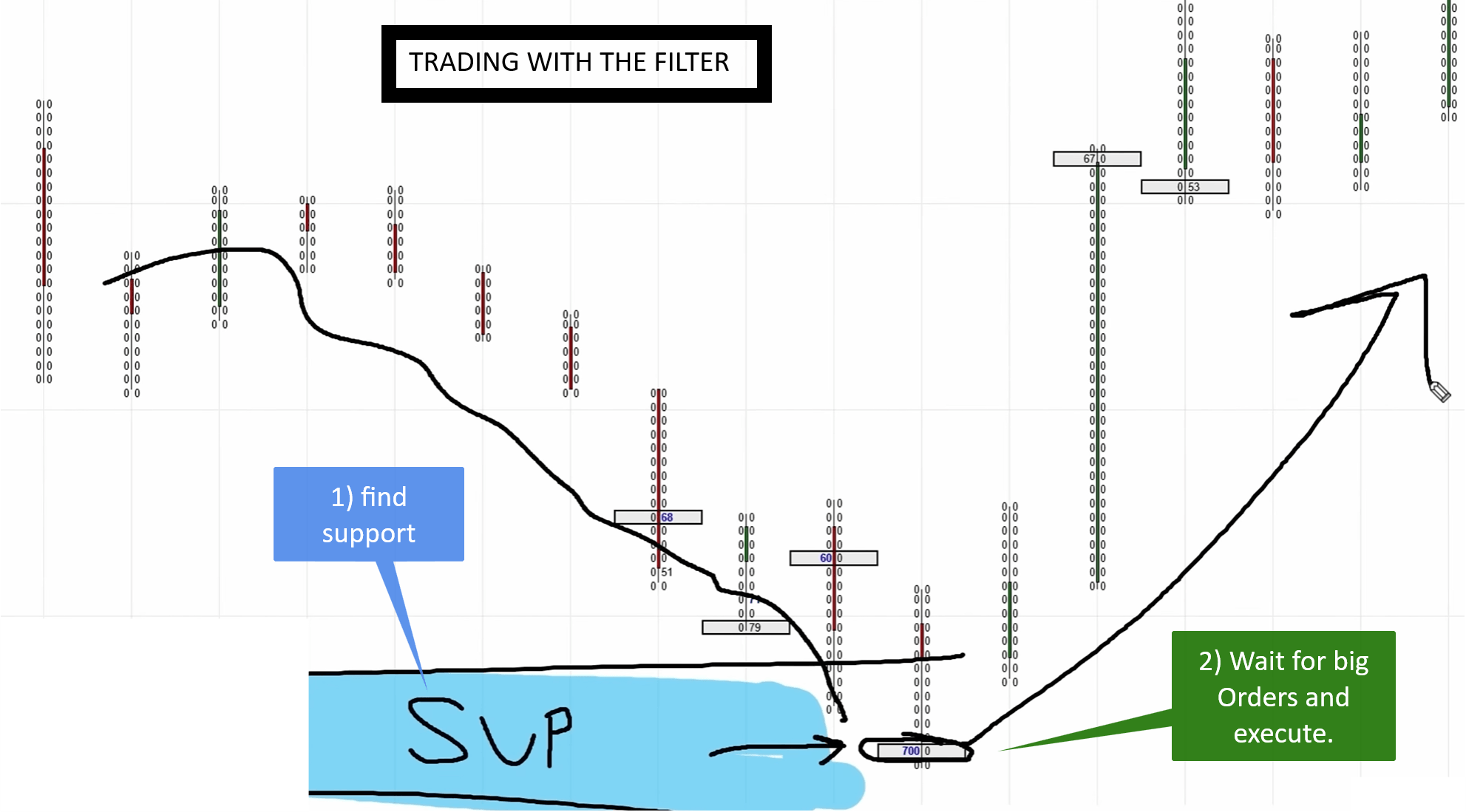
One of the most useful ways to apply a trade filter is at support zones. A support zone is a price level where buyers have historically stepped in to stop the price from falling further. On its own, support is helpful, but it becomes far more powerful once you can confirm a big player is active at that level right now.
Here is how this works. Imagine price is falling and approaching a known support zone. As it reaches that zone, your trade filter suddenly shows a massive single order, for example, 700 contracts appearing all at once. This is not a series of small trades adding up. It is one single, large transaction, and that kind of size does not come from casual retail buying.
Why This Confirms Institutional Buying
When you see this happen, it tells you something valuable. Somebody big just committed real size to this level, which strongly suggests the support zone is being defended right now, not just in the past. This gives you a much stronger reason to consider a long position, because you are no longer relying purely on a historical pattern. You are watching live confirmation that a significant player agrees the level matters.
Why Bid Versus Ask Matters Here
There is one more detail that strengthens this signal. It matters whether the big order shows up on the bid or the ask. For a long trade at support, it is more reassuring if the order appears on the bid side, because that tells you clearly this is a large buy limit order that just got filled.
While the exact side is not always essential, seeing it on the bid removes doubt and makes the buying pressure unmistakable. In short, when price reaches support and your trade filter shows a large single order on the bid, you have solid confirmation that serious money is defending that zone.
4. How To Spot Big Order Confirmation At Resistance Zones
The Resistance Zone Scenario
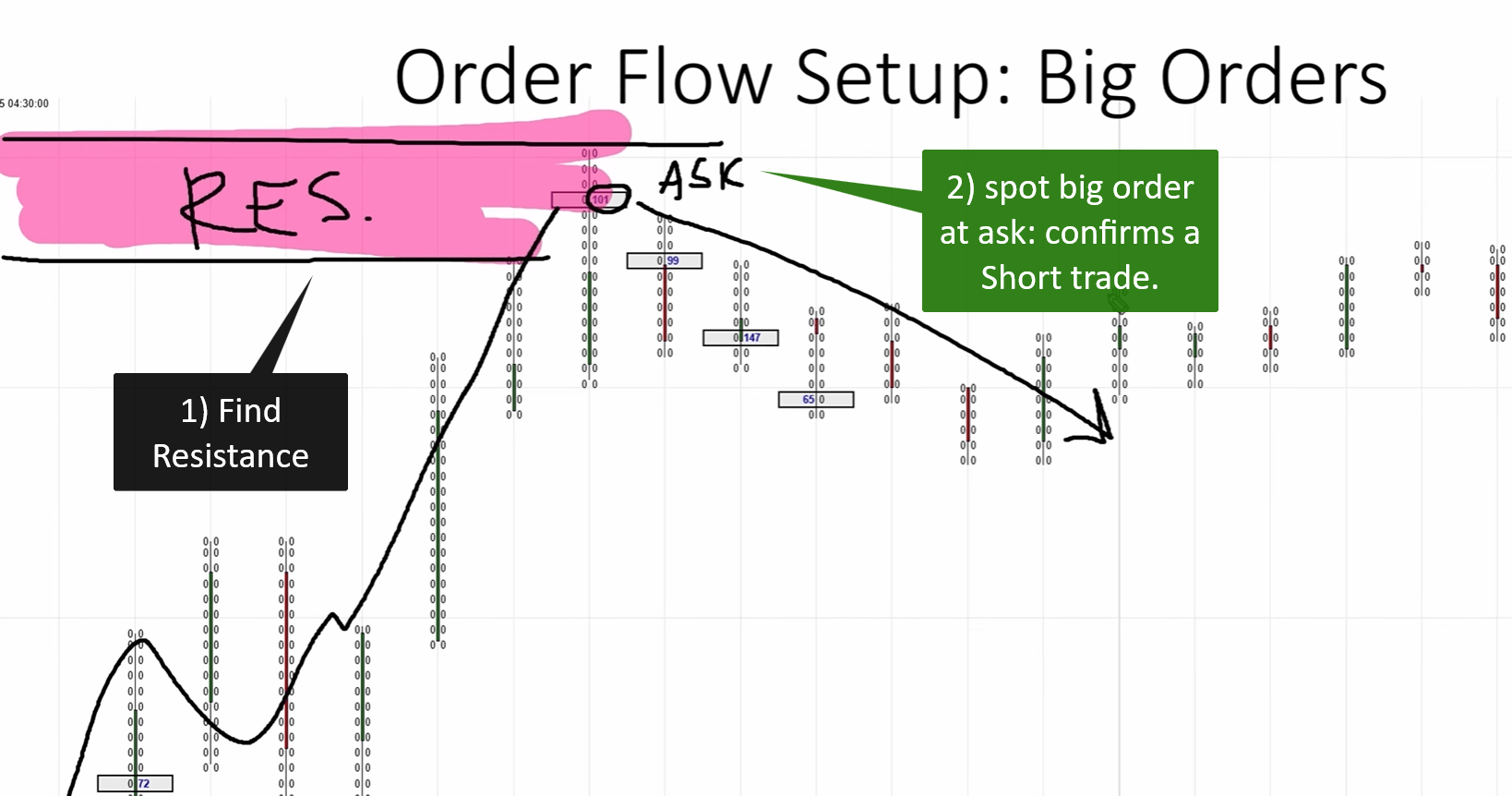
The same logic applies in reverse at resistance zones, price levels where sellers have historically pushed price back down. Resistance becomes far more meaningful once you have live confirmation from a big single order, rather than relying only on the level’s past behavior.
Picture price rising toward a known resistance zone. As it reaches that level, the trade filter shows a single large order of 101 contracts. This is one order, not several smaller ones stacked together. Because this order appears on the ask, it is very likely a large sell limit order, meaning a big trader placed an order to sell at that exact price and price reaching that level triggered the fill.
When Multiple Big Orders Appear Together
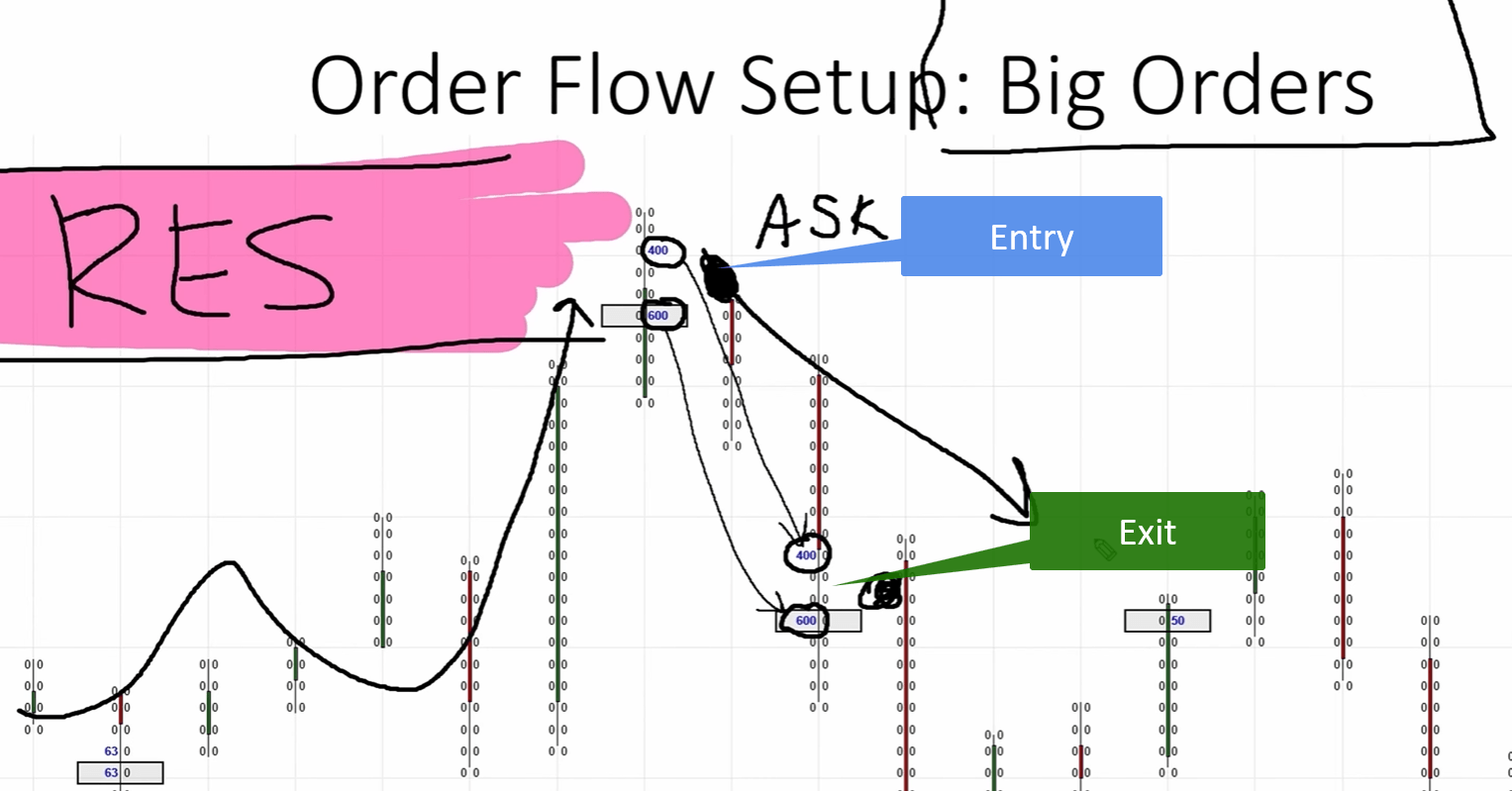
Big order confirmation does not always arrive as a single transaction. Sometimes you will see two or more large orders appear close together at the same zone. Imagine price reaches resistance and you see one order of 600 contracts followed shortly by another order of 400 contracts, both on the ask.
Even though these are two separate trades, the fact that both are large and both land on the ask at the same resistance zone tells the same story. It is likely a big trader, or possibly more than one, was waiting with sell limit orders, and price reaching resistance triggered those fills.
Confirming Direction With The Ask
This tells you a significant seller is active right at resistance, which is strong confirmation the level is likely to hold, at least for now. This is exactly the kind of signal that supports a short trade, because you are watching real size enter the market at the precise moment price tests a familiar level.
As with support zones, the location of the order on the bid or ask adds certainty. Seeing large size on the ask at resistance confirms genuine selling pressure, which helps you trade with confidence instead of second guessing the signal.
5. Reading Multiple Big Orders As One Big Player
Spotting Repeated Order Sizes
One of the more advanced but genuinely useful skills you can develop is noticing when the same size of order appears more than once on your chart. This small detail can reveal information that goes beyond a simple entry signal.
Returning to the resistance example above, imagine you saw a 600 contract order and a 400 contract order appear together at resistance, and your short trade worked out well. Later, as price falls toward a lower zone, you notice the exact same sizes appear again, a 400 contract order and a 600 contract order, close together. This is not a coincidence to ignore. It is likely the same trader exiting the short position they opened earlier at resistance.
Why This Matters For Your Trading
Why does this matter to you? Because it gives you a second opportunity. If a big trader opened a short position with these two orders at resistance, and the same sizes show up again at a lower price, it is reasonable to consider this a good area for a similar short trade, or a sensible place to close your own position if you were already short.
Tracking repeated order sizes lets you follow not just where a big player enters the market, but also where they may be planning to exit. This pattern will not appear on every trade, but when it does, it is one of the more rewarding parts of using a trade filter. The core idea is simple: do not look at big orders in isolation. Compare their size to orders you have seen earlier, since matching sizes at different price levels can reveal a single large trader’s entire plan.
6. Bid Versus Ask: Why It Matters
Understanding whether a big order appears on the bid or the ask helps you confirm the direction of pressure behind that order.
Order Location | Zone | Likely Meaning | Suggested Bias |
Bid | Support | Large buy limit order filled | Long |
Ask | Support | Large order present, less clear direction | Wait for more confirmation |
Ask | Resistance | Large sell limit order filled | Short |
Bid | Resistance | Large order present, less clear direction | Wait for more confirmation |
As the table shows, the clearest signals come from a big order on the bid at support, or a big order on the ask at resistance. These combinations align the size of the order with the natural direction of trading at that zone, giving you the strongest possible confirmation before entering a trade.
Conclusion
Order Flow does not have to be an overwhelming wall of numbers. Once you understand that most of the activity on the chart comes from small retail traders, the solution becomes obvious: filter it out and focus only on the big players. A trade filter does exactly this, isolating large single orders so you can clearly see when institutions are stepping into the market.
Throughout this article, you learned how a big single order appearing at a support zone, particularly on the bid, confirms buying pressure and supports a long trade. You also learned how the same idea applies at resistance zones, where a large order or a pair of large orders on the ask confirms selling pressure and supports a short trade. Beyond single signals, you learned how watching for repeated order sizes can reveal when a big trader is exiting a position, giving you insight into their entire trade rather than just their entry.
The overall approach is simple. Instead of trying to predict what the market will do, you are watching for confirmation that large, well funded traders are already acting at the levels you care about. Trading alongside this kind of activity, rather than guessing independently, gives you a clearer and more grounded way to make trading decisions.
Frequently Asked Questions
Does it matter if a big order shows up on the bid or the ask?
It is not always essential, but it does add clarity. A big order on the bid at support suggests a strong buy limit order, while a big order on the ask at resistance suggests a strong sell limit order.
What software can I use to filter big orders on Order Flow?
A trade filter needs to be built into your Order Flow software so it can isolate single large trades from the rest of the noise. Not every platform includes this feature, so check whether your current tool supports it.
Is a big order always a guarantee that the level will hold?
No signal in trading offers a guarantee. A big single order at support or resistance is strong confirmation that a large player is active, but it should still be combined with your own risk management before entering a trade.
Next Steps :
If you want to explore this approach further and get access to the trade filter tools used throughout this article, visit trader-dale.com and check out the Trading Course and Tools section, where you will find the complete Order Flow Pack, including custom software and full training.
