
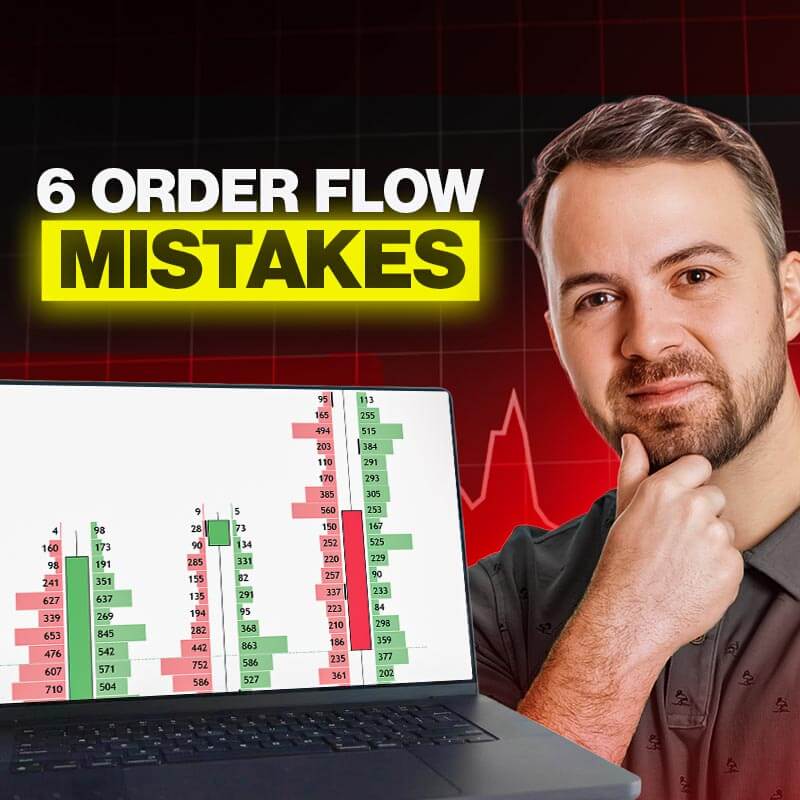
Prefer an article? Go here: Order Flow Mistakes That Are Costing You Money (And How to Fix Them)
Do you want ME to help YOU with your trading?
Video Transcript
Hey everyone. In this video, I’ll show you the six most common Order Flow mistakes that traders make. Chances are you’re making at least one of them yourself — but the good news is they’re easy to fix once you know what to look for. So let’s get to it.
Mistake #1: Over-Analyzing Every Footprint
Common mistake number one is over-analyzing every footprint. So many people just focus on every single number they see on the chart, which leads to analysis paralysis. What you should focus on instead are the big things: heavy volume zones, significant volume clusters, what the delta is doing, imbalances (those are trapped traders), and stacked imbalances — because they represent strong support and resistance zones. As you can see, the price made a beautiful reaction to those zones. Keep an eye on the important things, not every single number. Don’t over-analyze Order Flow — it’s a mistake so many traders make.
Mistake #2: Ignoring the Big Picture
Closely tied to that is mistake number two: ignoring the big picture. That’s why it’s very important to have a chart like this on one of your screens — one that shows the big picture, with a weekly Volume Profile and a 30-minute time frame. You can also use a weekly view or something similar. You need to see what’s going on from the bigger perspective before you dive into the details of Order Flow.
You can also use something like this — a 30-minute footprint chart that still shows you the big picture because it includes the Volume Profile and heavy volume clusters that are very important for your decision making. Having that bigger picture on your screen will definitely help you see where the market is going, whether it’s rotating or trending, where the big levels are, and where the significant volume zones are. You need to see all of that before diving into Order Flow detail.
Mistake #3: Misunderstanding Bid and Ask
Common mistake number three is misunderstanding bid and ask. I just want to make sure to mention it again because it’s really, really important. So to repeat: on the bid, you can have aggressive sellers (market sell orders) as well as passive buyers (limit buy orders). On the ask, there could be either aggressive buyers (market buy orders) or passive sellers (limit sell orders). Keep that in mind.
Mistake #4: Using Order Flow for Swing Trading
Another mistake is people thinking that Order Flow is not just for intraday trading but also for swing trading. It’s not. People keep asking me if they can use Order Flow for swing trading — the answer is no. This tool is good for intraday trading and scalping. For swing trading, there are other tools like Volume Profile. If you want to use Order Flow, stick to tick charts or the 1-minute through 30-minute time frames — that’s the maximum. For higher time frames like hourly, 4-hour, or daily, Order Flow is not the right tool. The right tool for that is Volume Profile.
Mistake #5: Trading Too Many Markets
Another common mistake is people thinking that if they trade more markets with Order Flow, they’ll have more winners. The truth is they probably won’t. Markets differ in so many ways: average volatility, typical volume, time of activity, and the things they react to — different setups, different news. Every market is different. You can’t apply the same approach across every market. The principle is the same, but the volumes and volatility will be completely different.
That’s why I highly recommend focusing on one or two markets. Take a look at these two tables. The first shows average daily volatility — for example, crude oil is about 7%, while Euro futures (6E) is only about 0.5%. You simply can’t trade these two instruments the same way. You need to become a specialist in one or two markets. Just focus on a couple of them, because they are clearly very, very different.
The volatility is different, and so is the average daily volume. On crude oil, typical daily volume is over 1 million contracts, while on Euro futures it’s only about 150,000 contracts. The charts will look completely different, the volumes will look completely different, and if you’re waiting for confirmation by absorption, that absorption will look completely different on crude oil versus Euro futures. You need to at least roughly know what typical volumes look like on the instrument you’re trading.
That’s why I say you should specialize in one or two markets. And here’s a very interesting fact: there was a survey that one of the top prop firms conducted, and it found that the top 6% of traders — those taking 43% of total payouts — trade only one market. Read that again. The top 6% of traders, the best traders, are taking 43% of all the payouts, and they’re trading just one market. Learn from them. Don’t try to multiply your winners by spreading across too many markets — chances are it will end up the other way and you won’t be as successful as you planned. Stick to one or two markets. That’s my best advice.
Now,
Mistake #6: Thinking You Need Level 2 Data
Another thing people keep asking about is Level 2 data. For some reason, many traders still think they need Level 2 data to trade Order Flow. The difference is this: Level 1 data shows executed trades — real orders that actually went to the exchange with real intent to buy or sell. Level 2 data shows market depth, or in other words, pending orders. Order Flow shows you Level 1 data.
Pending orders are very often not executed. You can see the DOM (Depth of Market), which shows pending orders. For example, if an algorithm wants to manipulate price upward, it places large pending orders to lure the price up — but as price approaches those orders, they’re simply withdrawn. So they don’t represent actual trading intent. That’s the big difference: Order Flow shows actual trades. The DOM or market depth shows pending orders that are not real trades. You don’t need Level 2 data — just Level 1.
All right, guys. That’s it! I hope you found this video useful. If you’d like to join my Order Flow course, head over to my website at traderdale.com, click “Trading Course & Tools”, and scroll down to browse the courses. The Order Flow course gives you a complete A-to-Z video curriculum, custom-built Order Flow indicators, and more. Thanks for watching, and I’ll see you in the next one. Until then, happy trading!
