

You can win more trades than you lose and still watch your account shrink. That sounds strange, but it happens to traders every single day. The hidden problem is almost never the strategy itself. It is how much money is risked on each trade. Many traders use the same position size on every instrument without thinking about how much that instrument actually moves. This one habit quietly drains accounts, even when the win rate looks strong on paper.
In this article, you will learn why using the same risk every trade is one of the most important habits a trader can build. This lesson comes from years of watching traders make this exact mistake, and it applies no matter what you trade, whether that is Forex, indices, or crypto. You will see a real example of how three wins and two losses can still end in a net loss for the day, and you will learn a simple system to fix it. By the end, you will understand exactly how to size your trades so that your risk stays consistent, your losses stay small, and your results start to reflect the real quality of your strategy.
The Article In 5 Points
- Trading the same lot size on every instrument ignores volatility, and that creates uneven risk.
- A calm pair like AUD/USD moves far less per day than a volatile pair like GBP/JPY, so the same lot size means very different dollar risk.
- Without the same risk every trade, a few losses on volatile instruments can wipe out several wins on calmer ones.
- The fix is simple: adjust your position size based on your stop loss distance, not on habit.
- Free tools, like a position size calculator, can automate this so the math is never a guessing game.
Table of Contents
1. The Hidden Mistake That Ruins Good Strategies
Trading One Lot Size For Everything
A lot of traders open a chart, pick a lot size they feel comfortable with, and use it for almost every trade. It might be one lot, half a lot, or whatever number feels safe. The problem is that this number rarely changes, no matter which instrument is being traded. That single habit is often the quiet reason a winning strategy still loses money over time.
Here is why this matters so much. Every trading instrument moves differently. Some currency pairs barely shift during a normal day. Others swing wildly within a few hours. When you use a fixed lot size across all of them, you are not actually trading with consistent risk. You are trading with consistent size, and size is not the same thing as risk.
Why This Feels Fine Until It Isn't
This mistake is easy to miss because it does not cause damage right away. A trader might use one lot on a calm pair for weeks and see small, manageable losses and gains. Confidence builds. Then that same lot size gets applied to a much more volatile instrument, and suddenly a single stop loss wipes out the gains from several previous trades combined.
This is not bad luck. It is math. If your stop loss on one instrument is three times wider than your stop loss on another, and you use the same lot size on both, your risk on that trade is three times larger. Nothing about your strategy changed. Only your exposure did.
The Real Cost Of Ignoring This
Traders often blame their strategy when results are inconsistent. They start second guessing entries, exits, and indicators. In reality, the strategy might be working exactly as intended. The real issue is that position sizing was never adjusted to reflect the risk of each specific trade. This is the first thing to fix before changing anything else about a trading plan.
2. Why Volatility Changes Your Real Risk
Understanding Average Daily Movement
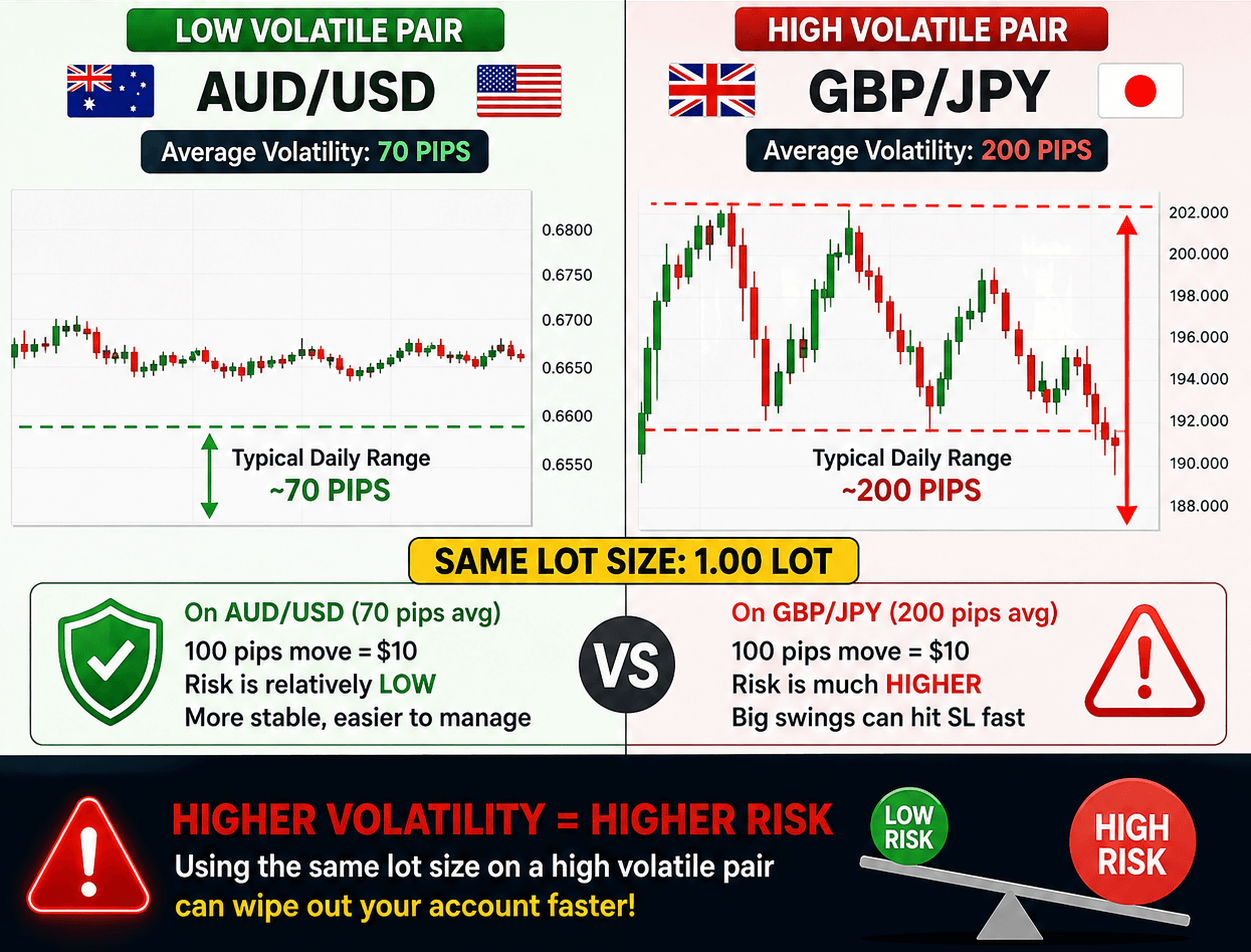
Every trading instrument has an average daily range, which is simply how far it tends to move in a normal day. AUD/USD, for example, tends to move around 70 pips on an average day. GBP/JPY, on the other hand, tends to move closer to 200 pips. That is nearly three times more movement in the same amount of time.
This difference matters because your stop loss should reflect that movement. A tight stop loss on a highly volatile pair gets hit constantly by normal price noise, not by an actual bad trade idea. A wide stop loss on a calm pair wastes potential profit and risks far more than necessary. Traders who understand this adjust their stop loss distance to match the personality of the instrument they are trading.
How Stop Loss Distance Connects To Position Size
Here is where many traders go wrong. Even after correctly widening a stop loss for a volatile pair, they still use the same lot size as before. If a trader risks 10 pips on AUD/USD with one lot, and then risks 30 pips on GBP/JPY with the same one lot, the dollar risk on GBP/JPY is three times higher. That is the exact opposite of consistent risk.
The fix is not complicated. As your stop loss distance increases, your position size should decrease. As your stop loss distance shrinks, your position size can increase. This keeps the actual dollar amount at risk stable, no matter which instrument you trade or how wide the stop needs to be.
A Simple Way To Picture It
Instrument | Average Daily Range | Typical Stop Loss | Lot Size Needed For Same Risk |
AUD/USD | 70 pips | 10 pips | 1.0 lot |
GBP/JPY | 200 pips | 30 pips | 0.3 lots |
This table shows the core idea in one glance. The stop loss is three times wider on GBP/JPY, so the position size needs to shrink to roughly one third to keep the risk level the same. This is the entire foundation of applying the same risk every trade, and once it clicks, it becomes second nature.
3. A Real Example: Three Wins, Two Losses, Still A Loss
Setting Up The Scenario
Numbers make this idea much easier to understand, so here is a real world style example. Imagine a trading day with five trades across five different instruments. Two of those trades result in losses, and three result in wins. On paper, that is a 60 percent win rate, which most traders would be happy with.
The two losing trades happen on Bitcoin and GBP/JPY, two highly volatile instruments. Combined, those two losses total $900. The three winning trades happen on EUR/USD, the S&P 500, and AUD/USD, three comparatively calmer instruments, using a 1:1 risk to reward ratio. Combined, those three wins total only $290.
Why The Math Doesn't Add Up
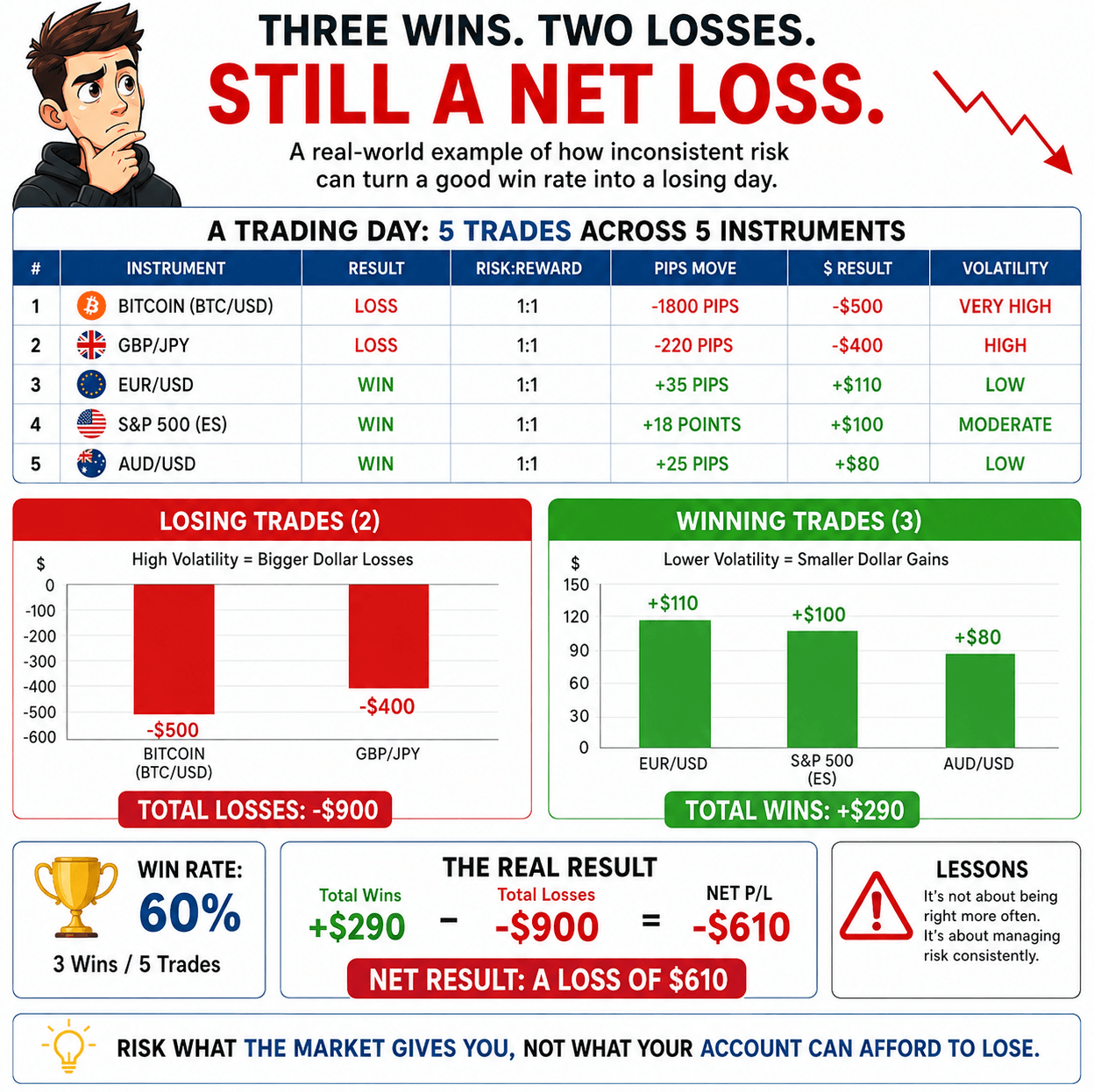
At the end of the day, this trader was right three times and wrong only twice, yet still finished with a net loss of $610. This is not a rare or extreme example. It is a very common pattern for traders who do not size their positions based on volatility. The strategy technically worked more often than it failed, but the losses were structurally larger than the wins because of uneven risk, not because the strategy was flawed.
What This Example Really Teaches
This scenario is exactly why relying only on win rate is misleading. A high win rate means very little if the losing trades are consistently larger than the winning ones. The fix is not to find a better entry signal. The fix is to make sure every trade, win or lose, carries a similar dollar risk. When that happens, win rate becomes a much more meaningful number, and small edges in a strategy actually show up in the account balance over time.
4. How To Apply The Same Risk Every Trade
Step One: Decide Your Risk Percentage
Before opening any trade, decide what percentage of the account is acceptable to risk. A common starting point is around 1 to 2 percent per trade. This number should stay fixed. It is the anchor that keeps every other calculation consistent, regardless of which instrument is being traded that day.
Step Two: Set Your Stop Loss Based On The Instrument
Rather than using a habitual stop loss distance, base it on the actual behavior of the instrument. A calmer pair can use a tighter stop. A more volatile pair, or one during a high volatility news event, needs a wider stop to avoid being closed out by normal price movement.
Step Three: Let Position Size Do The Adjusting
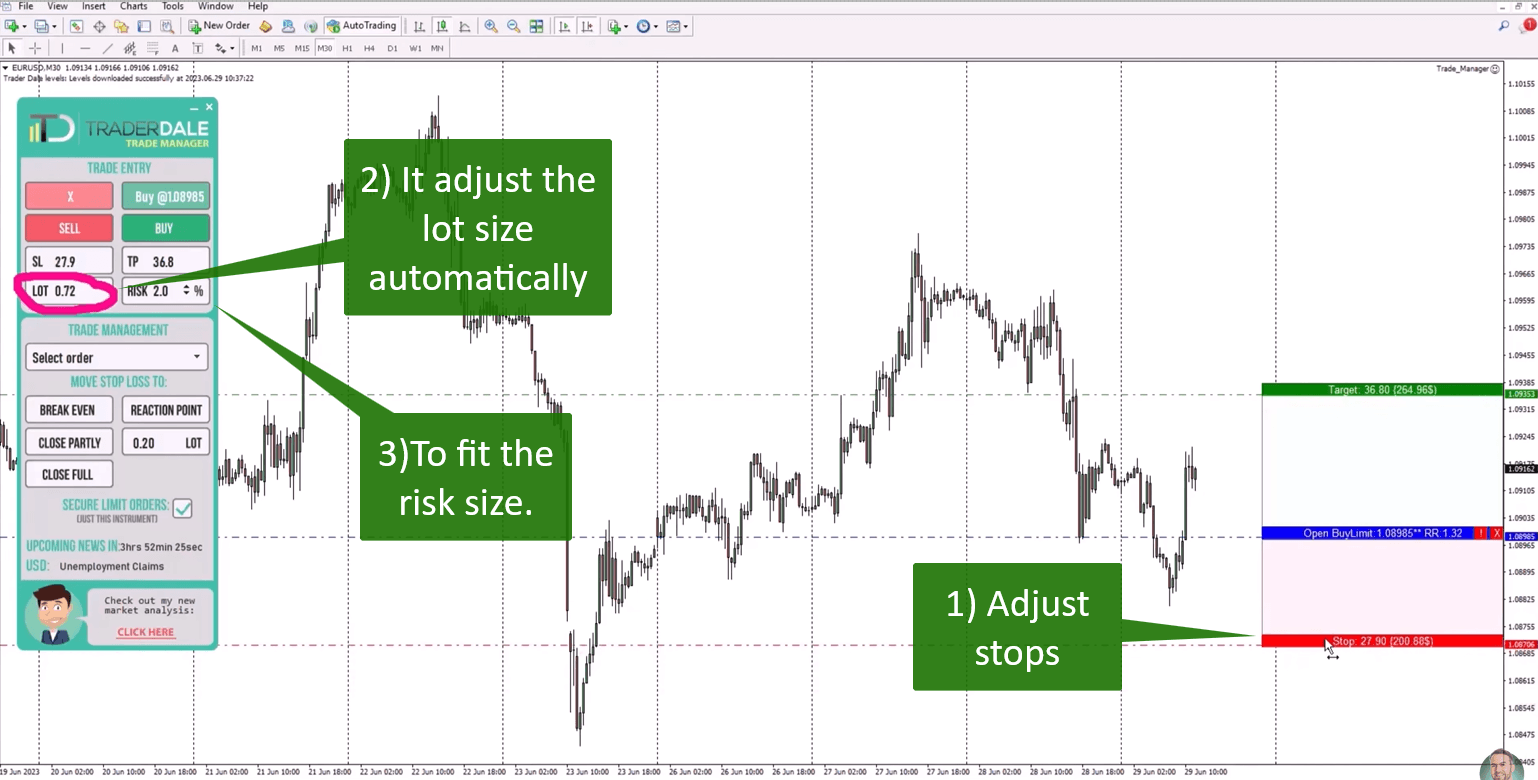
This is the step most traders skip, and it is the most important one. Once the risk percentage and stop loss distance are set, the position size should be calculated to match. A wider stop loss should always come with a smaller position size. A tighter stop loss should always come with a larger position size. This keeps the dollar amount at risk the same, trade after trade, instrument after instrument.
Doing this math manually for every trade is tedious, which is exactly why tools exist to automate it. A position size calculator takes your account risk percentage and your stop loss distance, and instantly tells you the correct lot size. Some platforms, like MetaTrader 4, support free tools built specifically for this purpose, removing the guesswork completely and letting the calculation update in real time as the stop loss is adjusted.
Step Four: Review Consistency Weekly
At the end of each trading week, it helps to review whether risk actually stayed consistent across trades. This is a simple check that takes only a few minutes, but it catches bad habits before they become expensive ones. Traders who build this review into their routine tend to notice sizing mistakes far earlier than those who only look at overall profit and loss.
Final Thoughts
Position sizing is rarely the exciting part of trading, but it may be the most important one. A strategy can have a strong win rate and still lose money if risk is not applied consistently across every trade. The example in this article showed how three wins and two losses added up to a net loss, simply because the losing trades carried far more risk than the winning ones. That is not a strategy problem. It is a sizing problem, and it is completely fixable.
The core lesson here is simple. Adjust your position size based on your stop loss distance, not out of habit. As your stop loss widens, your position size should shrink. As your stop loss tightens, your position size can grow. This keeps your dollar risk stable no matter which instrument you trade, which is the entire idea behind using the same risk every trade.
If you want to stop doing this math by hand, tools exist that calculate position size automatically based on your risk percentage and stop loss distance. Start applying consistent risk on your very next trade, and track your results over the following weeks. You will likely notice that your account curve becomes far smoother, even before your strategy itself changes at all.
5. Common Questions About Trade Risk Management
Why does the same lot size create different risk levels?
Because each trading instrument has a different average movement per day. A fixed lot size ignores that difference, so the same size can mean a small risk on one instrument and a much larger risk on another.
What is a reasonable risk percentage per trade?
Many traders use somewhere between 1 and 2 percent of their account per trade, though this depends on personal risk tolerance and overall trading strategy. The key is choosing a number and staying consistent with it.
Can a good strategy still lose money without consistent risk?
Yes, and this is one of the most misunderstood parts of trading. A strategy can have a strong win rate and still lose money overall if the losing trades are consistently larger than the winning ones, which is exactly what happens without the same risk every trade.
NEXT STEPS
Ready to stop letting inconsistent risk quietly drain your trading account? Trader Dale’s complete course library teaches you exactly how professional traders manage position sizing, read Volume Profile and Order Flow, and apply Smart Money Concepts to make every trade count.
Whether you are just starting out or refining an existing strategy, these courses give you the structured, practical framework needed to trade with real confidence and consistency. Stop guessing with your position sizes and start trading with a proven system behind you.
Enroll today and use coupon code KEVIN10 at checkout to get 10% off any course. Your more disciplined trading future starts right now.

dfoozqtjywrnxkfvqpvqlgpjdtvqij