
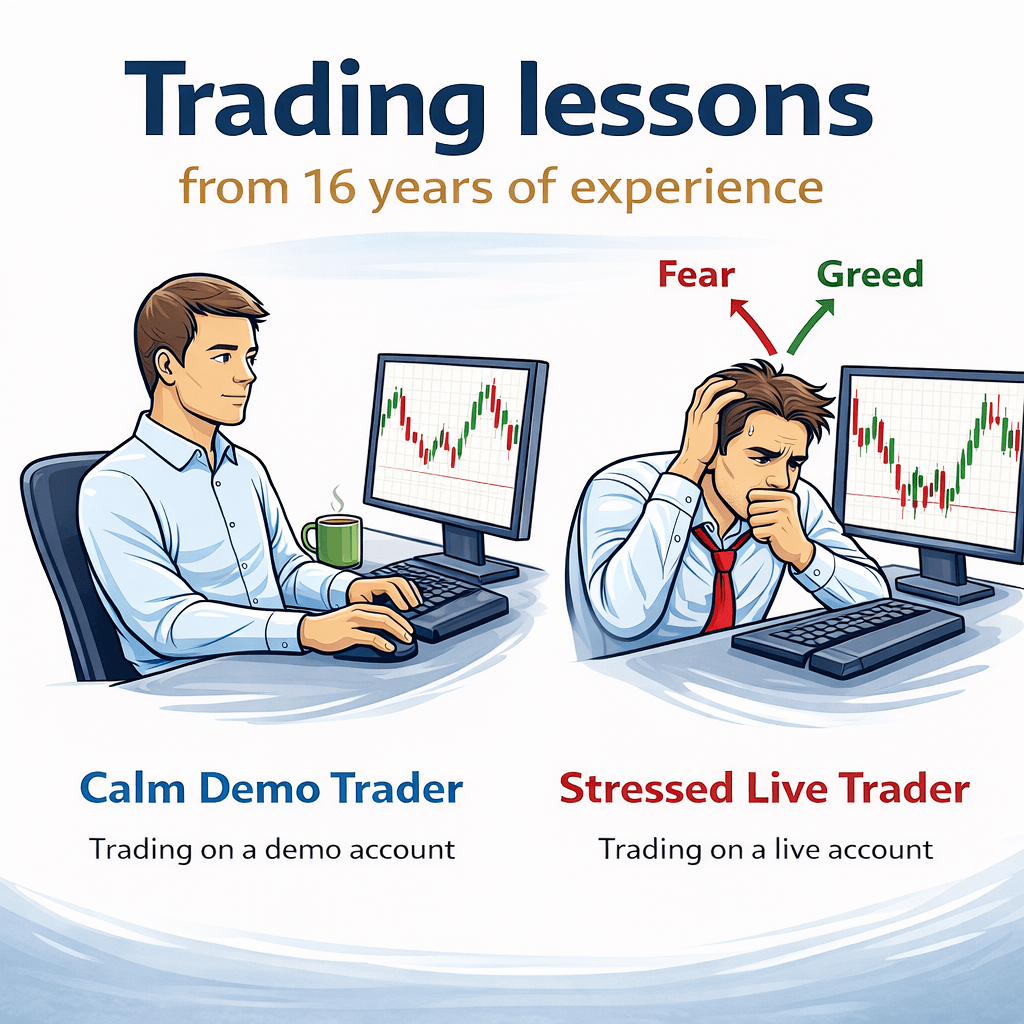
I have been trading full-time since 2008. In those 16 years I have made almost every mistake possible — blown accounts, chased indicators that never worked, quit strategies too early, and traded on demo for far too long. What I am sharing in this article is not theory. It is what I actually learned the hard way.
If you are struggling to find consistency, keep switching strategies, or feel like you are going backwards — these six lessons are for you. I am not going to give you a magic formula. I am going to tell you what most trading courses will not: the honest, sometimes uncomfortable truth about what it actually takes to trade professionally.
Table of Contents
Summary
- Indicators are not the answer. RSI, MACD, Bollinger Bands — they are all based on past price and time. They cannot tell you what institutional money is doing right now. Volume Profile can.
- Every good strategy loses sometimes. The traders who survive drawdowns are the ones who know their statistics cold. Know your maximum losing streak before it happens.
- Your journal is more valuable than your strategy. You cannot improve what you do not measure. A proper journal reveals which instruments, sessions, and setups are actually making you money.
- You need a written trading plan. Rules mean nothing if they only exist in your head. Write them down. If you cannot explain exactly why you entered a trade, you should not have taken it.
- Demo trading will not prepare you for real money. The psychology only kicks in when real money is at stake. Move to a live micro account as fast as possible, even if you are only risking $1 per trade.
- Small accounts are a trap. You cannot earn a professional income risking 1% on a $1,000 account. Prop firms exist to solve this problem — they give you the capital once you prove you can manage risk.
Lesson 1: Why Your Indicators Are Failing You
When I started trading in 2009 I did exactly what most beginners do. I loaded my charts with every indicator I could find — RSI, MACD, Bollinger Bands, Stochastics. I thought that if I just found the right combination, I would have a money printer. I spent months tweaking settings and watching lines cross, convinced the answer was somewhere in those coloured lines.
It was not. Here is the fundamental problem with almost every popular indicator: they are all built from the same two ingredients — past price and time. They are reactive by nature. They can only tell you what happened minutes or hours ago. They have no idea what the major banks and institutions are doing right now, today, in real time. That is why relying on them alone is a dead end. You are always a step behind.
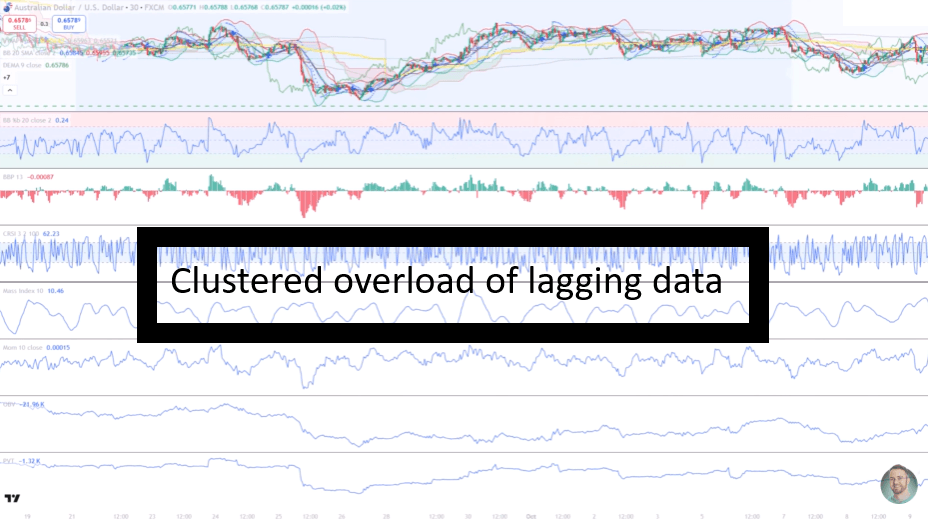
If I were starting my trading career today, the first thing I would do is delete every lagging indicator from my charts. Instead, I would focus entirely on Volume Profile. Unlike a moving average, which just smooths price over time, Volume Profile shows you exactly where the high-volume price levels are — the areas where institutions and hedge funds have placed their orders. When you see a big spike in volume at a specific price, that level matters. It will act as support, resistance, or a magnet for future price movement.
This is not a signal system. It is market structure. You are reading the auction — where money actually changed hands — rather than a coloured line that tells you what already happened. That shift in thinking is what separates a professional trader from someone who keeps buying indicator courses and wondering why nothing works.
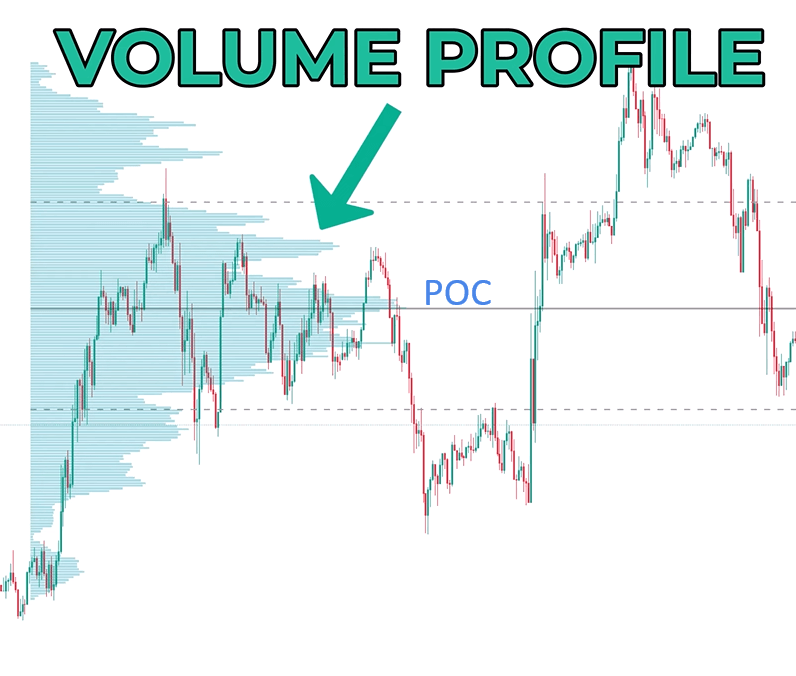
The deeper lesson here is about how you think about the market. A market moves because there is an imbalance between buyers and sellers. Indicators take that raw information and average it, smooth it, and delay it until the useful signal is gone. Volume Profile shows you the raw imbalance directly — no lag, no smoothing.
When you can look at a chart and immediately see the high-volume nodes, the low-volume gaps, and the areas where price moved quickly with no institutional interest — you start to see the market completely differently. You stop looking for a signal and start reading the story the market is telling you. That is the foundation of how I trade, and it is what I teach.
Lesson 2: Every Strategy Has Losing Periods
No strategy wins every trade. This sounds obvious, but most traders have not truly accepted it — and that gap between knowing it intellectually and being prepared for it emotionally is what blows most accounts.
I went through a difficult period earlier in my career where my trades were barely breaking even for weeks. It felt awful. But I did not change a single rule in my plan. Why? Because I had done the work beforehand. I knew my strategy’s statistics. I knew what the worst historical losing streak looked like. So when I was sitting in the middle of a drawdown, I was not panicking and improvising — I was executing my plan and waiting for conditions to shift back in my favour. The next month I had a 90% win rate. The strategy had not changed. The market conditions had.
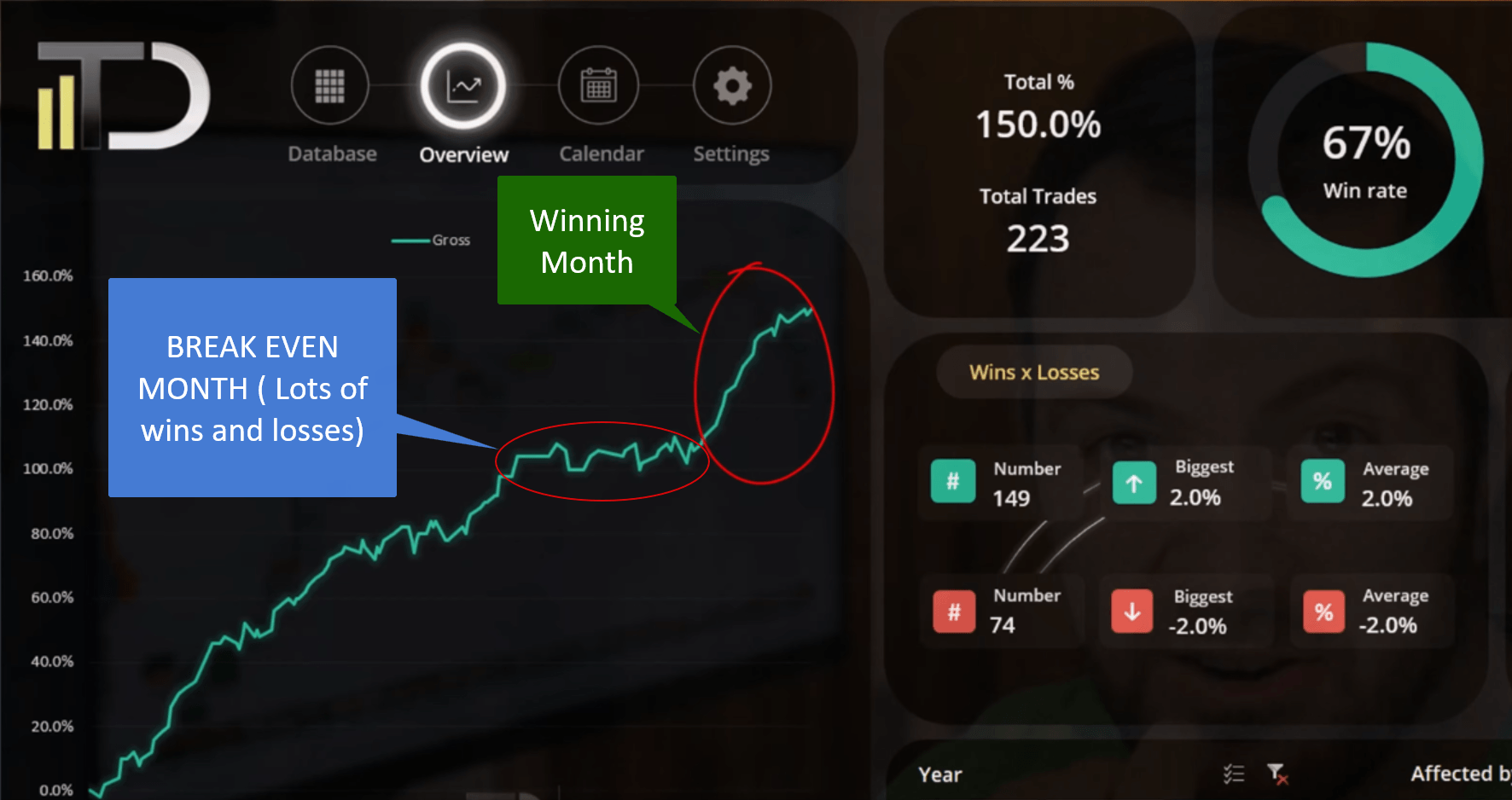
Before you trade a strategy live, you need to know two numbers: your maximum historical drawdown and your longest losing streak. If backtesting shows that your strategy has historically lost five trades in a row, then when you are on your third consecutive loss, you will not spiral into doubt. You will recognise it as normal variation and keep executing.
Most traders destroy their accounts not because their strategy is bad, but because they abandon it during a perfectly normal drawdown. They take revenge trades, increase their position size to “win it back,” or switch to a completely different approach — all at exactly the wrong time. The antidote is simple: know your numbers before the drawdown starts, not during it. Treat your trading like a business and judge performance over months, not individual trades or individual weeks.
Lesson 3: Your Journal Is Your Most Powerful Tool
When I first started, I only paid attention to my account balance. Up meant good, down meant bad. That is a completely emotional way to operate and it gives you nothing to work with. You cannot improve what you do not measure.
A real trading journal does not just record profit and loss. It records the instrument you traded, the setup you used, the time of day, the day of the week, and — importantly — your emotional state before and during the trade. After 100 trades, that data becomes genuinely valuable. You might discover that you have an 80% win rate on EUR/USD but only 20% on Gold. Or that you consistently lose money every Monday morning. You would never notice these patterns from just watching your account balance.

Once you have the data, you act on it. You stop trading Gold and stop trading Monday mornings. Suddenly your “mediocre” strategy becomes much more profitable, just by cutting out the losing variables. You did not need a new strategy — you needed better data about the one you already had.
A journal also has a second function: it enforces discipline. When you know you have to write down a clear reason for every trade, you naturally stop taking impulsive entries that do not fit your rules. The act of recording forces you to think before you click. That alone will cut a significant number of losing trades from your record. If you want to go deeper on the methodology behind reading markets this way, my free Volume Profile book covers it in detail — no cost, shipped to your door.
Lesson 4: You Need a Written Trading Plan
Having a good strategy is not enough on its own. You need a written trading plan — a clear set of rules that defines exactly when you enter, when you exit, where you place your stop loss, and how much you risk per trade. If those rules only exist in your head, they will bend under pressure.
When a trade goes against you and stress kicks in, your brain will find reasons to move the stop loss “just a little,” or close a winner too early because you are afraid it will reverse. A written plan removes that negotiation. You wrote the rules when you were calm and rational. You follow them when you are in a live trade and emotions are running hot.
Your plan should also define what a valid setup looks like. If you cannot describe in one clear sentence exactly why you are entering a trade — what specific pattern or condition triggered the entry — then the trade does not meet your criteria. Walk away. The discipline to not trade is just as important as knowing when to trade.
Lesson 5: Demo Trading Will Not Prepare You
I see traders who have been on demo accounts for a year or more, posting screenshots of their “profits” and thinking they are ready to go live. They are not — and here is why. A demo account teaches you the mechanics: which button is Buy, which is Sell, how to set a stop loss. It does not teach you anything about the psychology of trading with real money.
On a demo account you have nothing at stake. When a trade goes against you, there is no pit in your stomach. When a trade is in profit, there is no urge to close it early and lock in the gain before it reverses. Without those emotional triggers, you follow your plan perfectly. You feel like a genius. Then you switch to real money and everything changes. Your brain — the part that is wired for survival and loss aversion — takes over. You start moving stop losses, taking profits too early, doubling down on losers. The strategy is the same but the results are completely different.
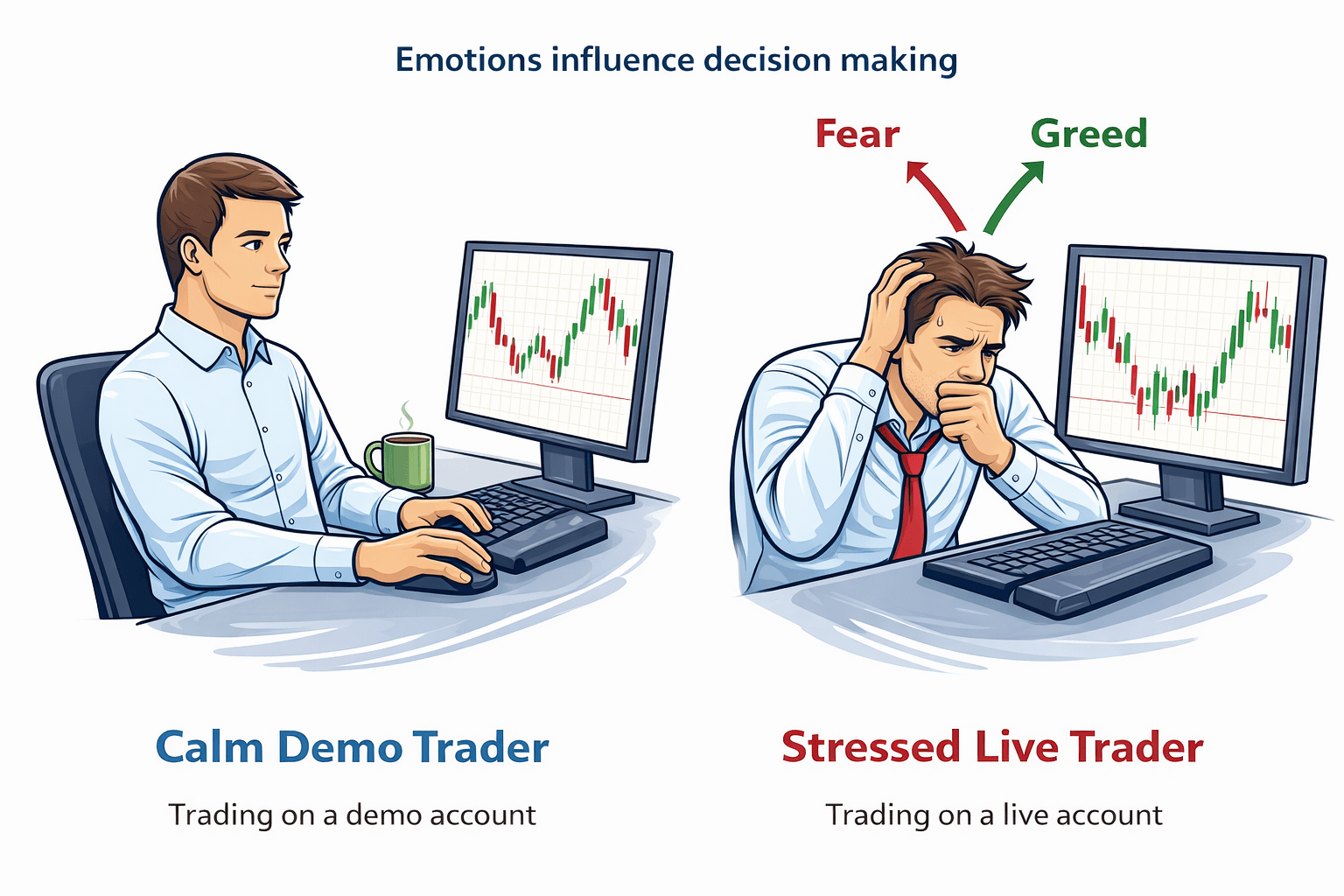
My recommendation is simple: move to a live account as fast as possible, even if the account is tiny. Open a micro account and risk $1 or $2 per trade. That small amount of real money is enough to trigger your emotional responses. You will feel the sting of a loss and the temptation to bend your rules. That is exactly where the real learning happens — in that discomfort.
Trading is roughly 20% strategy and 80% psychology. You can have a genuinely excellent Volume Profile setup, but if you panic and close the trade the moment it dips into the red, the strategy never gets a chance to work. By building your emotional muscle on a small live account, you develop the discipline to eventually execute properly on a large account. There are no shortcuts here — the market is the teacher, and tuition is paid in real dollars.
Lesson 6: Small Accounts Are Holding You Back
One of the most common frustrations I see from traders who are genuinely improving is this: they are executing well, managing risk properly, following their rules — but their account is so small that the results barely matter. You cannot earn a professional income risking 1% on a $1,000 account. If your goal is to make $5,000 per month at a disciplined 5% monthly return, you need $100,000 to trade with. For most people, saving that amount on their own takes years.
This is the capital problem, and it is the reason most skilled traders never make it to a professional level. Not because they cannot trade — but because they never had enough money to trade at the scale where the results are meaningful.
Prop firms are the practical solution to this problem. They provide funded trading accounts — typically between $25,000 and $200,000 or more — to traders who can demonstrate consistent discipline through a structured evaluation. You pay a small fee to take the challenge, prove you can follow risk rules and manage drawdown, and if you pass, you get their capital to trade. You keep 80–90% of the profits.
This is not a get-rich-quick scheme. The challenge is designed to screen out gamblers and impulsive traders. If you do not have a written plan, proper risk management, and the emotional discipline to stick to your rules — you will fail the evaluation. But if you have done the work described in every section above, prop firms become a genuine career path. At our Funded Trader Academy we prepare traders specifically for this: not just the strategy, but the mindset and structure needed to pass evaluations and stay funded long-term.
Conclusion & FAQ
Why do most trading indicators fail?
Most indicators only use two inputs — past price and time — which makes them lagging and reactive rather than predictive. They tell you what happened minutes ago but have no insight into what institutional traders are doing right now. A better approach is to use Volume Profile, which shows exactly where big players placed their orders by mapping volume at specific price levels, revealing true market structure.
Why do most traders struggle to become consistently profitable?
The honest answer is that most traders never make the fundamental shift from reactive to structured. They react to every candle, chase entries they missed, and break their own rules under pressure. Consistent profitability requires three things working together: a strategy with a genuine edge, mechanical execution without improvisation, and enough psychological discipline to take losses without abandoning the plan. The traders I see succeed are not necessarily the smartest — they’re the most disciplined. They treat every trade as one data point in a series of 100, not a personal win or loss.
How do I handle a losing streak in trading?
Why is demo trading not enough to become a profitable trader?
What should I track in a trading journal?
How do prop firms work for traders?
What is the biggest mindset shift that separates amateur traders from professionals?
The shift I see in every trader who makes it is this: they stop thinking about money and start thinking about process. When you’re fixated on your P&L, every loss feels like a personal failure and every win feels like confirmation of something you probably got wrong. When you shift focus to execution quality — did I follow my rules? did I wait for the right setup? did I manage the trade correctly? — the results start to take care of themselves. It sounds simple, but it’s genuinely difficult to internalise. Most traders intellectually understand it but don’t truly live it until they’ve blown an account or two and had no choice but to change.
