
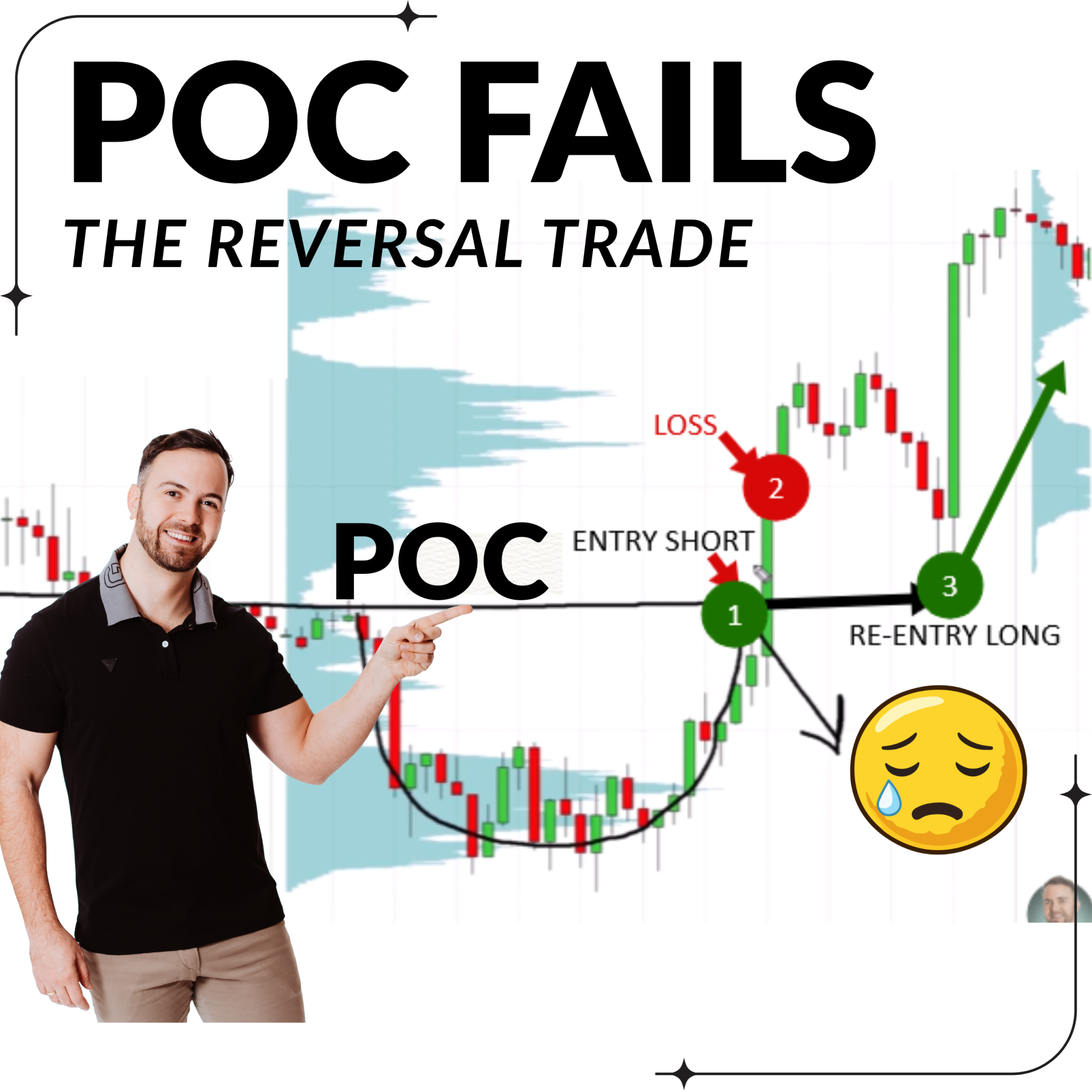
The Point of Control (POC) is one of the most important levels in Volume Profile trading. It marks the price area where the most trading activity happened inside a session or a profile. Most of the time, price respects this level. But what happens when it does not? What happens when price just blasts straight through the POC without stopping? This article covers exactly that situation — the POC reversal trade — and how you can use a failed POC setup to find a new, often very high-quality entry from the other side of the same level. You will also learn how to read the market’s message when the POC fails, so you understand why you are taking the trade, not just when.
5 Key Points
1. The Point of Control (POC) is the highest-volume price level in a Volume Profile. |
2. When price shoots through the POC with no reaction, that is a POC failure. |
3. A POC failure tells you that market sentiment has shifted — do not ignore it. |
4. After the POC fails, wait for price to pull back to that same level and take a trade in the new direction. |
5. The reversal trade works best when the initial breakout is fast, aggressive, and shows no hesitation at the POC level. |
Table of Contents
1. What is the Point of Control?
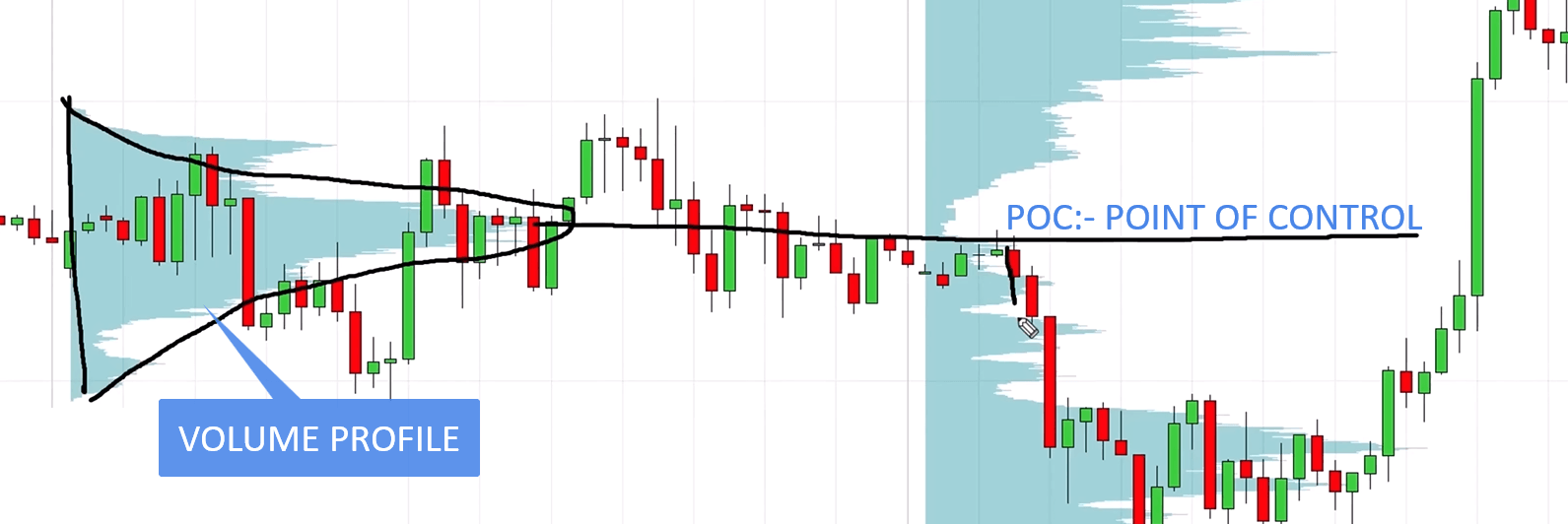
Before looking at what happens when the Point of Control fails, it is worth making sure we are both looking at the same thing. The Point of Control — often shortened to POC — is a horizontal price level produced by Volume Profile analysis. Volume Profile shows how much trading volume occurred at every price level during a specific period. The POC is simply the price level with the highest volume of all.
Think of it this way. If you imagine a busy market, the stalls that attract the most buyers and sellers are naturally the most important ones. If the price comes back to that area, there is a good chance it will attract attention again. That is the basic logic behind using the POC as a trading level — it is where the market found the most agreement between buyers and sellers in the past.
Why does price keep returning to the POC?
The POC does not guarantee a reaction from price every time. It is a zone of interest, not a magic line. But because so many participants transacted at that level in the past, there is a very good chance that some of them will respond when price returns. That is why it is a strong trading level — and also why it matters so much when the market decides to ignore it completely.
In Volume Profile, the shape of the profile also gives you context. A D-shaped profile — wide in the middle, narrow at the top and bottom — usually signals a balanced market. The POC sits right in the middle of that balance. When price moves away from that central zone and then returns to test it, that test is where many traders look for their entry. Understanding this shape helps you frame what is about to happen if and when the POC fails.
Key Concept
The Point of Control is the price level with the highest traded volume in a Volume Profile. It acts as a magnet for price. When price respects it, you get a standard POC trade. When price ignores it, you get something even more useful — information about a shift in sentiment.
2. What Does It Mean When the POC Fails?
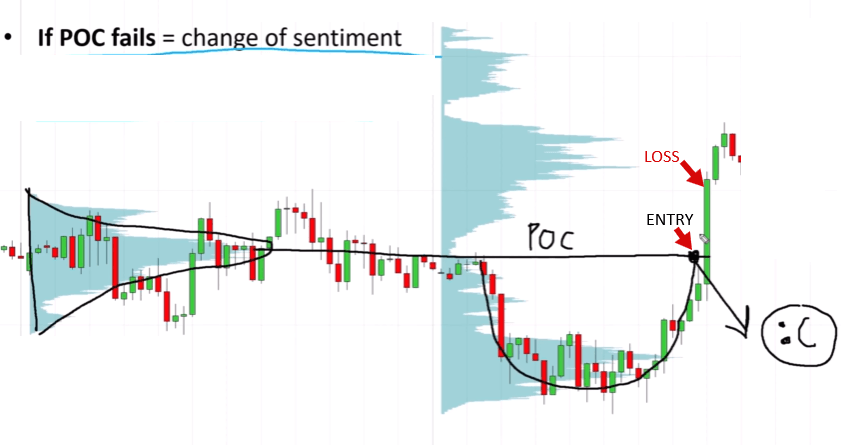
A POC failure happens when price approaches the Point of Control and instead of reacting — bouncing, stalling, or reversing — it passes straight through. There is no hesitation, no obvious reaction. Price just moves through the level as if it were not there.
At first glance, this can feel like a bad outcome, especially if you were holding a trade at that level. And yes, the trade you had at the POC is now a losing trade. That is uncomfortable. But here is the important part: the failure itself is not a sign that Volume Profile is broken or that the POC was a bad level. It is a signal. A very specific signal.
When price breaks through the POC with force, it means one side of the market — buyers or sellers — has become significantly stronger. They pushed through a level that previously held a great deal of market activity. That takes effort and commitment. It means the sentiment of the market has changed. The balance that existed before is gone, and a new direction is starting to take hold.
What should you do with this information?
This is why experienced Volume Profile traders do not simply walk away when the POC fails. They adjust. The original trade is closed. The loss is accepted. But now there is a new question on the table: is there a way to trade this new information? Almost always, the answer is yes. The POC that just failed becomes the reference point for the next opportunity — the reversal trade.
It is also worth noting that a POC failure does not mean price will never return to that area. In fact, it almost always does. After the aggressive move through the level, price will typically come back to re-test it — but this time from the other side. That pullback is what you are waiting for. That re-test is your entry.
Important Note A POC failure is not a reason to add to a losing trade or hold on hoping for a recovery. Close the losing trade, accept it, and shift your focus to the reversal setup that follows. |
3. How the POC Reversal Trade Works
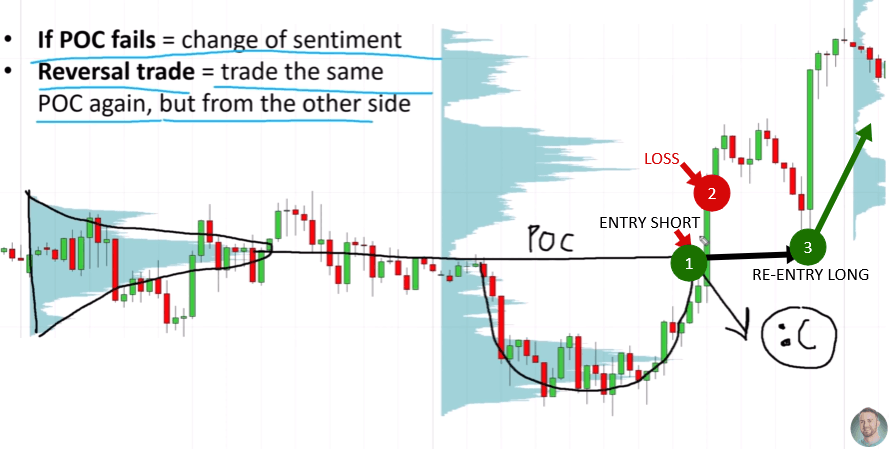
The POC reversal trade is simple in concept. You are taking the same level — the same Point of Control that just failed — and trading it again, but now from the opposite direction. The level has not lost its significance. What has changed is the direction in which price is likely to react from it.
Here is how it plays out, step by step:
- Price approaches the POC. Based on Volume Profile analysis, you take a trade — short or long — at that level. This is a standard POC trade.
- Price does not react. It pushes straight through the POC. Your trade is now a loss. Close it and cut the position.
- Keep the POC line extended on your chart. Watch for price to pull back to that same level after the initial aggressive move through it.
- When price pulls back to the POC level, enter in the direction of the new trend — the opposite of your original trade. This is the reversal trade.
- Manage the trade with a clear stop loss. The POC level now acts as support or resistance from the new side.
Why does the reversal level attract so much interest?
The reason this works so consistently is rooted in market structure. After a strong move breaks through the POC, some of the traders who drove that move will step back. Others who missed the breakout will be looking for a place to enter in the direction of the new move. The POC level — now flipped from resistance to support, or vice versa — becomes the natural point where both groups converge. That confluence of interest is exactly what gives the reversal trade its edge.
You are not chasing the move. You are waiting for the market to come back to a known, high-volume level and then re-engaging in the direction the market has already shown you. That patience is what separates this setup from impulsive trading.
4. Two Detailed Trade Examples
Example One — Short Fails, Reversal Long Sets Up
Take a D-shaped Volume Profile. The POC sits right in the middle of the distribution. Price moves away from that level and then comes back to re-test it from below. You go short at the POC because that is the setup the profile is showing you. The trade gets stopped out. Price pushes up through the POC with no real hesitation.
Now you extend the POC line to the right on your chart. You wait. Price continues upward for a while, then begins to pull back. It drifts back down toward the same POC level. This is your signal. You now enter long at the same level where you were previously short. The POC, which once acted as resistance and failed to hold price down, now acts as support on the re-test. Price bounces from it and moves higher.
The trade you entered long at the POC is the reversal trade. You lost on the short, and then you recovered ground — and more — by adapting quickly and reading the market correctly the second time around.
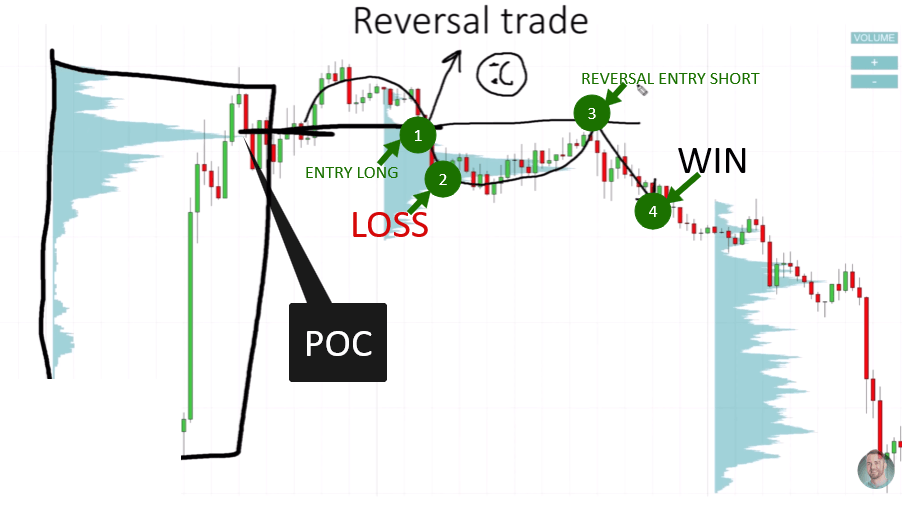
Example Two — Long Fails, Reversal Short Sets Up
The second example is the mirror image. The Volume Profile shows a POC at a clear level. Price approaches from above. You take a long trade at the POC because the profile suggests buyers should be active there. But price cuts straight through the level. The long trade is stopped out. Sellers were simply too strong at that point.
You keep the POC line on the chart. Price drops further, then starts to pull back up toward the POC. When it reaches that level again, you enter short. The POC now acts as resistance on the re-test from below. Price is rejected and moves lower, giving you a strong move in the direction of the new trend.
This is the reversal short. You started with a losing long. You finished with a winning short from the same price level, simply by staying alert and reading what the market was telling you about the change in sentiment.
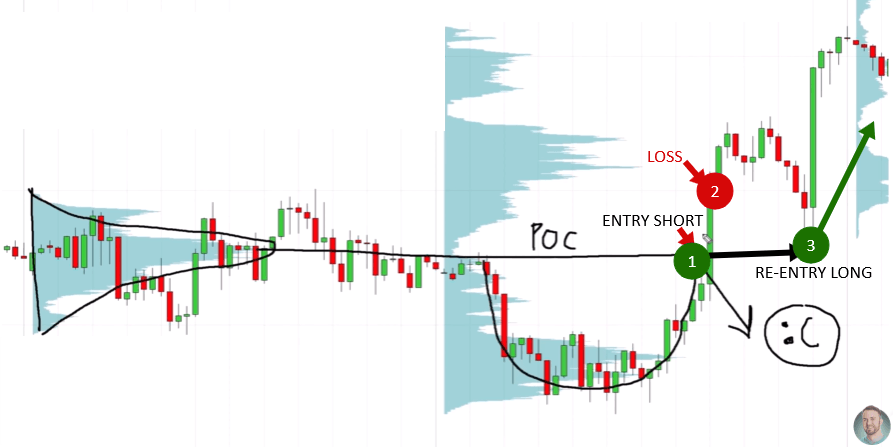
Examples 1 & 2
|
Short fails → Reversal long Original trade: short at POC. POC fails upward. Pullback to POC from above. Reversal entry: long. The POC now acts as support. |
Long fails → Reversal short Original trade: long at POC. POC fails downward. Pullback to POC from below. Reversal entry: short. The POC now acts as resistance. |
What both examples have in common
In both cases, the setup follows the same logic. The POC level did not stop being important when price broke through it. It simply changed its role. A level that once attracted sellers now attracts buyers, and a level that once attracted buyers now attracts sellers. The market is consistent in how it treats these high-volume zones — and that consistency is what makes the reversal trade repeatable.
5. The Ideal Scenario for the POC Reversal
Not every POC failure leads to a clean reversal trade. Knowing what the best version of this setup looks like will help you filter out weaker opportunities and focus on the high-quality ones.
The ideal scenario starts with a very fast, very aggressive move through the Point of Control. A single large candle, or a rapid sequence of candles, that shows almost no hesitation at the POC level. The faster and more committed the move is, the more clearly it signals a genuine shift in market sentiment — not just a temporary spike that might quickly reverse.
Macro news events are a very common trigger for this kind of move. When a major economic release comes out — interest rate decisions, non-farm payrolls, inflation data — the market can lurch aggressively in one direction. If that move happens to run straight through a POC level, that is actually fine. In fact, it can set up a particularly clean reversal trade, because the initial move through the level was driven by a specific, identifiable catalyst. Once that catalyst is absorbed, price tends to settle, pull back, and re-test key levels — including the POC that was blown through.
Breakdown
What you do not want to see is a slow, choppy grind through the POC. If price takes many candles to work its way through the level, with wicks back and forth, it suggests there is still genuine two-way interest at that price. The reversal trade relies on a clear shift in control — buyers overwhelming sellers, or vice versa. A slow grind does not give you that clear signal.
Signal | Strong Reversal Setup | Weak Reversal Setup |
Speed of breakout | Fast — one or two large candles | Slow — multiple small candles |
Reaction at POC level | No reaction — clean break | Multiple wicks, back and forth |
Pullback quality | Clean pullback back to the POC | Price stalls far from the POC |
News catalyst | Fine — actually adds clarity | No news — cause of breakout unclear |
6. POC Trade vs POC Reversal Trade — What Is the Difference?
It helps to see both setups next to each other so the distinction is completely clear. They share the same reference level — the Point of Control — but they involve different market conditions and different logic.
In a standard POC trade, price comes back to the POC level and the market shows that it still respects it. There is a reaction — a bounce, a stall, a rejection candle — and you enter in the direction of that reaction. The POC is acting as intended: as a high-volume magnet that attracts two-way interest and generates a tradeable reaction.
In a POC reversal trade, the standard setup has already failed. Price showed that it did not respect the POC, at least not in the direction you first expected. The market gave you information — one side is stronger. Your job is to use that information by waiting for the re-test of the same level and entering in the new direction. The POC has not lost its relevance. It has simply changed its role. It is now a flipped level — old resistance becomes new support, or old support becomes new resistance.
Both setups require patience and a clear plan. The reversal trade, in particular, requires that you first accept and close the losing trade before looking for the new opportunity. Carrying the losing trade while waiting for the reversal creates more problems than it solves. A clean slate — close the loser, wait, re-enter — is the clearest and most straightforward approach.
Conclusion
The POC reversal trade is one of the most practical responses to a failed setup you will encounter in Volume Profile trading. Rather than treating a losing trade at the Point of Control as simply a loss, you treat it as market information. When price blows through the POC without reacting, it is telling you that sentiment has shifted, and that the same level will likely provide an opportunity in the opposite direction once the initial move exhausts itself and price pulls back.
The key things to take away from this are: wait for the pullback, enter in the new direction, and pay close attention to how aggressive and clean the original breakout was. The faster and more decisive that move was, the higher the quality of the reversal setup that follows. You do not need to overthink this. You need to stay patient, stay observant, and be ready to adapt when the market shows you something new. A failed POC is not the end of the trade, it is often just the beginning of a better one.
Frequently Asked Questions
Can I take the reversal trade without taking the original POC trade first?
Yes, you can. If you see that price has already broken through a POC level aggressively and is now pulling back to re-test it, you can enter the reversal trade directly. You do not have to have been in the original losing trade. The setup is valid either way — the key is recognizing that the level has flipped and that price is returning to re-test it from the new side.
How long do I wait for the pullback after the POC fails?
There is no fixed time limit. You keep the POC line extended on your chart and stay alert. The pullback may come within a few candles, or it may take longer depending on the market and timeframe you are trading. What matters is that when price returns to that level, you are ready and watching for the reversal entry signal.
What if price never pulls back to the POC after breaking through it?
It happens. Sometimes the move is so strong that price never gives you a clean re-test of the POC. In that case, there is simply no reversal trade available. You wait, and if the pullback does not come, you move on and look for other setups. Not every failed POC produces a reversal opportunity. Patience means accepting that, not forcing a trade.
Next Steps:
If this breakdown made sense to you, imagine what you could do with a full structured course behind you. Our Volume Profile course takes you step by step through every major setup — including the POC reversal — with real chart examples, live trade walkthroughs, and lifetime access. Stop piecing it together from free content. Get the full picture. Enroll in the course today.
