

If you’ve ever been in a trade that was profitable, only to watch it turn into a loss because you didn’t know when to get out — I’ve been there. It took me years to figure out that the problem wasn’t my entries. It was my exits.
In this article, I’m going to show you how I use Volume Profile and the Point of Control (POC) to trail my stop-loss in a logical, structured way. No guessing. No random pip amounts. Just reading where the big money is sitting and using that as your shield.
Table of Contents
Summary of the Article
- Only trail in trends: Markets trend only about 30% of the time. Don’t try to trail during rotations — you’ll get chopped up.
- Set fixed take-profits: Don’t wait for the market to kick you out. Decide your exit before it happens.
- Use POC as your shield: Place your stop-loss behind high-volume zones. The market has to break through serious buy/sell interest to hit your stop.
- Avoid tight stops in volatile conditions: A stop too close to price gets hit on normal market noise. Give it room — but base that room on volume, not pips.
- Move your stop only when the market builds a new floor: Trail to the next POC or volume cluster, not just because price moved a few ticks.
What is Stop-Loss Trailing?
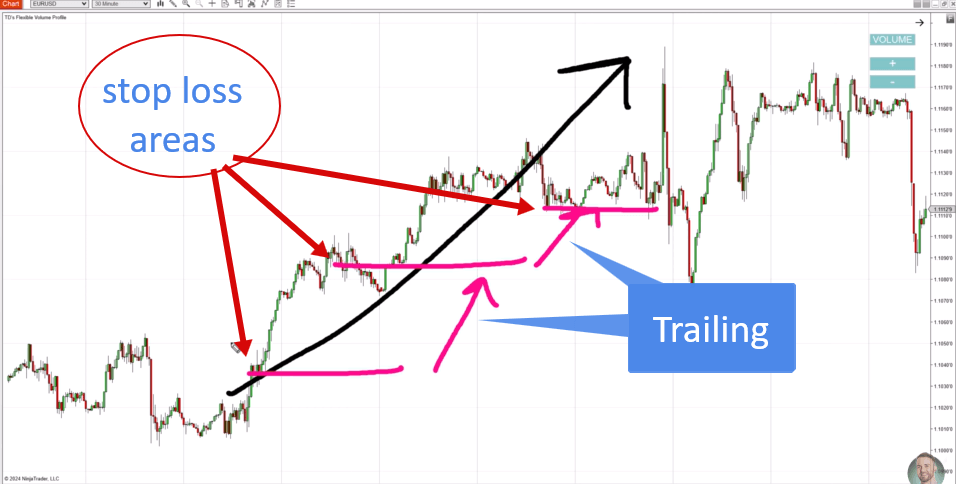
Trailing a stop-loss means you move your safety net in the direction of your trade as it profits. If you’re short and price drops, you move your stop down behind it. The goal is simple: stay in the trade as long as it’s moving in your favour, and lock in profit if it reverses.
Most traders understand the concept. The problem is execution. Move your stop too tight, and a perfectly normal price “hiccup” kicks you out of a winning trade early. Move it too wide, and you give back a huge chunk of profit before you’re finally stopped out.
The answer isn’t a fixed number of pips. It’s volume. By reading the Volume Profile, I can see exactly where the market has done the most trading — those are the walls I want to hide my stop-loss behind. The market has to break through a wall of buy orders (in an uptrend) just to reach my stop. That’s the edge.
The Reality of Market Movements
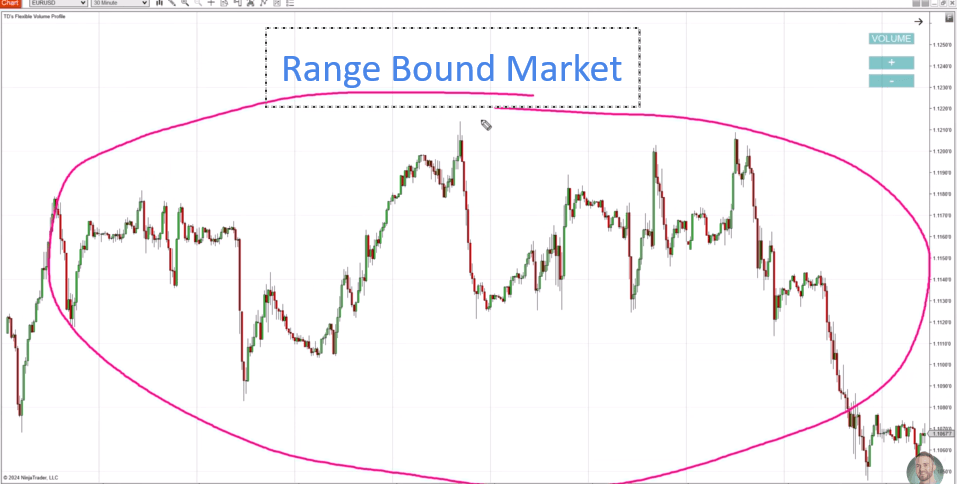
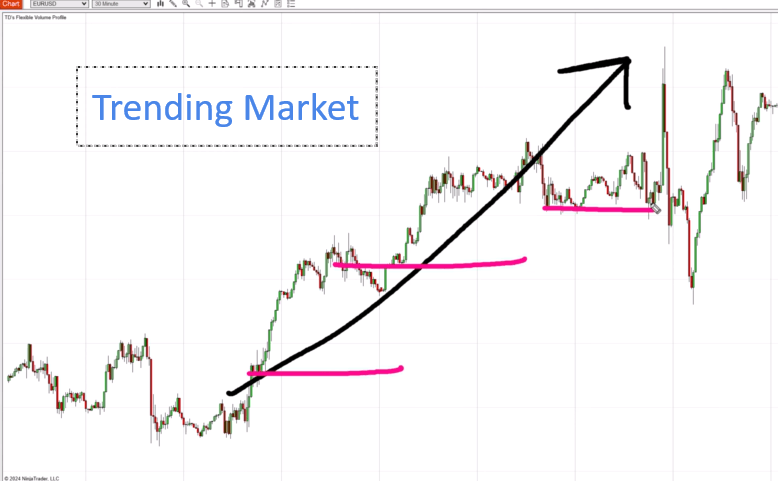
Here’s something most trading educators won’t tell you upfront: markets only trend about 30% of the time. The other 70% is rotation — price bouncing up and down inside a range like a ping-pong ball.
Why does this matter for trailing? Because if you try to trail your stop during a rotation, you will get stopped out. The market chops in both directions and your trailing stop gets hit on a counter-move that means nothing. You exit a trade that was actually fine.
I only apply Volume Profile-based trailing when I can clearly see a trend forming — when price is making higher highs and higher lows (or lower lows and lower highs). Outside of that, I use fixed take-profits and get out at my target. Simple. Don’t overcomplicate it.
Another thing to watch for: stop-loss runs. Big institutions will sometimes deliberately push price in the wrong direction to harvest retail stops before reversing. Your trailing logic needs to be built around volume levels, not tight pip-based stops that are easy to hunt.
The Danger of Letting the Market Decide Your Exit
One of the biggest mistakes I see traders make is saying: “I’ll just let the market kick me out.” Sounds disciplined. But in practice, it’s a recipe for watching profits evaporate in seconds.
Here’s why: reversals are often violent and instant. A news event hits, price spikes through your trailing stop before you even process what happened — and by the time you’re “out,” you’ve given back 80% of a trade that was comfortably profitable minutes earlier.
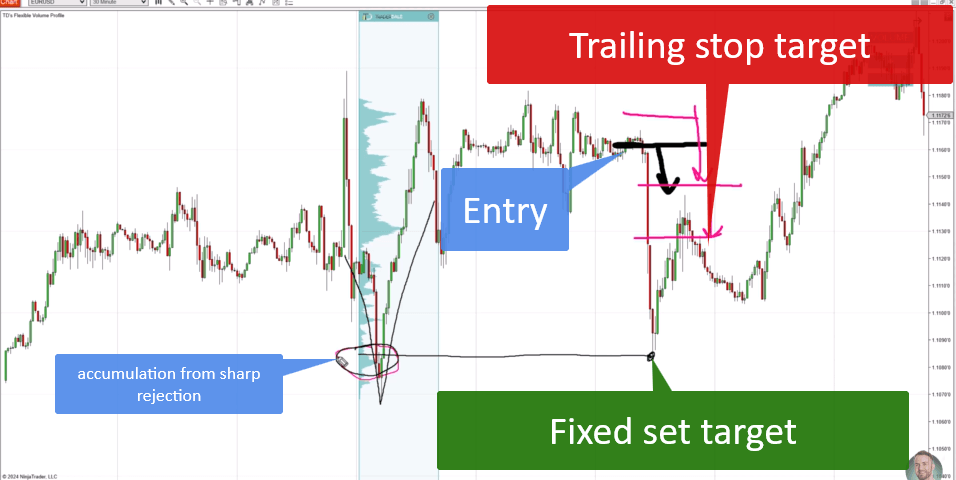
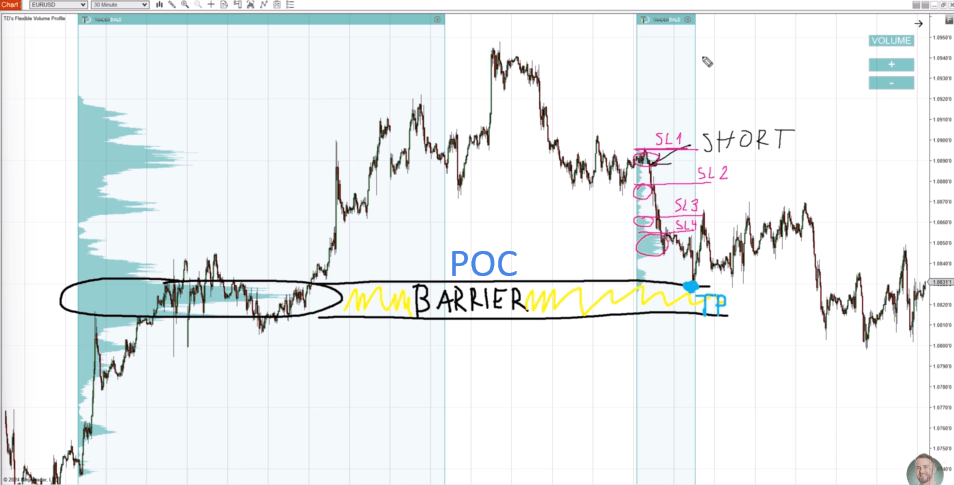
My approach is different. I always have a fixed take-profit target in mind before I enter a trade. I use Volume Profile to identify the next major high-volume zone ahead of price. That zone is where I expect the market to slow down, consolidate, or reverse — so that’s where I take my profit. I don’t wait to be pushed out; I decide where I’m leaving.
Trailing your stop-loss is great for managing risk on the way to that target. But it should work together with a fixed exit, not replace it. Know your target. Trail your stop to protect you if the market turns early. Exit at the target if it doesn’t. That’s the full picture.
Using Volume Profile for Logical Take-Profits
The Volume Profile shows me how much trading volume occurred at each price level. The most important level is the Point of Control (POC) — the price where the most volume traded during a given session or period.
Think of a high-volume zone as a brick wall. Price moves quickly through thin-volume areas (like a highway) but slows down and struggles at high-volume zones (like rush-hour traffic). When I’m in a short trade and price is approaching a big POC from a previous day, I know that’s likely where my trade will stall or reverse. So that’s where I book my profit — not after the wall, but before it.
Don’t be greedy at these levels. The temptation is always to think “maybe it’ll push through.” Sometimes it does. But the statistically smart play is to take your profit just before the wall and let someone else fight that battle. You catch the clean move; they deal with the reversal.
Low-volume areas are the opposite. Price cuts through them fast. Those aren’t places to set your take-profit because you’ll get poor fills or find that price blew past your level entirely. Always aim for the next heavy-volume zone — that’s where the market wants to go and that’s where it tends to pause.
Wide vs. Tight Stop Loss: Why Fixed Pips Don’t Work
Let me give you an example. Say you decide your trailing stop is always 15 pips. Markets don’t care about your 15 pips. A slow EUR/USD session can have perfectly normal 20-pip swings that mean nothing — and your stop gets hit. A stop that’s “too tight” relative to market volatility is basically a guaranteed loss.
On the flip side, a stop that’s too wide leaves you at the mercy of a sharp reversal. You might give back 50 pips of profit just trying to stay in a trade that’s already turned. Both extremes are costly.
The solution is to anchor your stop to volume structure:
- In a slow, volatile market: Use a wider stop placed behind a major POC. The volume cluster acts as your buffer.
- In a fast, trending market: Trail tighter, using smaller session POCs as you stack profits. Each new volume node becomes your next stop level.
- When the market consolidates: Pause the trail. Consolidation can look like a reversal but isn’t. Wait for the breakout to confirm direction before moving your stop.
There’s no magic pip number. There’s only where is the market showing me that buyers or sellers are committed? That’s where I put my stop.
Where to Place Your Trailing Stop-Loss
Here’s how I actually do this step by step:
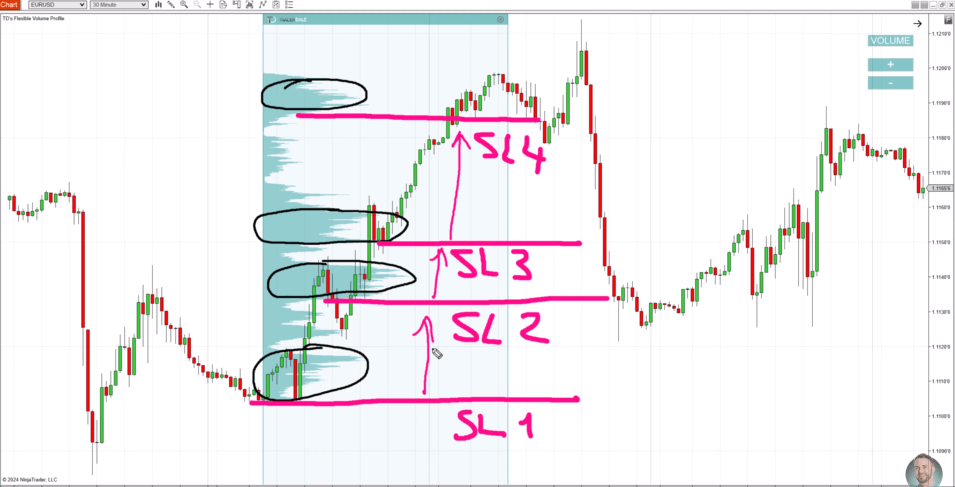
- Find the recent POC: Look at the most recent high-volume cluster behind price. This is where the market established “fair value” during that move.
- Place your stop just beyond it: Not a tick below — give it a few pips of buffer. The idea is that if price breaks back through that POC convincingly, the trend is likely over and you should be out.
- Wait for a new POC to form: As the trade moves in your favour, new high-volume clusters develop. Each new cluster becomes your next stop level.
- Trail to the new POC: Once the new volume node has clearly formed, move your stop to just below (or above, depending on trade direction) that new level.
- Repeat: Keep doing this until either your fixed take-profit target is hit or price breaks through a POC and stops you out with a profit locked in.
This is what I call Logical Trailing. You’re not moving your stop because price moved a certain number of pips — you’re moving it because the market has built a new structural floor (or ceiling) that supports your position. That’s the difference between professional trade management and guessing.
Trade Examples: Volume Profile Trailing in Action
In the video above, I walk through two complete trade examples showing exactly how this works in real market conditions. Here’s a brief summary of what to look for:
Trade Example #1: Short Trade with Trending Conditions
In the first example, price is clearly trending downward with consistent momentum. After entering short, I identify the most recent high-volume cluster (POC) above price and set my initial stop just above that level. As price moves lower and creates a new high-volume zone below, I trail the stop down to sit just above that new cluster. The market is building lower and lower “ceilings” — each one becomes my new stop. Eventually, price reaches my take-profit target at the next major POC below. Clean exit, maximum capture of the move.
Trade Example #2: Handling a Rotation Mid-Trend
The second example is more realistic — it shows what happens when the market starts rotating during a trade. Price pulls back but doesn’t break through the high-volume zone I’m hiding behind. This is the critical test: do you panic and exit? No. The volume cluster held as support, which confirms the trend is still intact. I hold the trade, price resumes its move, and the take-profit gets hit. The POC did its job as a shield.
These examples are in the video because charts explain this far better than words. Scrub to 11:03 and 13:18 in the video to jump directly to each trade walkthrough.
Putting It All Together: Conclusion
Stop-loss trailing with Volume Profile changed how I think about trade management. Before I understood this, I was either exiting too early out of fear or holding too long out of greed. Now I have a framework built on what the market is actually telling me, not on arbitrary numbers or emotions.
The core principle is simple: let the volume do the work. Identify where the big players are trading. Put your stop behind their activity. Move it when the market gives you a new, better anchor. Exit at your target before the next major wall.
If you want to see this in practice — on real charts with real trade setups — I walk through two specific examples in the video above. Watch them. The concept clicks much faster when you see it applied to an actual trade setup step by step.
And if you want to go deeper on Volume Profile strategies, my trading course and tools cover everything from basic setups to advanced institutional techniques. You can also grab my free Volume Profile book to get started at no cost.
FAQ: Frequently Asked Questions
Because it’s placed based on a fixed number of pips rather than market structure. When your stop is set at an arbitrary distance — say 15 or 20 pips — the market doesn’t know or care about that number. Normal price fluctuations, small counter-moves, and institutional stop-hunts will hit it repeatedly even when your trade direction is correct.
The fix is to anchor your trailing stop behind a high-volume zone (POC). That zone represents real buying or selling interest. For the market to reach your stop, it has to work through all of that activity first — which means you only get stopped out when the trend has genuinely broken down, not on random noise.
No. This is one of the most common and costly mistakes traders make. Markets only trend about 30% of the time — the other 70% they’re rotating sideways. In a ranging market, price oscillates back and forth without a clear direction, which means a trailing stop will get triggered on every counter-swing.
Save trailing for when you have a clear, confirmed trend with momentum. Outside of that, use a fixed take-profit and exit at your target. Trying to trail in a choppy market doesn’t protect your profits — it guarantees you give them back.
If price is moving fast through low-volume territory with no obvious volume cluster nearby, that’s a signal to hold your stop where it is and wait. Don’t trail into thin air. Let the market slow down, consolidate, and build a new high-volume zone.
Once that new POC has formed clearly behind price, you have a new anchor to trail to. Moving your stop before that structure exists means you’re guessing — and guessing is exactly what this approach is designed to eliminate.
There’s no fixed answer in pips — and that’s the point. The distance is determined entirely by where the nearest significant POC sits relative to current price. If the closest high-volume zone is 10 pips away, your stop goes just behind it at roughly 12–15 pips. If it’s 40 pips away, your stop goes there instead.
The market structure sets the distance, not a rule. This is why Volume Profile-based trailing performs better than ATR-based or pip-based trailing in almost every market condition — it adapts to what the market is actually doing.
A fixed stop-loss stays at one price level from entry to exit — it protects you from a large loss but doesn’t lock in profit as the trade moves in your favour. A trailing stop-loss moves with price as it profits, so if the market reverses, you exit with a gain rather than breaking even or losing.
The weakness of most trailing approaches is that they use fixed pip increments to move the stop, which makes them just as arbitrary as a fixed stop. Volume Profile-based trailing improves on both by moving the stop only when the market builds a new structural level — giving you the profit-locking benefit of trailing without the random early exits.
