
Getting stopped out of a trade feels frustrating. It does not have to be the end of the story for that setup. There is a volume profile reversal trade that many traders use to win back money they just lost. It works far more often than most people expect. And when it works, it can turn what looked like a losing day into a winning one.
This article explains exactly how it works using real chart examples. You will learn what a reversal trade actually is, why it works so well with volume profile levels, and how to recognize one forming in real time. We walk through three full examples step by step. Each one shows the failed trade and the reversal that followed it on the same level.
By the end, you will understand why the strongest levels on any chart often produce the best reversal opportunities. This is especially true when price pushes straight through them with no reaction at all. This is not a complicated strategy. It does not require any special tools. It simply asks you to flip your thinking when the market proves your first idea wrong, and then act quickly once that new opportunity appears in front of you.
Table of Contents
Quick Summary
- A reversal trade happens when a price level fails and you flip your position in the opposite direction.
- Strong volume profile levels rarely get ignored, so when price shoots through one with no reaction, that is a strong signal.
- The same level that failed as resistance often becomes support, and the same level that failed as support often becomes resistance.
- You need to act quickly, because the window to enter a reversal trade is often short.
- Practice this on a real account with very small trades, not on a demo, because real emotions teach you faster.
What Is a Reversal Trade in Volume Profile Trading?
A reversal trade is a second trade taken in the opposite direction. You enter it after your first trade gets stopped out. Most traders never use it. They are too focused on the loss instead of watching what the chart does next.
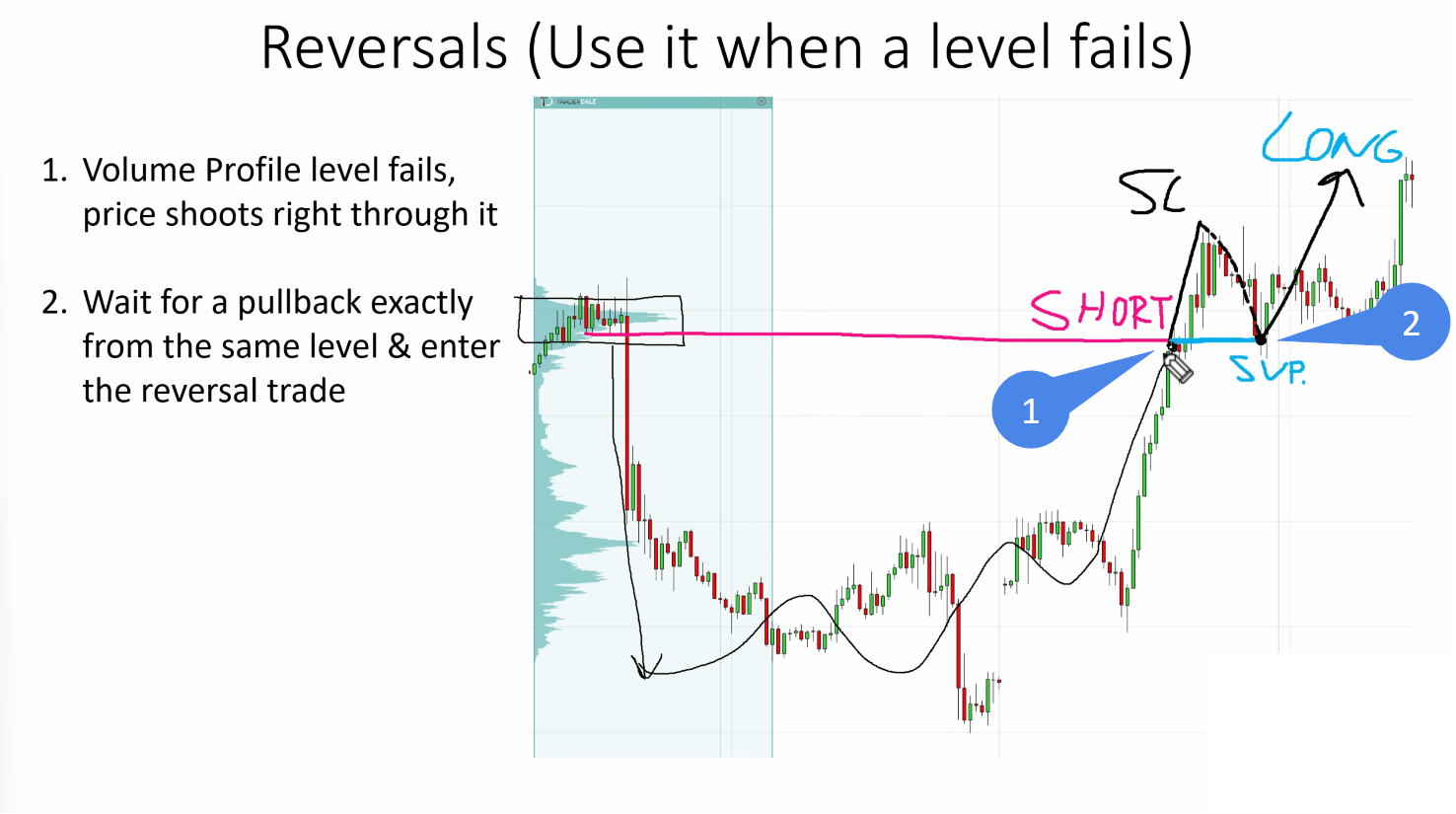
Here is the idea in plain words. Draw a level based on a heavy volume zone. Take a trade from that level. You expect price to respect it. Instead, price pushes straight through and stops you out.
If you were short and price broke above your level, it is no longer resistance. It is now support. If you were long and price broke below, that level is no longer support. It is now resistance. The market often comes back to test this flipped level. When it does, you get a second chance to trade in the new direction.
This works because volume profile levels are built from real trading activity. A heavy volume zone shows where many contracts changed hands. Many traders have orders sitting around that exact price. When price breaks through such a zone, it usually comes back to tap the level one more time. That tap is your entry point. The reversal trade takes advantage of this natural behavior. That is exactly why it works so often, and why it belongs in your trading plan.
Why Reversal Trades Work So Well
The Signal Behind a Clean Break
Reversal trades work because they are based on what the market just told you. When a heavy volume zone fails completely, that is one of the clearest signals you can get. Price moved through the level as if it was not even there. This tells you that one side of the market is far stronger than the other right now.
Think about what a heavy volume zone actually represents. It is a price area where a large amount of buying and selling already happened. Normally, when price returns to that area, it slows down. There are many resting orders sitting at that level. But sometimes price does not slow down at all. It blows straight through without any hesitation. This means the controlling side absorbed every order at that level and kept going. That is genuinely powerful information for you as a trader.
Recognizing this kind of break, where there is truly zero reaction, is one of the most useful skills you can build. Not every break looks the same. Some are clean. Others are messy and full of back and forth movement. Learning to tell the difference takes practice, but it changes how you read price action at every level on your chart.
Why the Pullback Happens
After a strong clean break, the market frequently pulls back to retest the broken level. This pullback is not random. Some traders want to add to their winning position at a better price. Others who missed the original move want to jump in late. Both groups are watching the same level. This creates a short window where price returns to your old level, except now it means the opposite of what it meant before.
This is why the strongest reversal trades come from the cleanest breaks. A weak break, where price chops around the level, does not give the same confidence. A clean break tells you the new direction has real strength. That is the setup you want to trade. When you see a level get completely ignored, start watching for the pullback. That pullback is your entry.
Step by Step, How to Spot a Reversal Setup
Step | What You Do | What You Are Looking For |
1 | Find a heavy volume zone on the chart | A thick cluster showing where lots of trading happened |
2 | Draw your level at the edge of that zone | A clean horizontal line marking the level |
3 | Take your first trade from that level | Short if resistance, long if support |
4 | Watch what happens when price reaches the level | Does it react, or does it blow straight through? |
5 | If price blows through with no reaction, prepare for a reversal | Watch for a pullback to the same level |
6 | Enter the reversal trade at the pullback | Opposite direction of your first trade |
7 | Move fast, the window is often short | Use a limit order so you do not miss it |
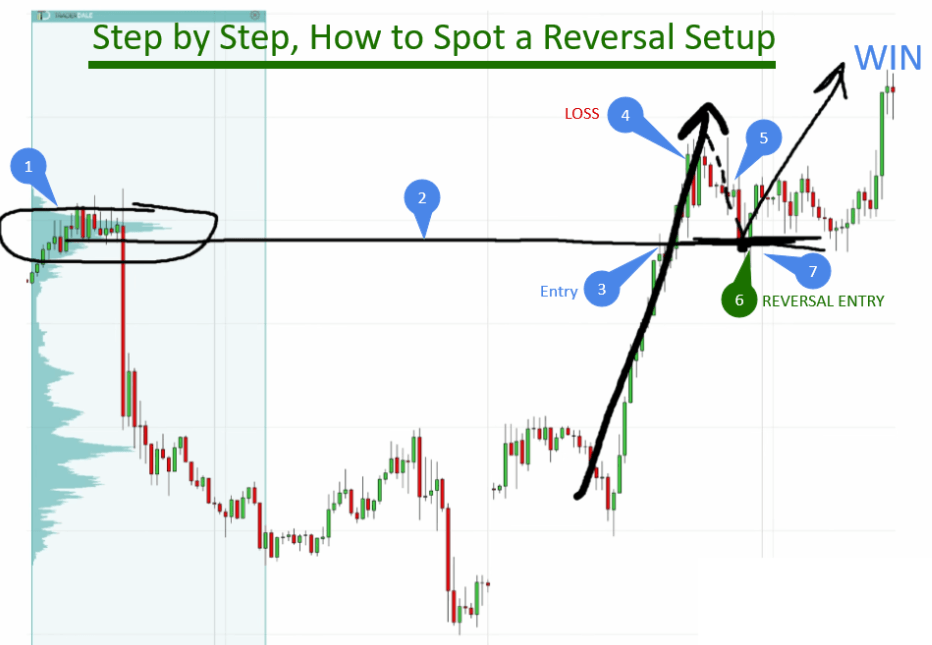
The most important detail in this table is step five. This is the moment that separates traders who catch reversal trades from traders who miss them completely. Most people see their stop loss get hit and immediately close their charts out of frustration. But this is exactly the wrong moment to look away, because the seconds and minutes right after a stop out are often the most valuable part of the entire setup.
Setting a limit order at the level before price even gets there can help you avoid hesitation when the moment finally arrives. Since reversal trades often only give you a short window to enter, having your order ready in advance means you do not need to react manually under pressure. This single habit, placing the order early instead of waiting to click a button in the moment, is one of the simplest ways to improve your results with this strategy and remove emotional delay from your decision making.
Example One, Reversal Trade in a Volume Accumulation Setup
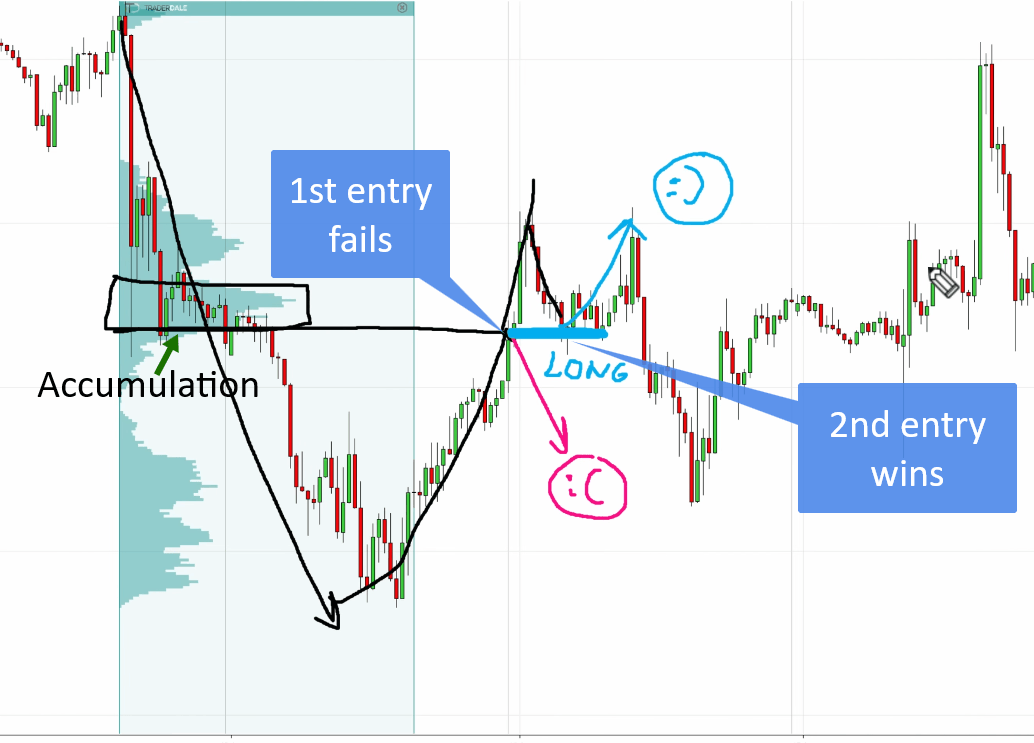
This first example starts with a volume accumulation setup, which happens when the market rotates sideways and builds up a heavy volume zone, followed by a strong trend move. The level is drawn at the beginning of that heavy volume zone, and the natural trade here is a short, taken after price pulls back up to the level one more time.
In this example, that short trade does not work out. Price gets stopped out and keeps climbing higher. But here is where the real lesson begins. The exact same level that just failed as a short now becomes a support level, because price has moved above it. Instead of giving up on the chart, the trade plan shifts to watching for price to return to that level one more time before continuing.
When price does return, it shows a strong reaction, bouncing cleanly off the same line that just stopped out the first trade only minutes earlier. This bounce is the reversal, and in this case it produces a long trade. The logic here is simple. The level did not disappear just because the first trade failed, it simply changed its meaning entirely. What was resistance is now support, and the market respects it the second time around, just in the opposite direction from before.
Example Two, Reversal Trade in a Downtrend
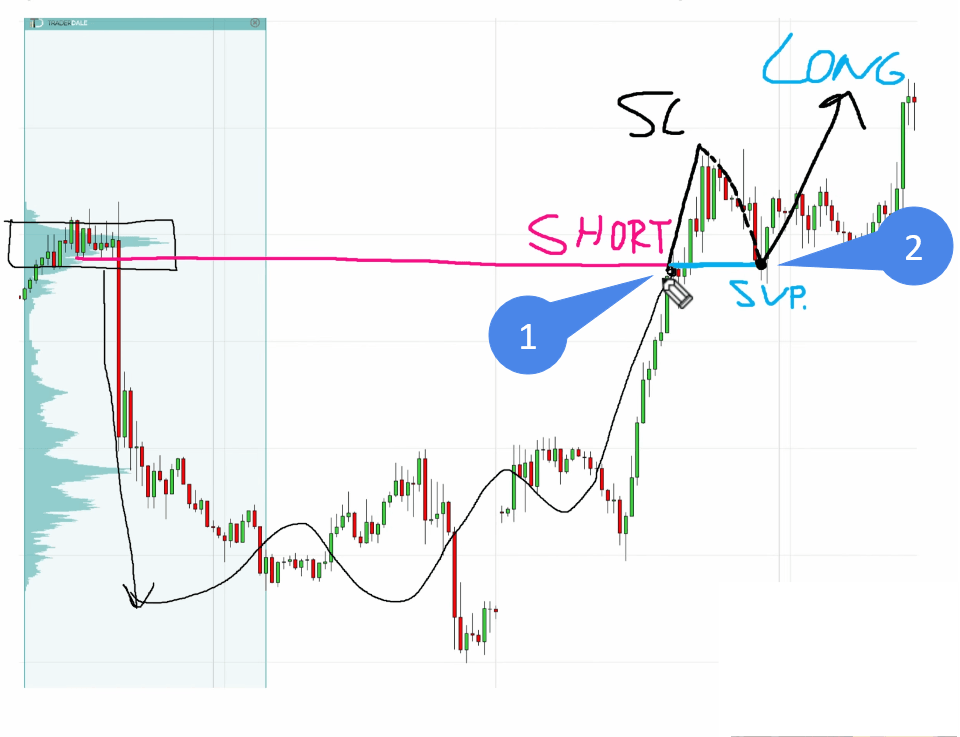
This second example takes place inside a clear downtrend. A significant volume cluster formed along the way down. The natural plan is to mark this cluster as a level and wait for a pullback to enter short. The broader trend direction is pointing down, so the setup looks solid.
The first trade does not go as planned. Price pulls back to the level and the short is entered with confidence. Then price turns around and climbs higher instead of dropping. This is discouraging. The downtrend made the short seem like the obvious call.
This is exactly where the mental shift becomes important. The plan now is to wait for another pullback to that exact same level and enter long instead. This means letting go of the original opinion about where price should go. Many traders struggle with this step. Their mind stays attached to the short idea even after the chart has clearly shown otherwise.
This example also shows that reversal trades are not limited to sideways markets. They can appear inside strong trending conditions. What matters is that the level was strong and the break was clean. When those two things are true, the reversal trade deserves your attention regardless of the trend direction.
Example Three, Reversal Trade After a Long Setup
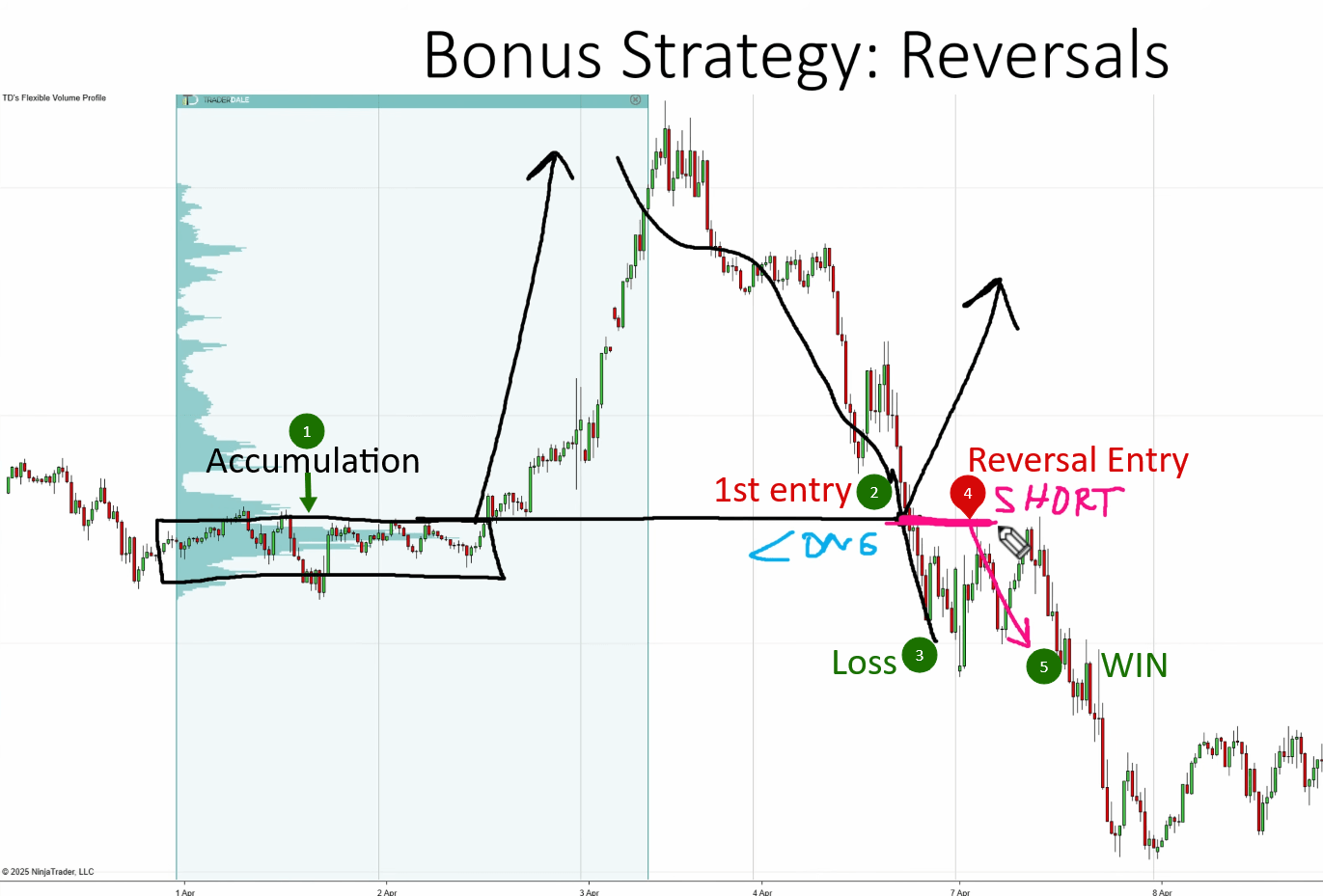
The third example flips the direction compared to the earlier two cases. Here, the setup begins with another volume accumulation pattern, where a heavy volume zone forms during a rotation, followed by strong trend activity in one direction. This time, the level looks like a solid spot to go long from, and the first trade is entered in that direction with reasonable confidence.
Price does pull back to the level as expected, which at first looks encouraging for the long trade. But then it shoots straight past the level with no reaction at all, which is the clearest possible sign that this is a strong reversal candidate forming. Remember, the cleanest breaks, the ones with zero reaction, tend to produce the most reliable reversal trades on any chart.
The trade plan flips to short from the exact same level, and the result is a precise reaction right at the level, almost to the pip. This kind of accuracy is common when the original break was this clean, because it shows that the new direction has real strength behind it, not just a temporary wobble that fades quickly.
The Hardest Part, Changing Your Mind Fast
The biggest challenge with reversal trades is not technical. It is mental. Once you form an opinion about where price should go, your brain wants to be proven right. When the market stops you out, the instinct is to feel frustrated and walk away. Most traders miss the reversal because of this reaction.
Their head stays stuck in the old mindset. The price should drop. The price should rise. Even after the chart has shown otherwise, the original idea lingers. Letting go of it quickly is a skill. Like any skill, it takes repetition to develop.
One practical solution is to treat the failed trade and the reversal as two completely separate decisions. The failed trade ends the moment your stop loss is hit. Full stop. The reversal is a brand new decision based on what the market is doing right now. Nothing more.
Traders who can separate these two moments catch far more reversals than those who stay tied to their original idea. The chart does not care about your first trade. It is showing you a new opportunity. Your job is to see it clearly and act on it.
How to Practice Reversal Trades the Right Way
If you want to get good at reversal trades, the way you practice matters just as much as the strategy itself. A demo account seems like the safe place to start, but it works against you here. A demo is useful for learning the platform, which buttons to click and how to set orders. But it does very little to prepare your mind for a real decision under pressure.
Reversal trades require a fast decision right after a loss. A demo removes all that pressure. There is no real money on the line. Your brain does not treat the decision the same way it would with actual funds involved. The emotional response is simply not there.
A better approach is to use very small positions with real money. Risk a few cents or a single dollar per trade. The financial risk stays extremely low, but the emotional response is real. That emotional response is exactly what you need to practice managing. It is the same feeling that will show up later when your sizes grow.
Training this way builds the right habits far faster than any demo ever could. Over time, you increase your size gradually. You carry the same calm decision making process forward at every stage.
Final Thoughts
A failed trade does not have to mean a lost opportunity. The volume profile reversal trade gives you a second chance from the exact same level that just stopped you out. That is one of the most useful ideas in this entire strategy.
The core idea is simple. A level that fails as resistance often becomes support. A level that fails as support often becomes resistance. The market frequently returns to test that flipped level before continuing. That return is your entry.
The cleanest breaks produce the strongest reversals. When price moves through a level with zero reaction, that is the signal to watch for. Weak, choppy breaks deserve far more caution before you commit to a trade.
The hardest part is not technical. It is mental. You must let go of your original idea quickly. Treat the reversal as a brand new decision, not a continuation of the old one. Practice this on small real money trades rather than a demo account. Build the habit of acting fast when the window opens. Once you start watching for reversals instead of walking away after a loss, you will likely be surprised at how often the market hands you a second chance.
Frequently Asked Questions
What is a volume profile reversal trade?
A reversal trade is a second trade taken in the opposite direction after your first trade at a volume profile level gets stopped out, using the same level which has now flipped from resistance to support, or from support to resistance.
Why do the cleanest level breaks make the best reversal trades?
When price moves through a level with no reaction at all, it shows that one side of the market is overwhelmingly strong, which usually leads to a clear pullback and a reliable reaction in the new direction shortly afterward.
Should I practice reversal trades on a demo account first?
It is better to practice with very small real money positions instead of a demo account, since real money creates real emotions, and learning to manage those emotions is a key part of trading reversal setups successfully over time.
Getting Started:
If you want to start spotting these reversal opportunities on your own charts, the best next step is to study how heavy volume zones form before you ever look for a reversal trade. Once you can identify those zones with confidence, watching for the failed break and the pullback becomes much easier with practice. Pull up your charts today and start marking your levels.
Check out our Volume Profile course today and begin your journey to mastering these principles.

This is a solid reminder that a failed trade doesn’t always mean the setup was completely wrong. I especially like the idea of watching how price reacts after the failure instead of immediately trying to recover the loss. The reversal can sometimes offer a better opportunity than the original trade, but waiting for confirmation is definitely key.
The part about treating a failed trade as new information really stood out to me. Sometimes the market gives a clearer signal only after the original idea gets invalidated. I like how this approach focuses on reading that change instead of forcing the first setup to work.
I have been looking for a reliable Chilean betting site for months and this one actually delivers on its promises. The support team speaks our language and the odds stay fair from kickoff to final whistle. I sleep much better knowing my funds are safe here. betsalachile11
I have been looking for a reliable Chilean betting site for months and this one actually delivers on its promises. The support team speaks our language and the odds stay fair from kickoff to final whistle. I sleep much better knowing my funds are safe here. betsalachile11